
Which statement about federation in watsonx.data is accurate?
Select an answer to reveal the explanation.
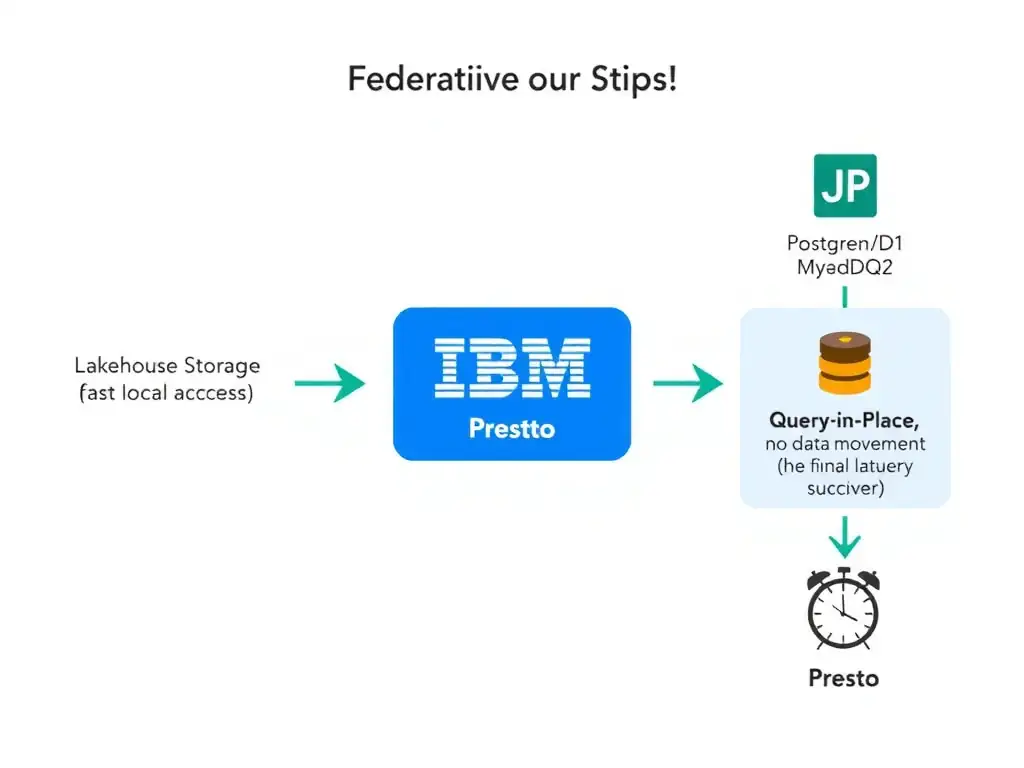
Short Explanation
Federation means you query data where it lives through connectors, so you only move it when it's worth the cost. You get current data, inherit the source's performance, and governance follows the request rather than the bytes.
Full Explanation
The accurate statement is that federation queries data where it resides through connectors, avoiding movement when movement is not required. Federation is defined by querying data in place through connectors so that data movement is confined to cases where it is genuinely justified—typically large volumes, heavy concurrency, or a need for performance the source cannot deliver. The statement that each federated source must first be duplicated into object storage is incorrect and describes ingestion; if the data has been duplicated into object storage, there is nothing left for federation to do. The statement that federation applies to structured relational sources only and cannot reach other system types is incorrect because connector coverage extends beyond relational databases; the relevant limit is what connectors exist and what each source can be asked to do, not a category restriction. The statement that federation removes the latency characteristics of the underlying source once a query has run twice is incorrect because repeat execution does not change the source's characteristics; caching may help a specific repeated result, but the underlying system remains as fast or as slow as it is. The zero-copy approach is described as data federation or query federation (https://www.ibm.com/docs/en/watsonxdata/standard/2.3.x?topic=overview-whats-new-in-watsonxdata). For the exam, keep the definition short and the caveats attached to it: no movement, current data, inherited performance, governance still applies.