
In watsonx.data, which two components must both be correct before a user can successfully read rows from a specific table?
Select an answer to reveal the explanation.
Short Explanation
Two gates have to pass: the engine you use must be able to reach the catalog, and governance policy must let you read that table. If the catalog isn't reachable, the table looks missing; if policy blocks you, it looks empty.
Full Explanation
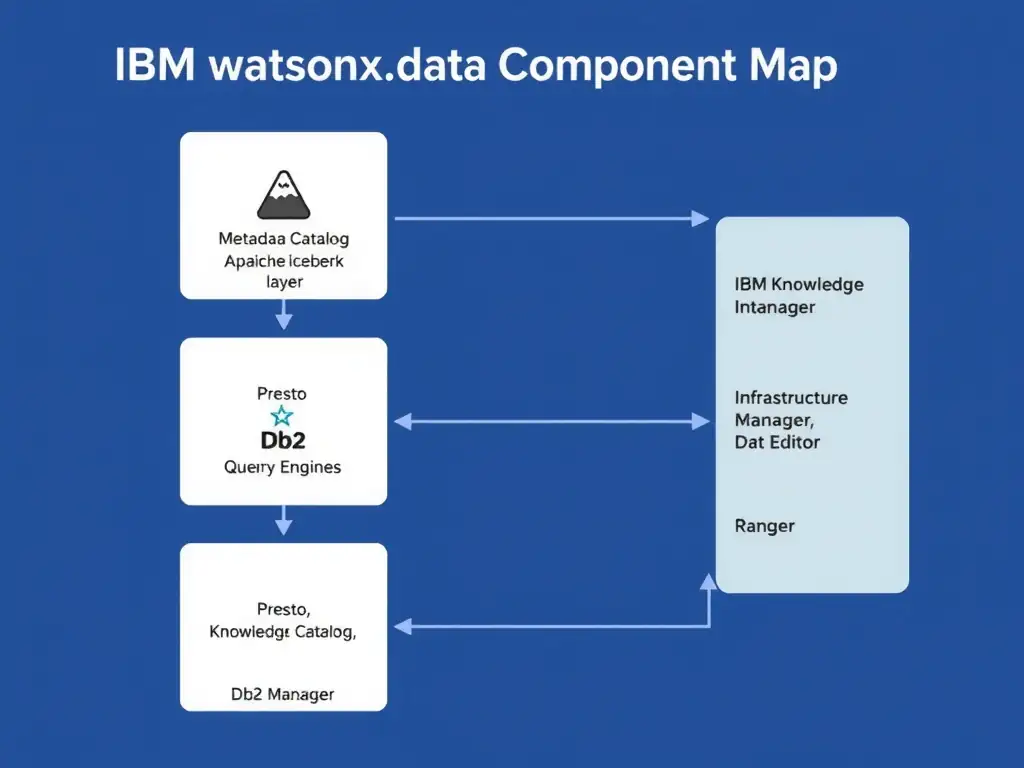
The correct choice is the one stating that the catalog must be associated with an engine the user can reach, and policy must permit that user to read the table. Reading a table requires reachability and permission. Reachability comes from the association between catalog and engine, which is what allows the engine to resolve the table at all. Permission comes from governance policy evaluated against the requesting identity. Both must hold; either one alone is insufficient.
The option claiming the bucket must be on a high-performance tier and the engine must be a native rather than external engine is incorrect because neither storage tier nor engine provenance affects entitlement. Cold-tier storage makes a read slower, and an external engine reads governed data exactly as a native one does.
The option claiming the table must be registered in query history and the user must hold the platform Admin role is incorrect because query history records what has run rather than enabling what may run, and requiring the Admin role for ordinary reads would defeat the purpose of having a policy model at all.
The option claiming the engine must be sized above the minimum and the catalog must contain only one schema is incorrect because engine size affects performance and concurrency, and the number of schemas in a catalog is an organisational choice with no bearing on access.
For the exam, this pair is worth memorising, because the two failure modes look different: unreachable presents as a missing table, unpermitted as an empty result.