
Why is federation an unsuitable choice for a workload that repeatedly runs heavy aggregations over a large source table?
Select an answer to reveal the explanation.
Short Explanation
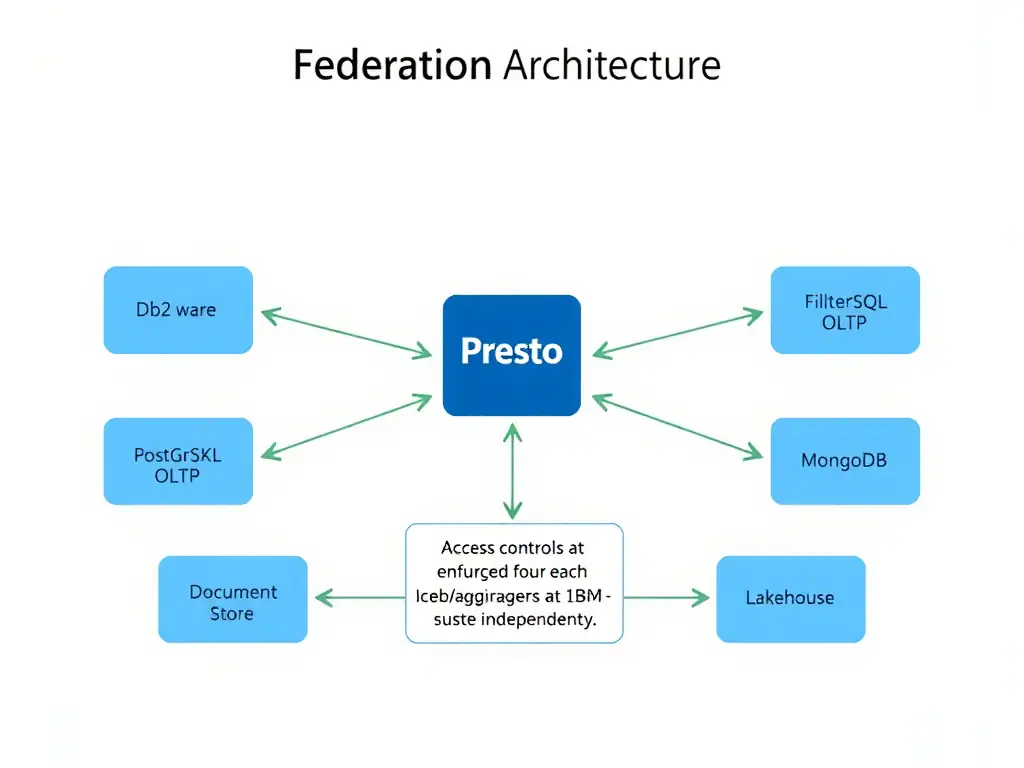
Federation is free until it's not. Every run hits the operational system again and drags data across the network, so if you're scanning the same large table repeatedly, ingesting it once is cheaper for everyone.
Full Explanation
The correct choice is the one that says each query pushes load onto the source system and pays network transfer cost, so repeated heavy scans are better served by ingesting the data once. Federation trades copy avoidance for per-query cost. Heavy repeated scans mean that cost is paid over and over, in load on a system that likely has an operational job to do and in data crossing the network each time. Ingesting once amortises it.
The claim that federated queries cannot perform aggregation functions is incorrect because federated queries do perform aggregation; capability is not the constraint.
The claim that federation does not support governance, so heavy workloads would be uncontrolled, is incorrect because federated access is governed like any other access - policy is evaluated against the connecting identity.
The claim that federated sources are limited to a fixed number of rows per query is incorrect because there is no such fixed row ceiling; the issue is cost and source impact, not a hard limit.
For the exam, weigh copy avoidance against repeated query cost, and let access pattern decide.