
A dashboard applies a filter for high-value customers in a specific region and shows the resulting revenue. A manager describes this as the team's predictive model. Why is that mischaracterisation a problem?
Select an answer to reveal the explanation.
Short Explanation
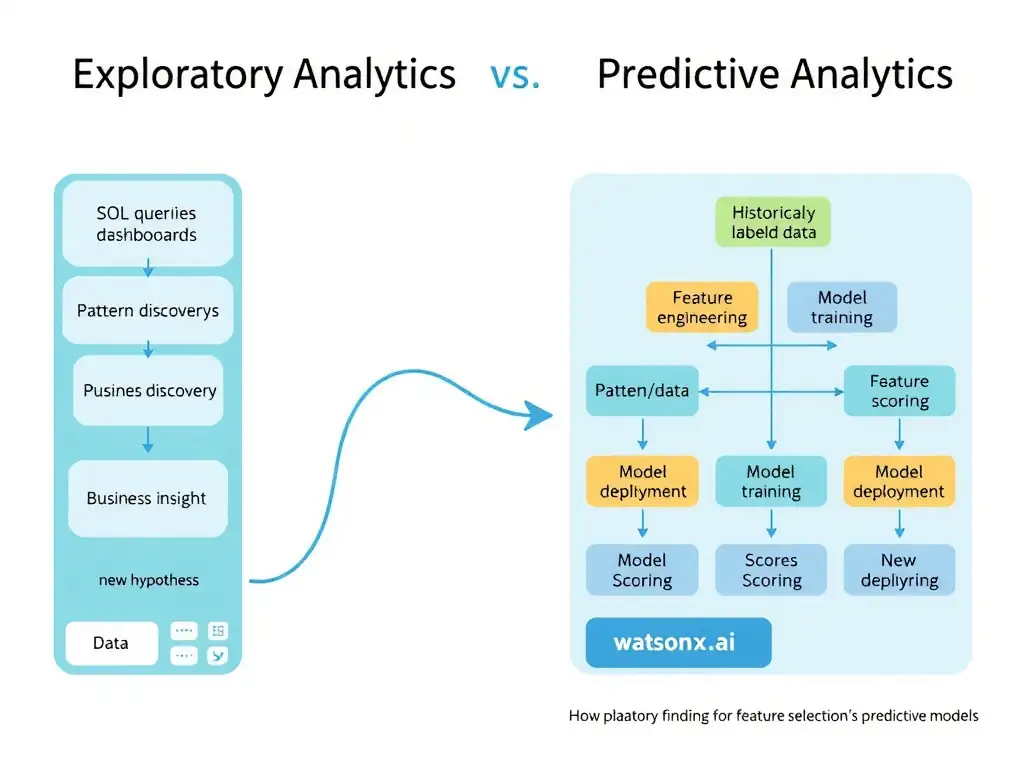
A filter only tells you what happened to rows you already have. A model estimates unseen cases and carries an accuracy or error measure. Calling the filter a model sets up decisions that nothing supports.
Full Explanation
The correct answer is the statement that filtering describes records that already exist; it makes no estimate about unseen cases and carries no measure of accuracy. An ad hoc filter is descriptive: it selects and summarises existing records. A predictive model is fitted on historical data to estimate an outcome for cases it has not seen, and it can be evaluated against held-out data to produce an accuracy or error measure. Presenting a filtered aggregate as a prediction invites forward-looking decisions that no validation supports.
The claim that filters are computed by the engine rather than the catalog, so they cannot be called models, is incorrect because where computation happens has no bearing on whether something is a model. Models can be evaluated in engines too.
The claim that the filter is a model, but an unsupervised one, so it should be labelled differently, is incorrect because unsupervised methods still learn structure from data, such as clustering. A hand-specified filter learns nothing; the criteria came from a person.
The claim that it is only a problem if the filter is applied to more than one dimension at a time is incorrect because the number of dimensions is irrelevant. A filter on ten columns is still a filter.
For the exam, the distinguishing tests are estimating unseen cases and having a measurable error.