
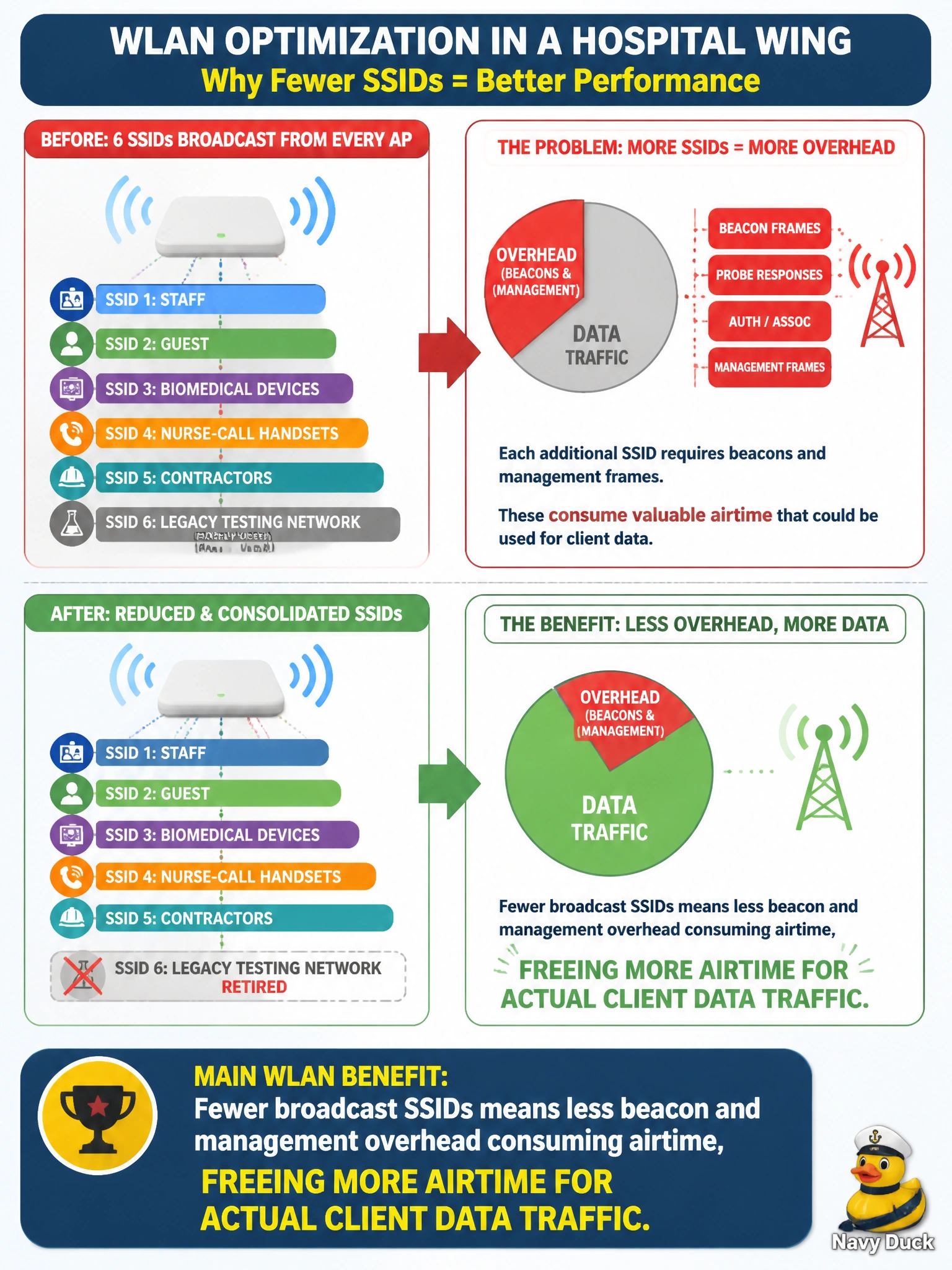
A hospital wing broadcasts six separate SSIDs from every AP — one each for staff, guest, biomedical devices, nurse-call handsets, contractors, and a legacy testing network that is rarely used anymore. During optimization, the team proposes retiring the unused testing SSID and consolidating some others. What is the main WLAN benefit of reducing the number of SSIDs broadcast per AP?
Select an answer to reveal the explanation.
Short Explanation
Every SSID an AP broadcasts has to keep announcing itself, over and over, whether anyone's using it or not — like a store that keeps a loudspeaker running for a department that closed years ago. Cut the SSID count down to what's actually needed, and that reclaimed airtime goes to real traffic instead of pointless announcements.
Full Explanation
Each SSID an AP broadcasts requires its own periodic beacon frames and contributes its own management overhead, and this overhead consumes airtime regardless of whether any client is actually associated to that SSID. A legacy testing SSID that's rarely used still costs airtime every beacon interval on every AP broadcasting it, so retiring genuinely unused SSIDs and consolidating overlapping ones reduces that fixed overhead and returns more of the shared airtime to actual client data traffic. This has nothing to do with the AP's allowed transmit power, which is governed by regulatory and hardware limits independent of how many SSIDs are configured. It also doesn't change which encryption standard remaining SSIDs use — each SSID's security configuration is set independently and consolidating SSID count is a separate decision from what security policy is applied to the ones that remain. And reducing SSID count doesn't eliminate the need for channel planning; the AP still operates on whatever channels are assigned regardless of SSID count, and co-channel interference between neighboring APs is governed by channel assignment, not the number of SSIDs layered onto each channel. The practical caveat: consolidation has to respect genuine segmentation needs — biomedical devices and nurse-call traffic likely still warrant their own SSID and VLAN for security and prioritization reasons, so 'fewer is better' only applies to SSIDs that no longer serve a real purpose. A concrete check: after retiring the unused SSID, compare beacon-related airtime utilization on the same APs before and after the change.