
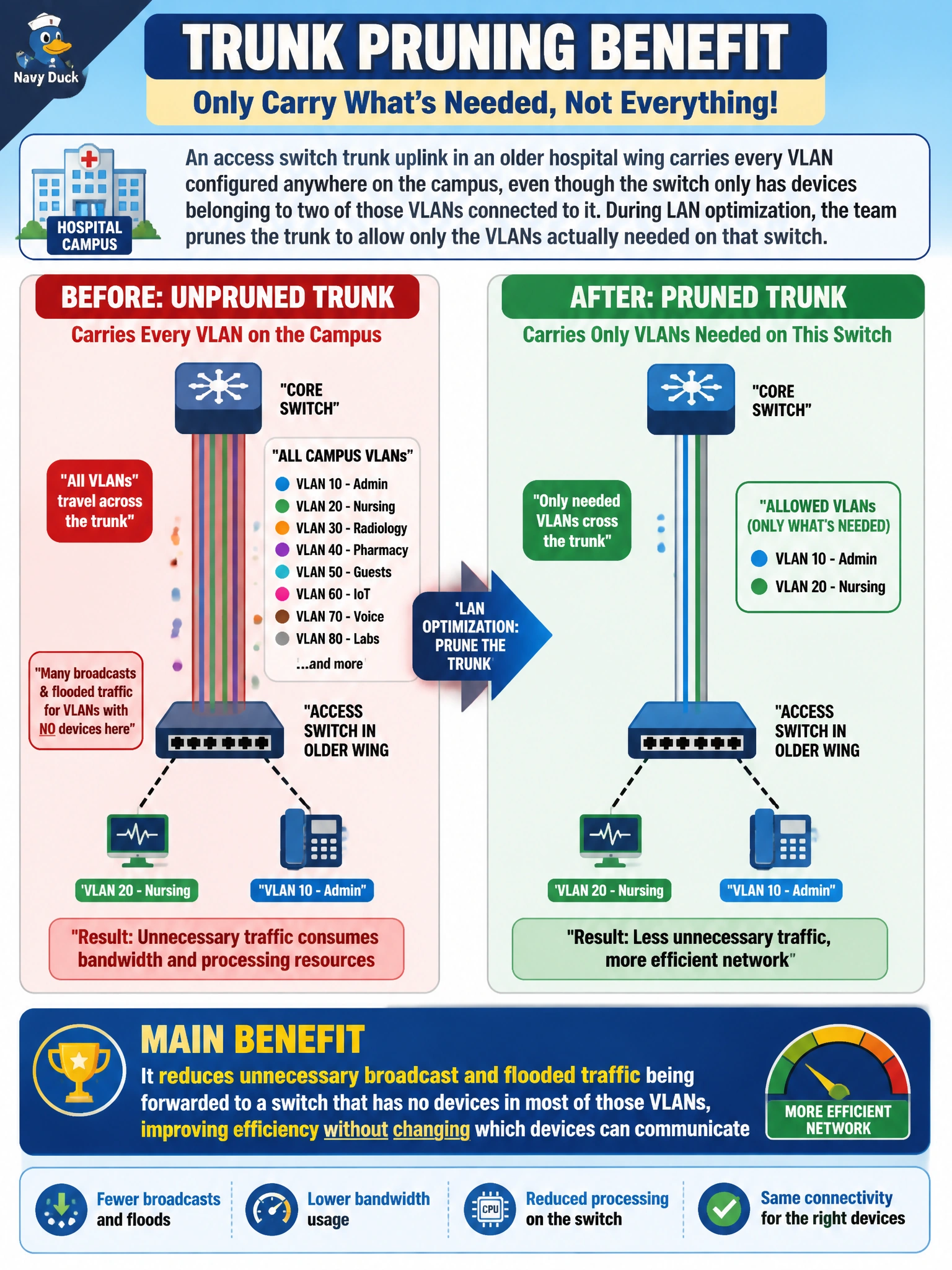
An access switch trunk uplink in an older hospital wing carries every VLAN configured anywhere on the campus, even though the switch only has devices belonging to two of those VLANs connected to it. During LAN optimization, the team prunes the trunk to allow only the VLANs actually needed on that switch. What is the main benefit of this change?
Select an answer to reveal the explanation.
Short Explanation
Carrying every VLAN down a hallway where only two of them actually live is like a delivery truck stopping at every house on the street when only two houses ordered anything. Pruning the trunk means the truck only stops where it's actually needed — less unnecessary traffic clogging a link that never needed to see it.
Full Explanation
Trunk pruning restricts which VLANs are allowed to traverse a specific trunk link, so broadcast, multicast, and unknown-unicast flooding for VLANs with no member devices on that switch no longer gets forwarded down a link where it serves no purpose. This is a pure efficiency gain: it reduces unnecessary traffic on the link and unnecessary processing on the receiving switch, without changing any actual reachability between devices that were already communicating through their proper VLANs and routing paths. It has no effect on the trunk's physical link speed, which is a hardware and interface-configuration property entirely separate from which VLANs are logically permitted to cross it. It also doesn't remove the need for spanning tree, since STP's job is loop prevention across the switched topology regardless of how many VLANs are pruned from any one trunk — the two mechanisms solve different problems. And pruning unrelated VLANs off a trunk certainly doesn't create new inter-VLAN communication paths; devices in different VLANs still require a Layer 3 device to route between them exactly as before, since pruning is a restriction, not a bridge. The caveat: pruning must be applied carefully, because removing a VLAN that a device actually needs will break connectivity for that device rather than just improving efficiency. A concrete check: after pruning, confirm both remaining VLANs' devices still communicate normally and that broadcast traffic volume on the trunk has measurably dropped.