
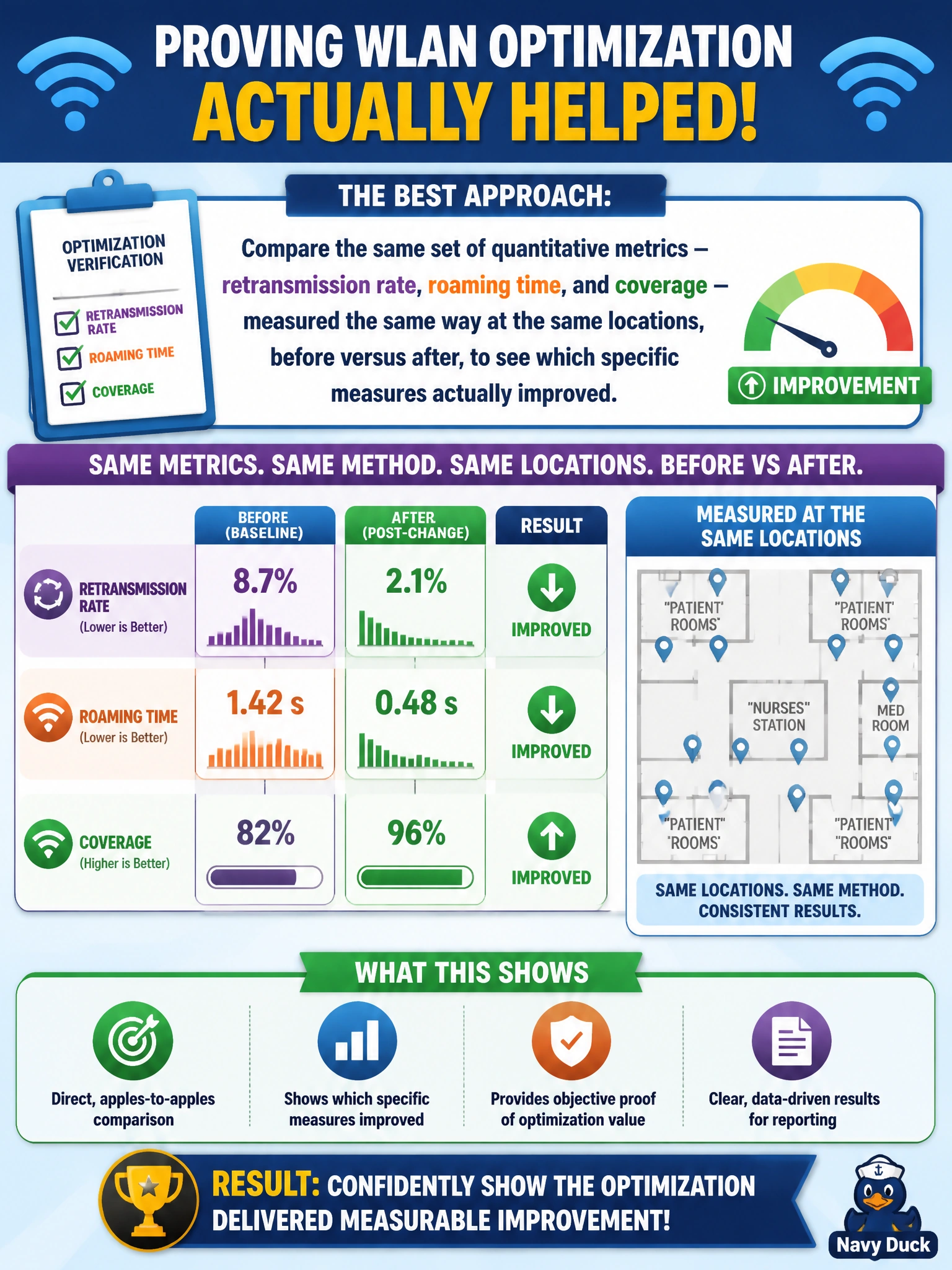
After completing a round of WLAN optimization in a hospital ward, a technician wants to prove the changes were worthwhile before reporting results to the network manager. The technician has both the original baseline and new post-change measurements for coverage, retransmission rate, and average roaming time. Which comparison approach best demonstrates whether the optimization actually helped?
Select an answer to reveal the explanation.
Short Explanation
Whoever asked 'is Wi-Fi better now?' deserves numbers, not vibes. Line up the same measurements, taken the same way, at the same spots — retransmissions, roam time, coverage — before versus after, and the answer becomes obvious instead of a guess.
Full Explanation
A defensible before-and-after comparison requires measuring the same specific, quantitative metrics using the same methodology and locations both times, so that any observed difference can be attributed to the optimization change rather than to inconsistent measurement. Retransmission rate, roaming time, and coverage were exactly the metrics captured in the original baseline, so comparing those same figures post-change against that baseline is the direct, apples-to-apples way to demonstrate impact. Reporting only whether the SSID credentials still work verifies basic functionality was preserved, but it says nothing about whether performance actually improved, which was the entire point of the optimization effort. Cherry-picking the single highest signal reading anywhere in the ward is a misleading summary statistic; it ignores the weak points that likely mattered most and doesn't reflect the overall distribution the baseline was meant to characterize. A single staff member's subjective impression, while not worthless as a data point, is not a substitute for measured data and can be swayed by unrelated factors like which specific spot or time of day they happened to notice. The caveat worth flagging in the report: measurement conditions such as time of day and device load should be reasonably similar between the baseline and follow-up captures, or differences could reflect changing conditions rather than the tuning itself. A concrete check: re-walk the identical measurement route and time-of-day window used for the original baseline capture when gathering the follow-up data.