
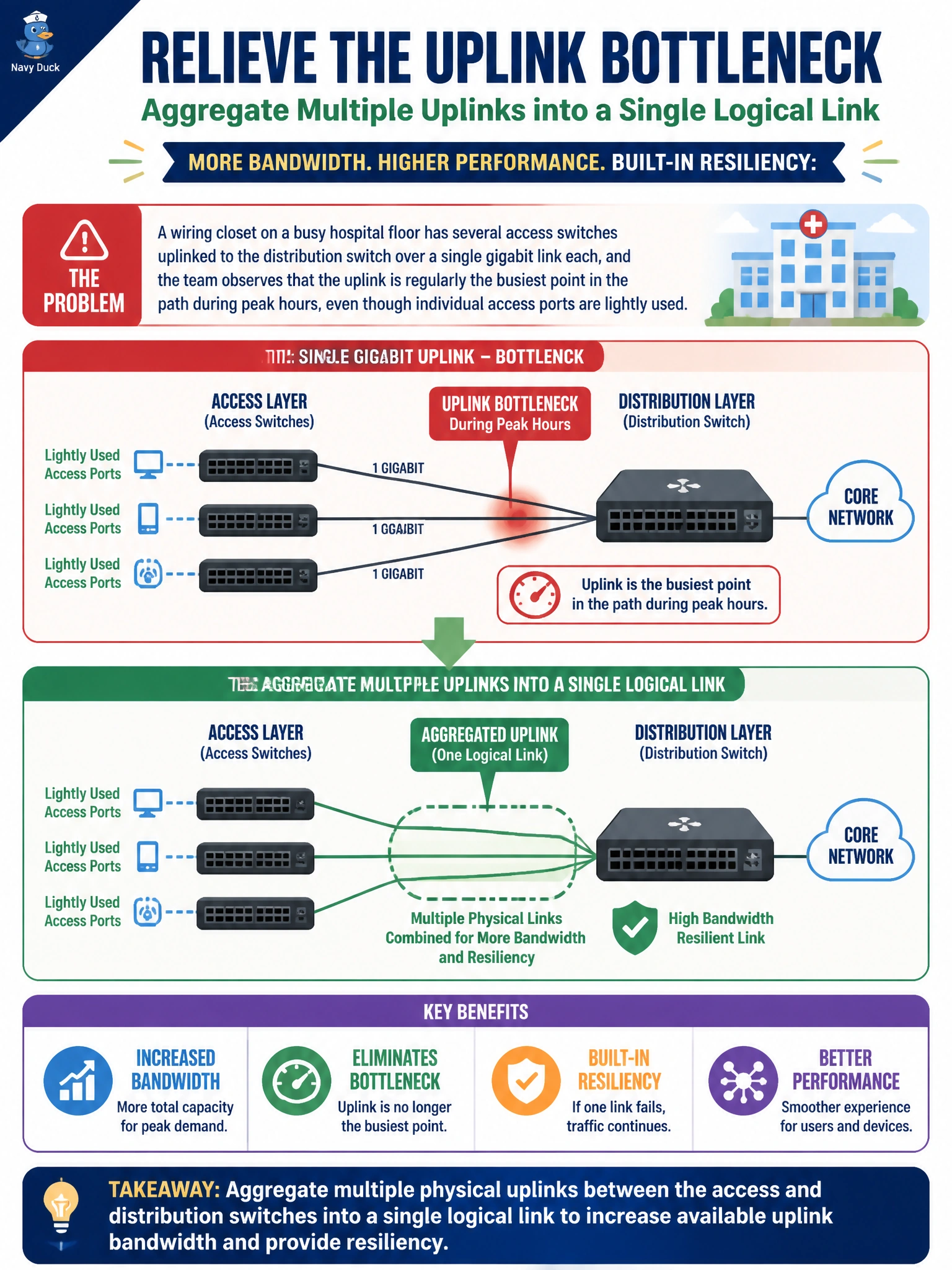
A wiring closet on a busy hospital floor has several access switches uplinked to the distribution switch over a single gigabit link each, and the team observes that the uplink is regularly the busiest point in the path during peak hours, even though individual access ports are lightly used. What is the appropriate LAN optimization to relieve this specific bottleneck?
Select an answer to reveal the explanation.
Short Explanation
One narrow doorway funneling traffic from a whole floor is going to bottleneck no matter how empty the rooms behind it are. Bundling several physical uplinks into one logical link widens that doorway — more capacity, and if one cable fails, the traffic just flows through the others.
Full Explanation
Link aggregation combines multiple physical uplink connections between the access and distribution switch into a single logical link, increasing the effective bandwidth available for traffic funneling upstream, and adding resiliency since traffic can continue flowing over the remaining links if one physical connection fails. This directly targets the described problem: individual access ports are underused, but the single oversubscribed uplink is the actual chokepoint, so widening that specific path is the correct fix rather than touching the access side. Adding more access switches doesn't relieve an uplink bottleneck; it would likely make things worse by funneling even more aggregate traffic through the same constrained uplink unless that uplink is also addressed. Deliberately lowering workstation port speeds trades one problem for another, throttling legitimate traffic at its source rather than fixing the actual constrained link, and would degrade the user experience without truly matching demand to the topology. Collapsing all traffic onto a single shared VLAN doesn't add bandwidth to the physical uplink at all; it removes a Layer 2 segmentation boundary and can actually increase broadcast traffic competing for the same limited uplink capacity. The exam-relevant caveat: aggregation requires matching configuration and supported hardware/protocol on both ends of the link to function correctly. A concrete check: after aggregating, monitor uplink utilization during the same peak-hour window to confirm the previously saturated link now shows meaningful headroom.