
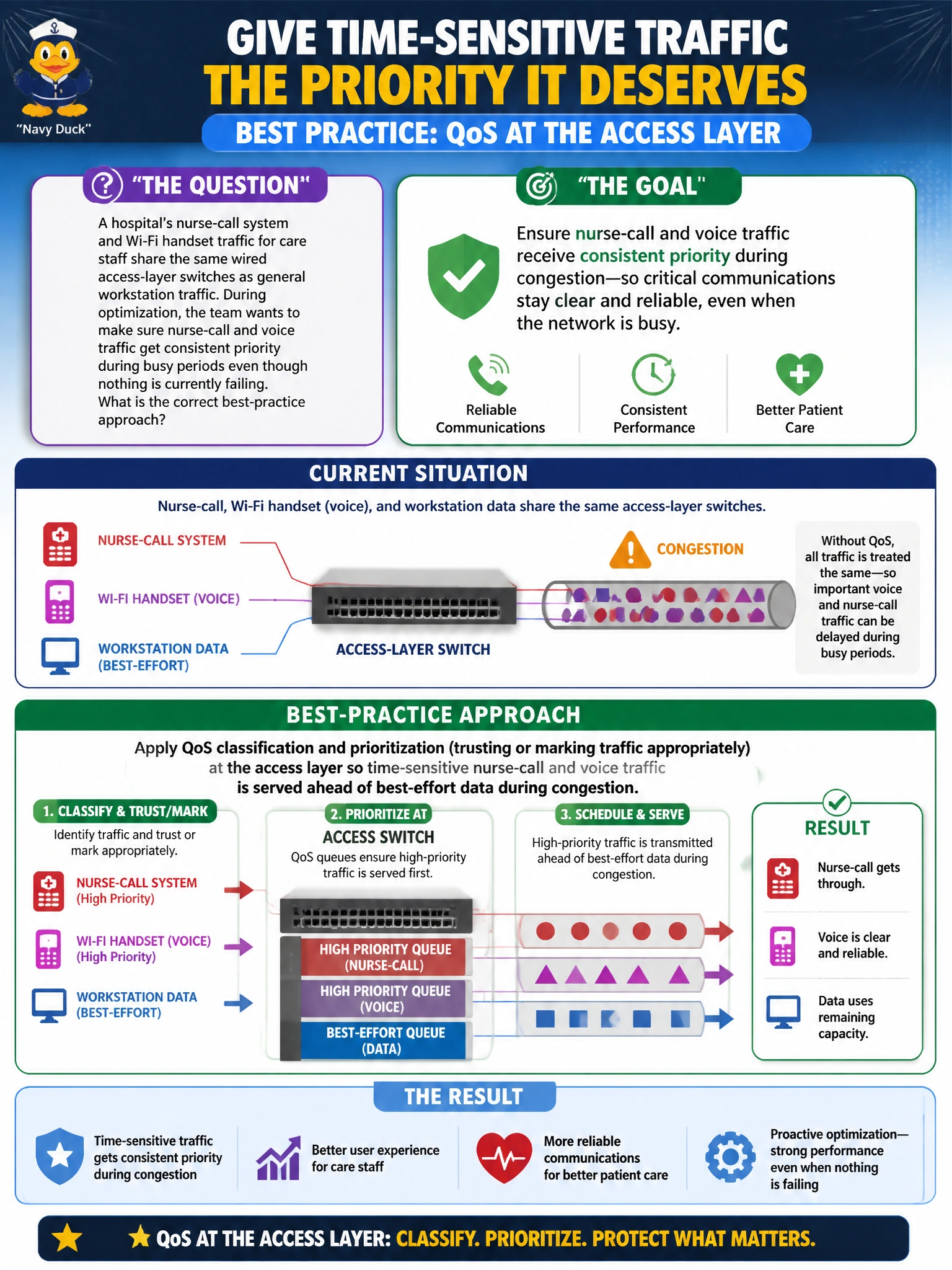
A hospital's nurse-call system and Wi-Fi handset traffic for care staff share the same wired access-layer switches as general workstation traffic. During optimization, the team wants to make sure nurse-call and voice traffic get consistent priority during busy periods even though nothing is currently failing. What is the correct best-practice approach?
Select an answer to reveal the explanation.
Short Explanation
Not every device needs its own private highway — sometimes you just need a fast lane painted onto the road that's already there. QoS marks nurse-call and voice traffic as high priority so it gets waved through ahead of routine workstation traffic when the network gets busy, without ripping out and rebuilding the whole wiring closet.
Full Explanation
Applying QoS classification and prioritization at the access layer is the standard best-practice way to protect time-sensitive traffic like nurse-call and voice on a shared network, without requiring separate physical infrastructure. By trusting or marking this traffic appropriately as it enters the switch, the network can consistently serve it ahead of best-effort workstation data whenever a link becomes congested, addressing the actual concern — consistent priority during busy periods — directly at the point where contention would occur. Building an entirely separate dedicated switch stack solves the same problem far more expensively and inflexibly, and is unnecessary when the existing infrastructure can enforce priority through configuration rather than physical isolation. Blanket-increasing port speed on every port is a brute-force approach that doesn't guarantee priority during congestion; a higher-speed link can still get congested, and priority marking is what determines who wins that congestion, not raw speed alone. Disabling spanning tree on those ports is unrelated to traffic prioritization and actively dangerous — spanning tree protects against loops, and turning it off on live clinical-traffic ports trades an availability risk for no QoS benefit at all. The caveat: QoS only helps if it's applied consistently end to end, so a marking scheme that isn't honored uniformly across the path won't deliver the intended benefit. A concrete check: verify voice and nurse-call VLANs carry the expected priority marking end to end using a switch port capture during a simulated busy period.