
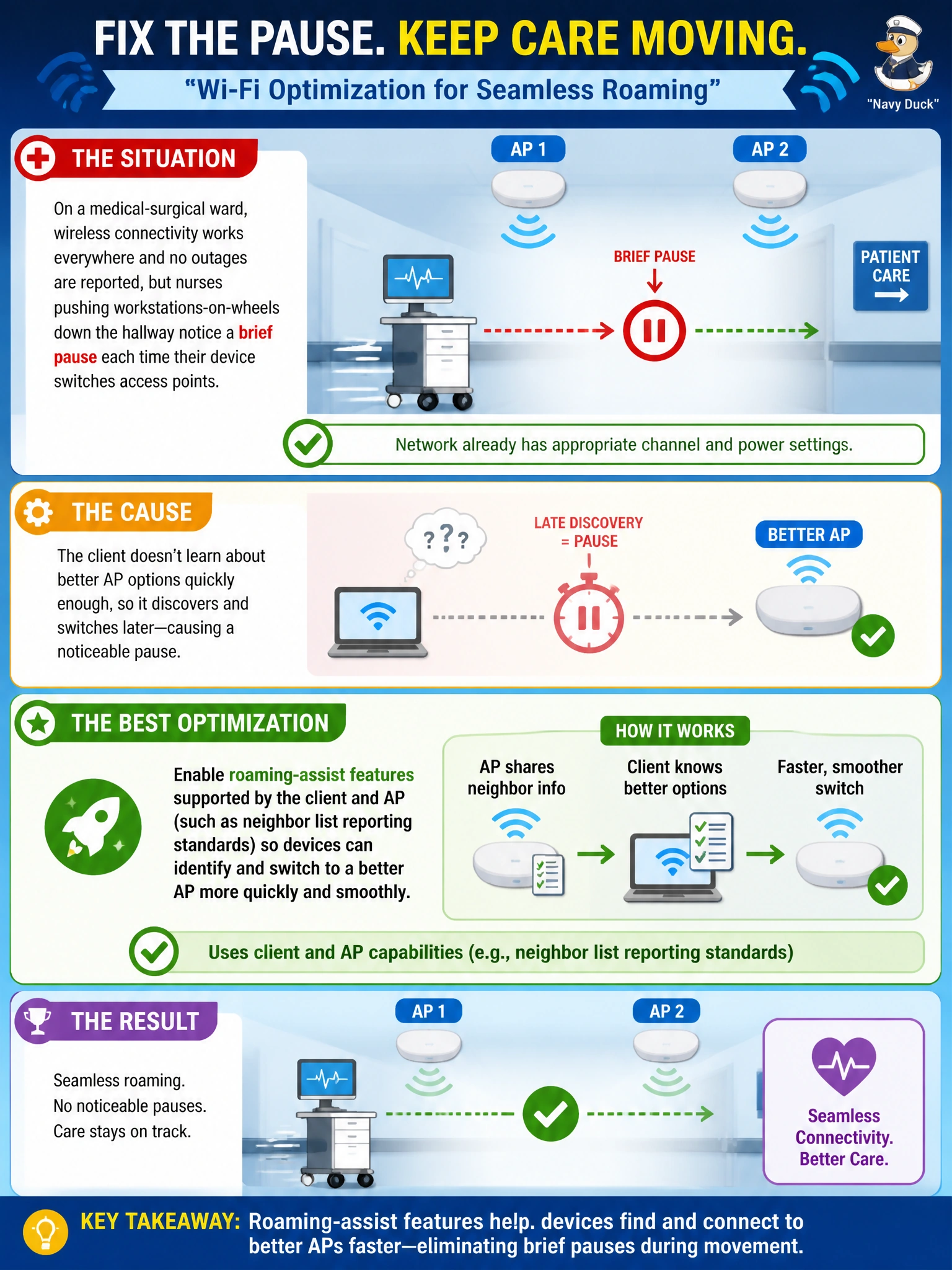
On a medical-surgical ward, wireless connectivity works everywhere and no outages are reported, but nurses pushing workstations-on-wheels down the hallway notice a brief pause each time their device switches access points. The network already has appropriate channel and power settings. Which optimization best addresses this specific complaint?
Select an answer to reveal the explanation.
Short Explanation
The network isn't broken — it's just slow to hand off, like a relay race where the runners fumble the baton for half a second every time. Roaming-assist features work like a coach who already told the next runner exactly where to stand, so devices know which AP to jump to and get there faster instead of scanning around first.
Full Explanation
This scenario describes a working network with a specific roaming-speed problem, not a coverage or capacity issue, since channel and power are already appropriately tuned and there are no outages. The right lever is roaming-assist capability — standards-based features that let a client receive information about neighboring APs so it can make a faster, better-informed decision about when and where to roam, reducing the pause during the handoff itself. Upgrading wired switch throughput addresses a wired-side bandwidth bottleneck, which isn't implicated here since the complaint is specifically about the moment of AP-to-AP handoff on the wireless side, not sustained throughput. Increasing session timeout affects how long a client's authenticated session persists before re-authentication is required, which is a different mechanism from the real-time roaming decision happening as a device physically moves between AP coverage areas, and wouldn't shorten the pause nurses are noticing. Weakening the security method to speed up authentication is also the wrong trade: it directly reduces the WLAN's security posture on a network carrying sensitive clinical traffic, and the pause described is more consistent with roam-decision latency than a full re-authentication delay each time. The operational caveat: roaming-assist features require support on both the AP and the client device, so results vary by device fleet. A concrete check: time the handoff pause with roaming-assist enabled versus disabled on the same test device and hallway route to confirm the improvement is measurable.