
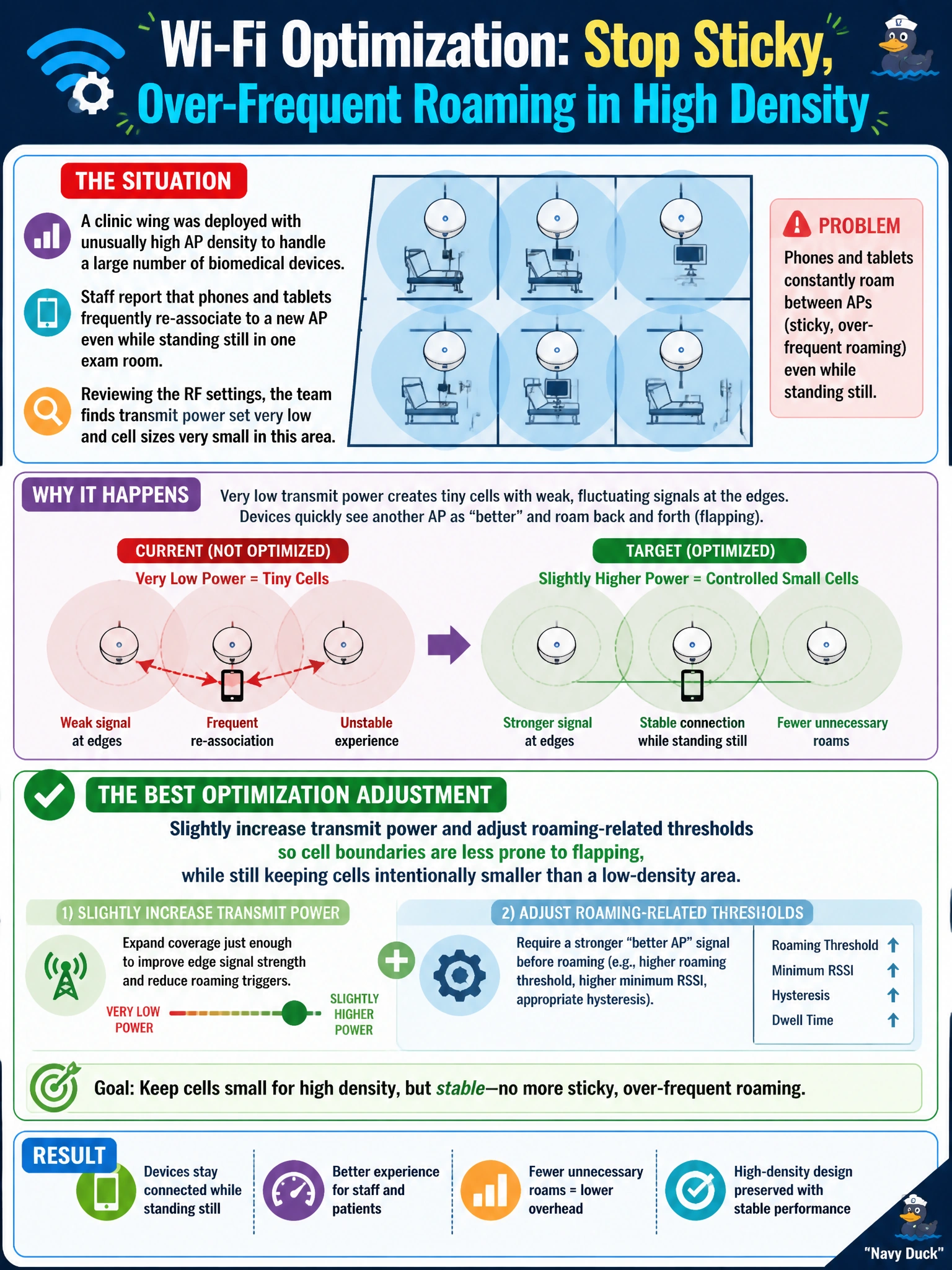
A clinic wing was deployed with unusually high AP density to handle a large number of biomedical devices, but staff report that phones and tablets frequently re-associate to a new AP even while standing still in one exam room. Reviewing the RF settings, the team finds transmit power set very low and cell sizes very small in this area. What optimization adjustment best addresses the sticky, over-frequent roaming without abandoning the high-density design?
Select an answer to reveal the explanation.
Short Explanation
Cells that are too small can backfire — a device standing still shouldn't feel like it's constantly crossing a border. The fix isn't to blow the cells back up to full size, it's a smaller nudge: a bit more power and better roaming thresholds, so the cell boundary is stable enough that a stationary device stops bouncing between APs it can barely tell apart.
Full Explanation
High-density deployments intentionally use smaller cells to spread devices across more APs, but cells that are tuned too aggressively small can create unstable boundaries where a device standing still still detects a neighboring AP as similarly strong, triggering unnecessary roams. The right correction is a measured one: nudge transmit power up slightly and adjust the thresholds that govern when a client is encouraged to roam, so cell edges become more stable without undoing the density strategy that was deployed for a reason. Removing APs contradicts the original design goal of spreading device load across more cells and would reintroduce the very congestion the high-density layout was meant to solve. Maxing out power on every AP is the opposite overcorrection — it would blow up the small cells back toward large-cell coverage, reintroducing the co-channel interference and capacity problems that smaller cells were deployed to avoid. Moving every device to a wired connection ignores that many of these are mobile phones, tablets, and portable biomedical devices that need to move around the exam rooms and cannot be tethered by cable. The exam-relevant nuance: this is a tuning problem, not a redesign problem, so the fix is incremental adjustment, not reversing the density strategy. A concrete check: after adjusting, log roam events per stationary test device over a fixed period and confirm the roam count drops meaningfully without cell sizes returning to their original, over-large state.