
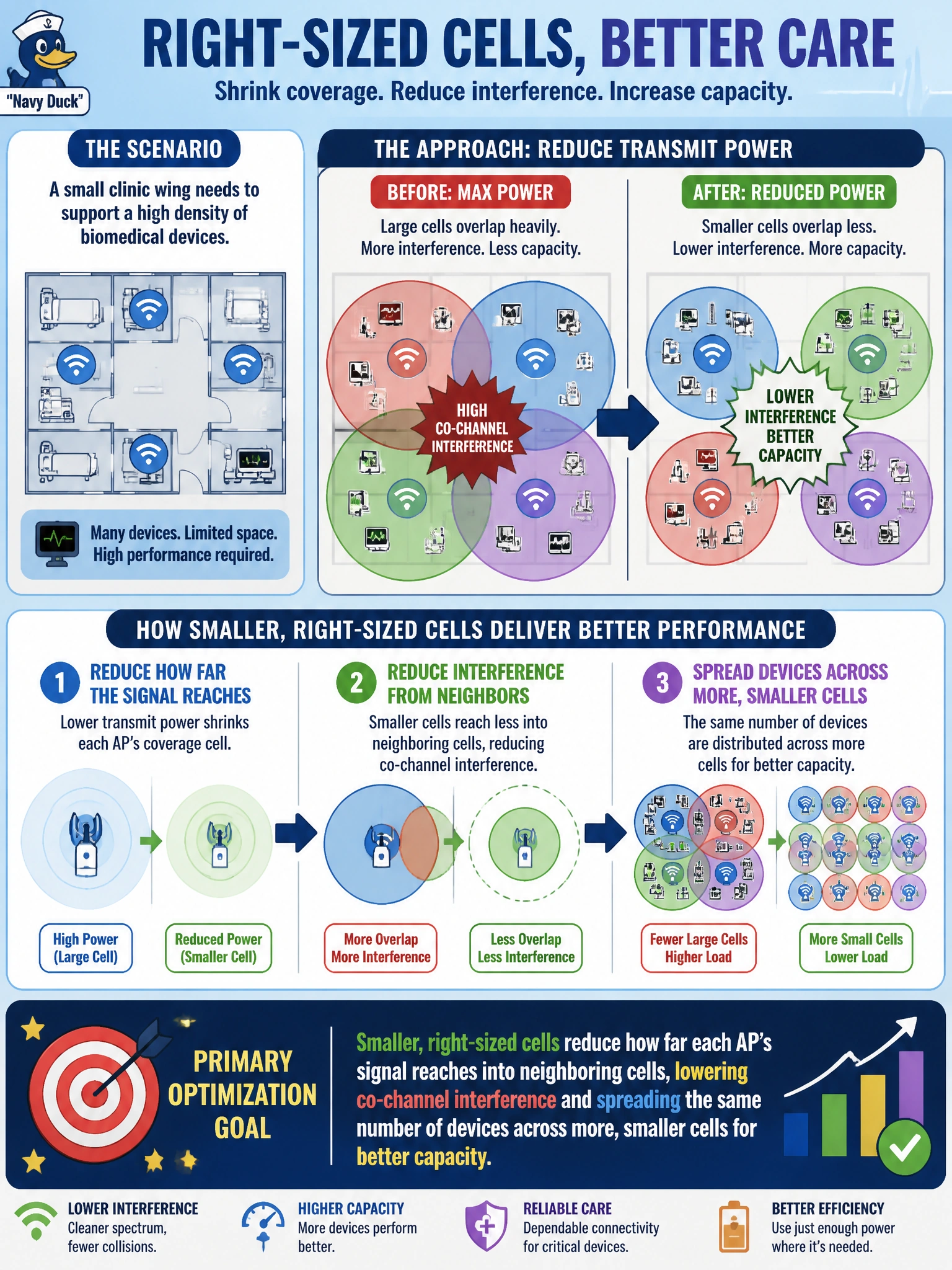
To support a high density of biomedical devices in a small clinic wing, the wireless team decides to reduce transmit power on several APs rather than leave them at maximum. What is the primary optimization goal of intentionally shrinking each AP's coverage cell in this way?
Select an answer to reveal the explanation.
Short Explanation
Think of it like breaking one big crowded room into several smaller rooms — each AP covers less ground, but that means fewer devices are crammed into any one cell competing for the same airtime, and less overlap bleeding into the AP next door. That's cell sizing: right-sizing coverage for capacity, not just reach.
Full Explanation
Right-sizing an AP's cell by reducing transmit power is a deliberate capacity-planning move in high-density environments. A smaller cell means the AP's signal doesn't extend as far into neighboring APs' territory, which reduces the co-channel and adjacent-channel overlap that causes contention, while also meaning fewer devices are physically within range of any single AP at once — spreading the same total device count across more, smaller cells instead of concentrating them under a few APs blasting at full power. This is a capacity strategy, not a speed strategy: reducing power does not raise the maximum data rate a client can achieve, since rate is governed by signal quality and 802.11 standard support, and in fact clients right at the new cell edge may see somewhat lower rates as the trade-off for better overall capacity. Framing the change as an electricity-saving measure misses the actual engineering reason and would be a coincidental side effect at best, not the goal. And reducing power doesn't remove the need for a channel plan — if anything, deliberately smaller cells still require careful channel assignment between adjacent APs, since shrinking cell size without also planning channels still leaves room for interference at the new, smaller boundaries. A concrete check: after tuning, verify that client counts per AP have become more evenly distributed across the wing rather than still clustering on the same subset of access points.