
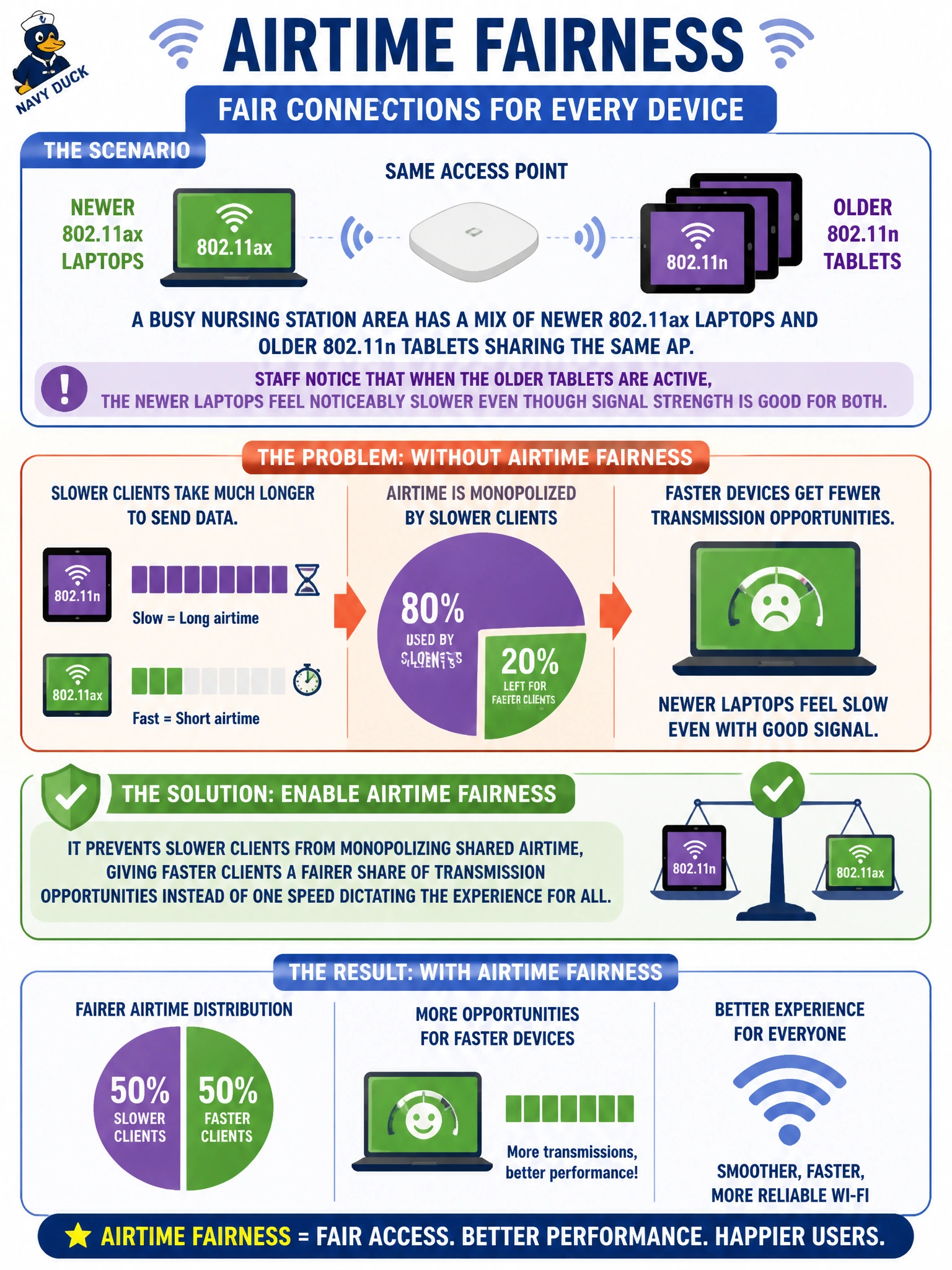
A busy nursing station area has a mix of newer 802.11ax laptops and older 802.11n tablets sharing the same AP. Staff notice that when the older tablets are active, the newer laptops feel noticeably slower even though signal strength is good for both. Enabling an airtime fairness feature on the AP is intended to address which specific problem?
Select an answer to reveal the explanation.
Short Explanation
Without airtime fairness, one slow talker can hog the whole meeting — an old tablet sending the same data as a fast laptop just takes longer to say it, and everyone else has to wait their turn. Airtime fairness makes sure each device gets a fair slice of transmission time instead of letting the slowest device set the pace for the group.
Full Explanation
Without airtime fairness, an AP typically serves clients in a way that gives every device a comparable number of transmission opportunities, but a slower client takes far longer per opportunity to move the same amount of data, effectively letting it consume a disproportionate share of total airtime. Airtime fairness rebalances this by allocating transmission time itself more evenly, so a fast 802.11ax laptop isn't held hostage to the pace set by a slower 802.11n tablet on the same AP. This is distinct from signal strength, which the feature doesn't touch — both device types already have good signal in this scenario, and the complaint is about shared-medium contention, not RF quality. It's also unrelated to VLAN assignment, which is a Layer 2/3 segmentation decision made independently of how airtime is scheduled. And the feature doesn't block older clients from associating; excluding legitimate devices would be a heavy-handed and disruptive way to solve a scheduling problem, not what airtime fairness is designed to do. The caveat worth remembering: airtime fairness improves the experience of faster clients in mixed environments, but it doesn't raise the older client's own achievable rate, so a genuinely weak or old device is still slow in absolute terms. A concrete check: compare per-client throughput at the nursing station before and after enabling the feature during a period when both device types are active simultaneously.