
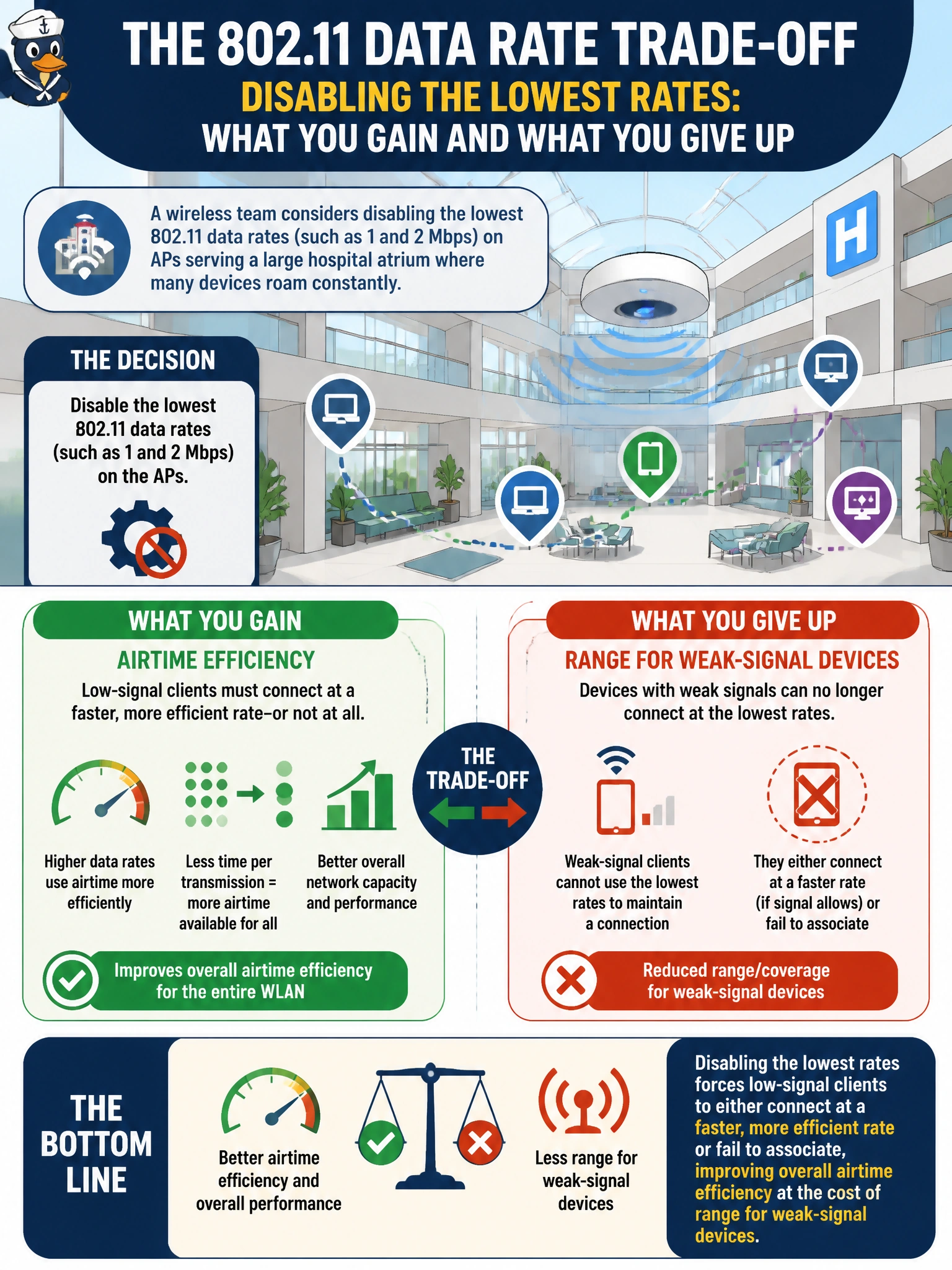
A wireless team considers disabling the lowest 802.11 data rates (such as 1 and 2 Mbps) on APs serving a large hospital atrium where many devices roam constantly. What is the main trade-off they are accepting by doing this?
Select an answer to reveal the explanation.
Short Explanation
Low data rates are the slow lane that everyone gets stuck behind — one device connecting at 1 Mbps can hog airtime that dozens of faster clients could have used. Turning off the slowest rates clears that lane, but it means devices with genuinely weak signal at the edge of coverage might not get in at all. It's a real trade: efficiency for the many versus reach for the few.
Full Explanation
Minimum data rate tuning removes the lowest, least efficient rates from an AP's supported rate set, which changes how much airtime a weak-signal client consumes to send the same amount of data. A client transmitting at 1 Mbps occupies dramatically more airtime per frame than one transmitting at 24 or 54 Mbps, and in a busy atrium with constant roaming, that inefficiency is shared by every other device trying to use the same channel. Raising the floor forces marginal clients to either associate at a higher, more efficient rate or fail to connect, which trades some effective range at the fringe of coverage for a meaningful gain in aggregate airtime efficiency for everyone else. The claim that this permanently raises maximum theoretical throughput is wrong — the ceiling rate doesn't change, only the floor does, so the gain is in efficiency and fairness, not peak speed. It also doesn't eliminate the need for power tuning, since coverage and interference are separate concerns from rate selection and still need their own adjustment. And it is not cosmetic to SSID visibility — it directly changes airtime consumption and can affect whether a marginal client associates at all. A concrete check: after the change, monitor for any increase in failed associations near known weak-coverage spots, which signals the floor was raised more aggressively than the actual coverage design supports.