
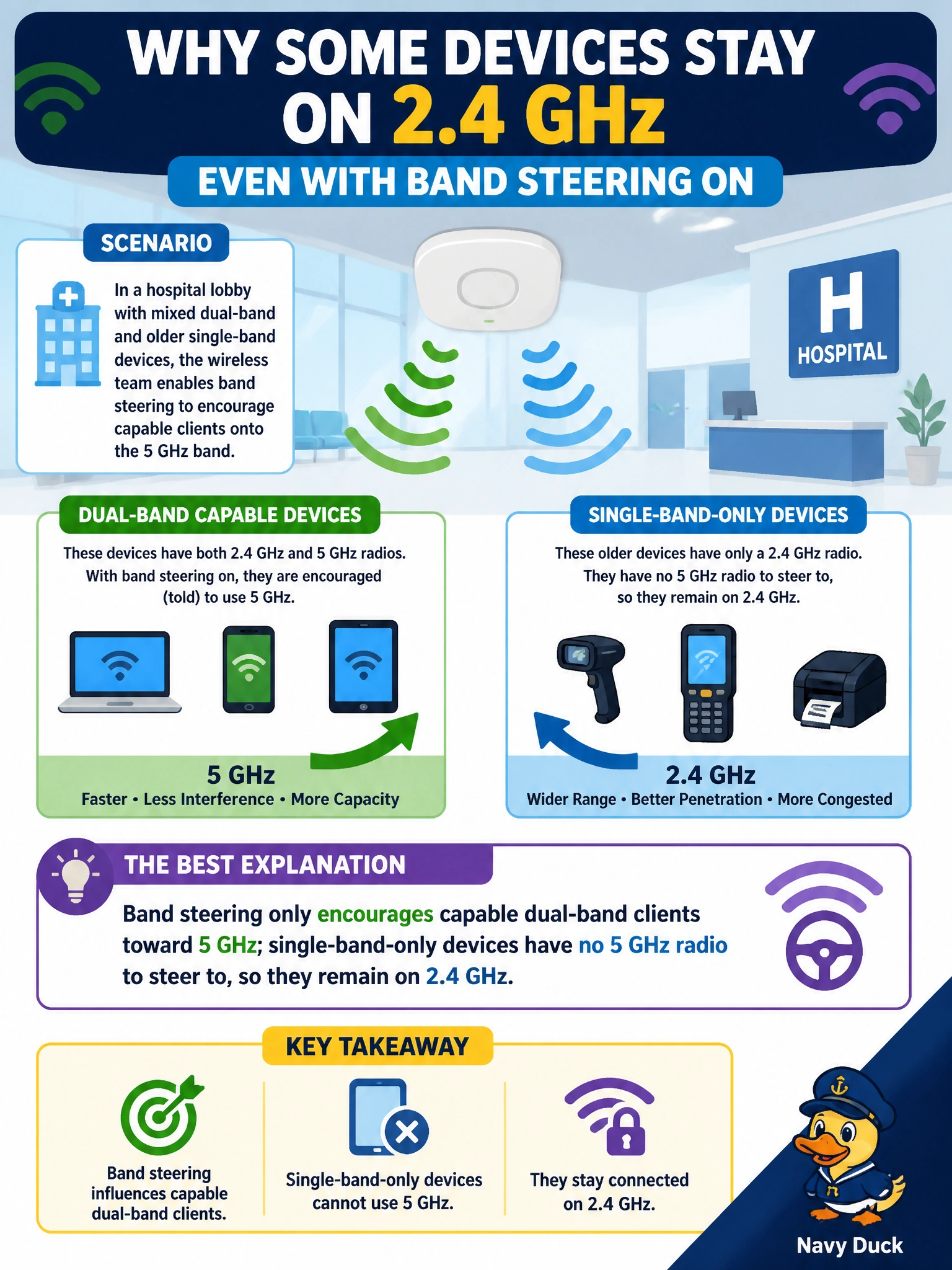
In a hospital lobby with mixed dual-band and older single-band devices, the wireless team enables band steering to encourage capable clients onto the 5 GHz band. A staff member later asks why some older handheld scanners still connect on 2.4 GHz even with the feature turned on. What is the best explanation?
Select an answer to reveal the explanation.
Short Explanation
Band steering is a nudge, not a mandate — it's the AP gently suggesting the faster lane to devices that can actually drive there. A handheld scanner with no 5 GHz radio simply doesn't have that lane available, so it stays on 2.4 GHz no matter how hard the AP nudges. It's a preference mechanism for capable clients, not a universal fix.
Full Explanation
Band steering works by having the access point delay or withhold probe responses on 2.4 GHz for clients it knows support 5 GHz, nudging dual-band devices toward the less congested, higher-capacity band. It cannot act on hardware the client doesn't have: a single-band 2.4 GHz-only device, common among older handheld scanners and some medical peripherals, has no 5 GHz radio for the AP to steer it toward, so it stays exactly where its hardware allows. The idea that the feature forces every device onto 5 GHz misreads it as a hard override rather than an encouragement mechanism that only affects capable clients. Believing it disables 2.4 GHz entirely is also wrong and would be counterproductive in a hospital, where legacy single-band devices like older scanners and some nurse-call handsets still depend on that band to function at all. And band steering is a software/RF-management feature on existing APs, not something that requires a hardware refresh to take effect. The exam-relevant caveat: band steering is a best-effort nuance, not a guarantee, so a small percentage of dual-band clients may still land on 2.4 GHz depending on signal strength at the time of association. A concrete check: pull a client association report filtered by band and cross-reference which client models are single-band before assuming the feature is misconfigured.