
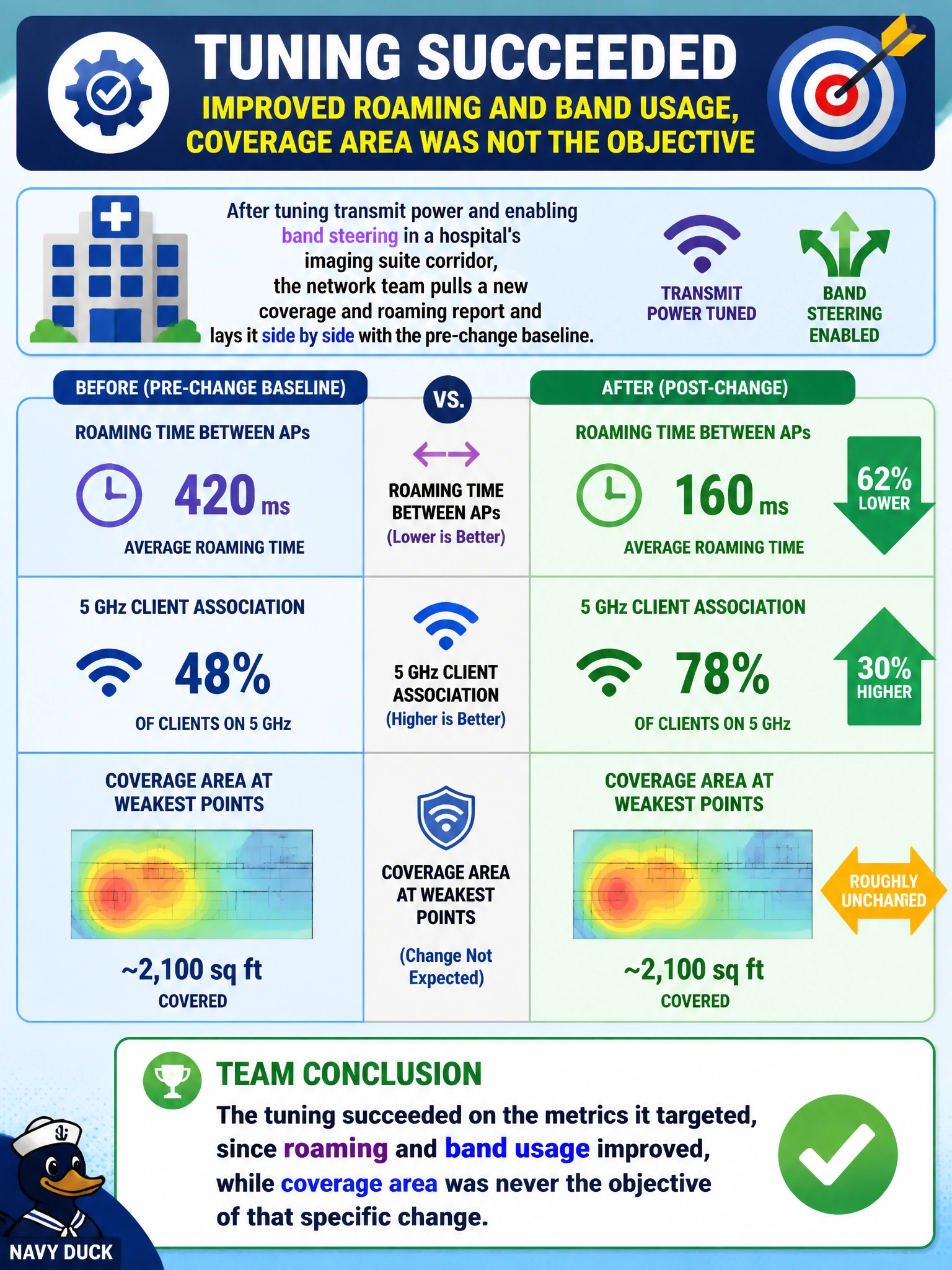
After tuning transmit power and enabling band steering in a hospital's imaging suite corridor, the network team pulls a new coverage and roaming report and lays it side by side with the pre-change baseline. Roaming time between APs has dropped and 5 GHz client association has increased, but overall coverage area at the weakest points is roughly unchanged. What should the team conclude from this comparison?
Select an answer to reveal the explanation.
Short Explanation
Not every fix moves every needle, and that's fine — you tuned for roaming and band balance, not for filling in a weak-signal corner. Judge the change against what it was meant to do, not against a metric it was never aimed at. Improved roaming and better 5 GHz uptake? That's a win on its own terms.
Full Explanation
Comparing against a baseline only works if the comparison is scoped to what the change was actually meant to affect. Transmit power tuning and band steering target client behavior and RF balance — roaming speed and band association — not the physical coverage footprint at the weakest measurement point, so an unchanged coverage number there doesn't indicate failure. The 'complete failure' framing conflates a metric outside the change's scope with the ones the change was designed to move, and both of those (roaming time, 5 GHz association) improved. Calling the baseline invalid because metrics moved in different directions misunderstands what a baseline is for: it's normal and expected for a tuning change to improve some measurements while leaving unrelated ones flat, and that pattern doesn't undermine the original measurement's validity. Reverting on that basis would discard a genuine improvement over a non-issue. The operationally sound move is to document that the coverage gap is a separate problem, possibly requiring an AP placement change rather than an RF-parameter change, and track it separately. A concrete check: confirm the coverage weak spot was already flagged as a known gap in the original baseline notes rather than a new regression, then open a distinct optimization item for it instead of undoing work that measurably helped.