
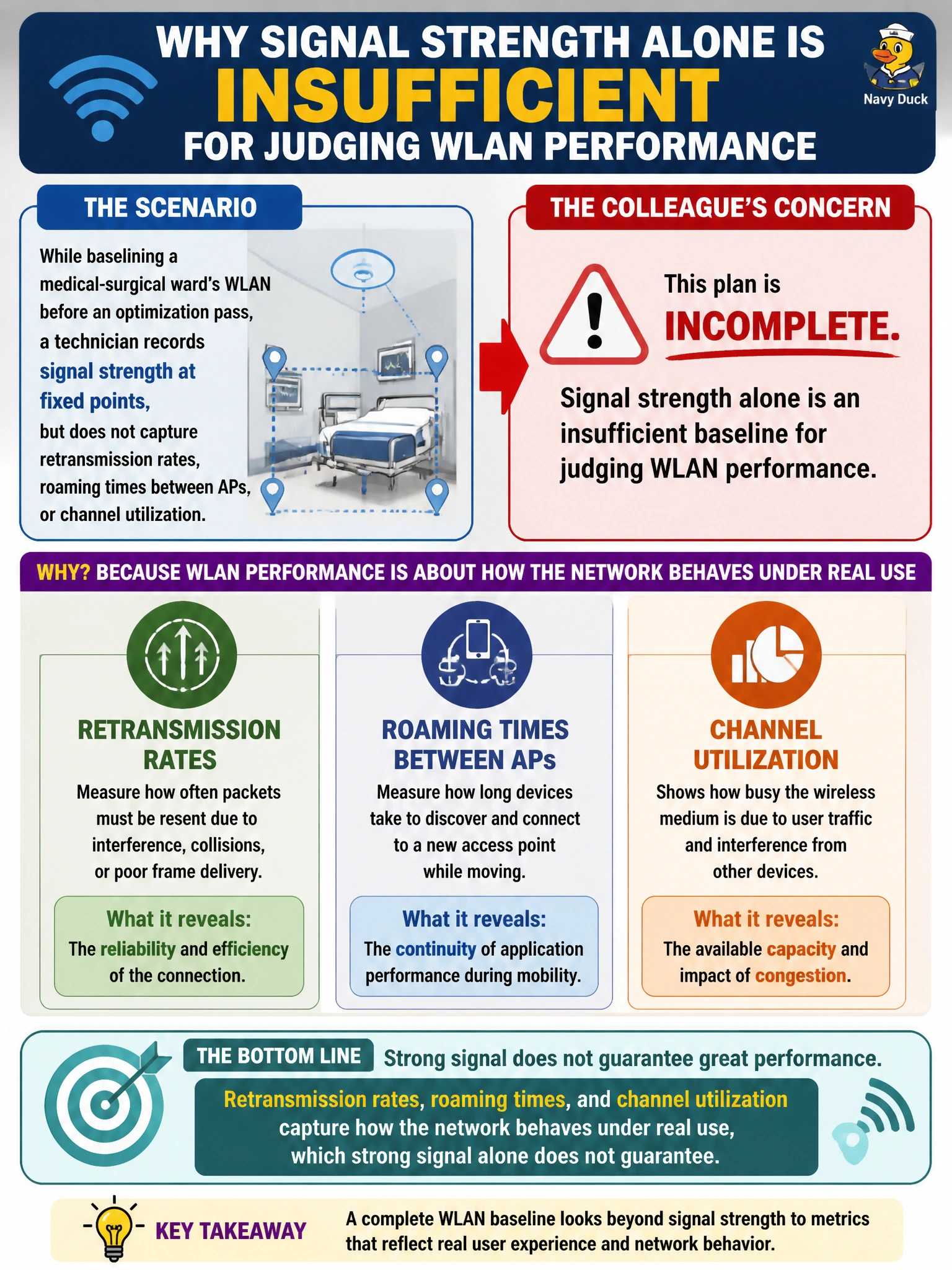
While baselining a medical-surgical ward's WLAN before an optimization pass, a technician records signal strength at fixed points, but does not capture retransmission rates, roaming times between APs, or channel utilization. A colleague reviewing the plan flags this as incomplete. Why is signal strength alone an insufficient baseline for judging WLAN performance?
Select an answer to reveal the explanation.
Short Explanation
Good signal bars don't mean a good experience — think of it like having full bars on your phone in an elevator that keeps dropping calls. Strong RSSI just says a radio can hear a signal; it says nothing about interference, congestion, or how smoothly a device hands off between APs. A real baseline has to capture how the network behaves, not just how loud it is.
Full Explanation
A useful WLAN baseline measures behavior under realistic conditions, not just raw signal presence. Retransmission rate reveals how often frames are being corrupted or lost, which strong RSSI can mask if interference or co-channel contention is high. Roaming time captures how long a client takes to hand off between access points, which directly affects the sluggish-roaming complaints staff notice while pushing a workstation-on-wheels down a hallway. Channel utilization shows how busy the RF medium is regardless of how strong any single signal looks. The idea that signal readings can't be trusted at all overstates the problem — RSSI is a legitimate data point, it's just not a complete one on its own. Claiming only throughput matters is equally narrow; throughput is useful but doesn't explain why performance is uneven across a ward. And there's no inherent conflict between passive Wi-Fi measurement and nurse call equipment, since capturing WLAN metrics doesn't require touching or disrupting those clinical systems. A concrete check: pull a channel-utilization and retransmission report alongside the coverage heatmap for the same time window, so a 'strong signal' area that is actually congested doesn't get mistaken for a healthy one.