
A patient monitoring device on a med-surg ward authenticates and is dynamically placed on the general guest VLAN instead of the clinical device VLAN, leaving it unable to reach the electronic health records server it needs to report vitals to. Other clinical devices in the same ward correctly land on the clinical VLAN. What is the most likely explanation?
Select an answer to reveal the explanation.
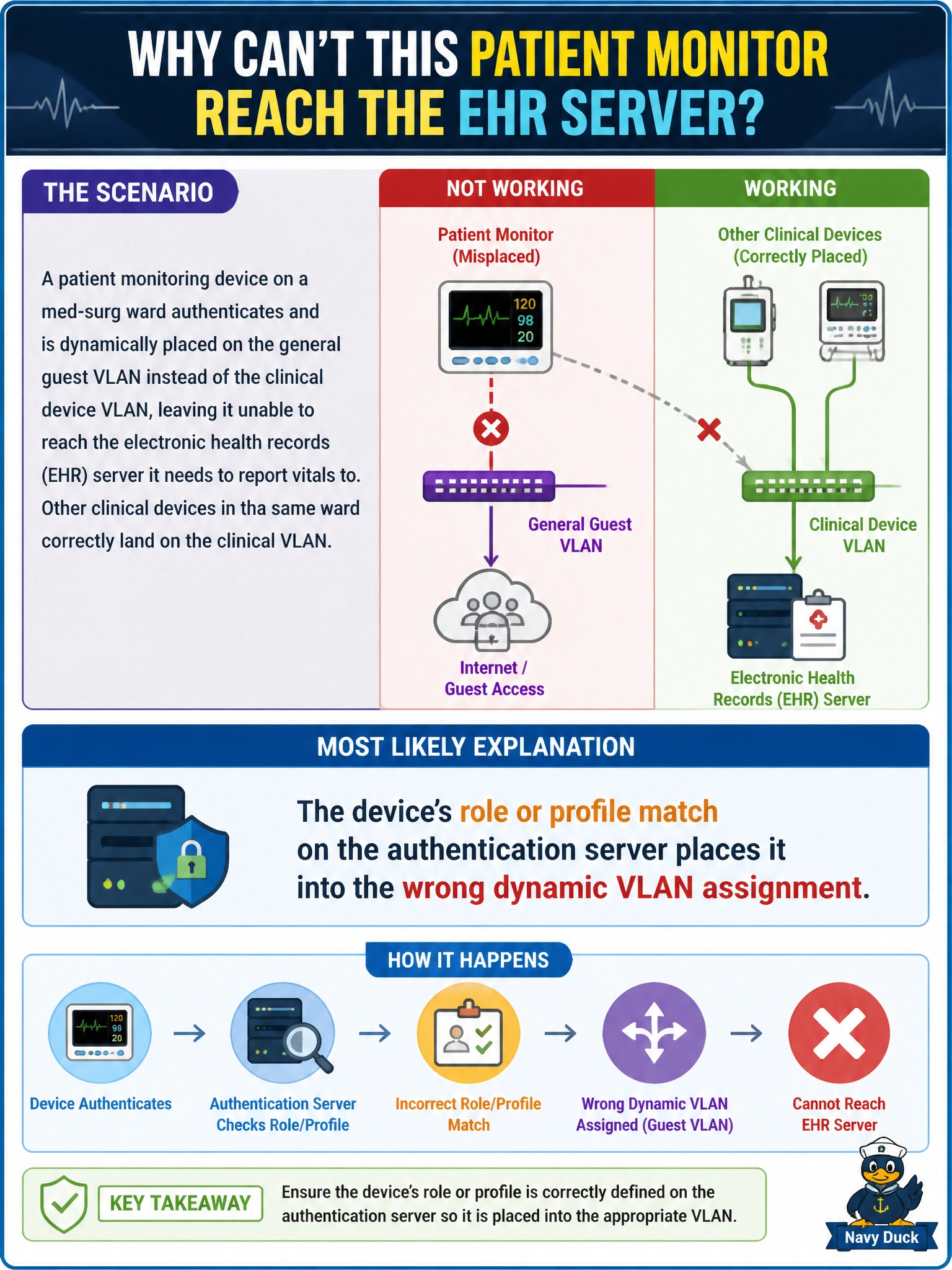
Short Explanation
Every device gets sorted into a role, and that sorting only works if the device is actually recognized as what it is. If this one monitor is matching the wrong profile, it gets handed the wrong VLAN ticket, while everything else that matches correctly sails through to clinical.
Full Explanation
Since other clinical devices on the same ward correctly receive the clinical VLAN, the switch configuration, the clinical VLAN's own DHCP scope, and the general authentication infrastructure are all evidently functioning, which rules out a spanning-tree state (that would affect the port generically, not selectively assign a wrong VLAN) and a DHCP exhaustion (the device would fail to get any address at all, not land on a working but wrong VLAN) as explanations. The behavior described is a dynamic role or profile-matching problem specific to this one device: many campus deployments use device fingerprinting, MAC-based authentication, or a profiling policy to automatically classify a connecting device and assign it the appropriate role and VLAN, and if this particular monitor isn't matching the expected clinical device profile — because of an unrecognized MAC OUI, a missing profile entry, or a policy rule ordering issue — it falls through to a default or catch-all role such as guest, even though its intended classification is clinical. An SSID mismatch is irrelevant since this is a dynamically role-assigned device on what appears to be a wired or managed connection, not a wireless association issue. The operational check is to review the authentication or profiling server's policy match logs for this specific device's session and compare which rule it actually matched against which rule the correctly-landing clinical devices matched. A caveat is that a firmware or software update on the device itself can sometimes change how it identifies on the network, causing a previously correct profile match to suddenly miss.