
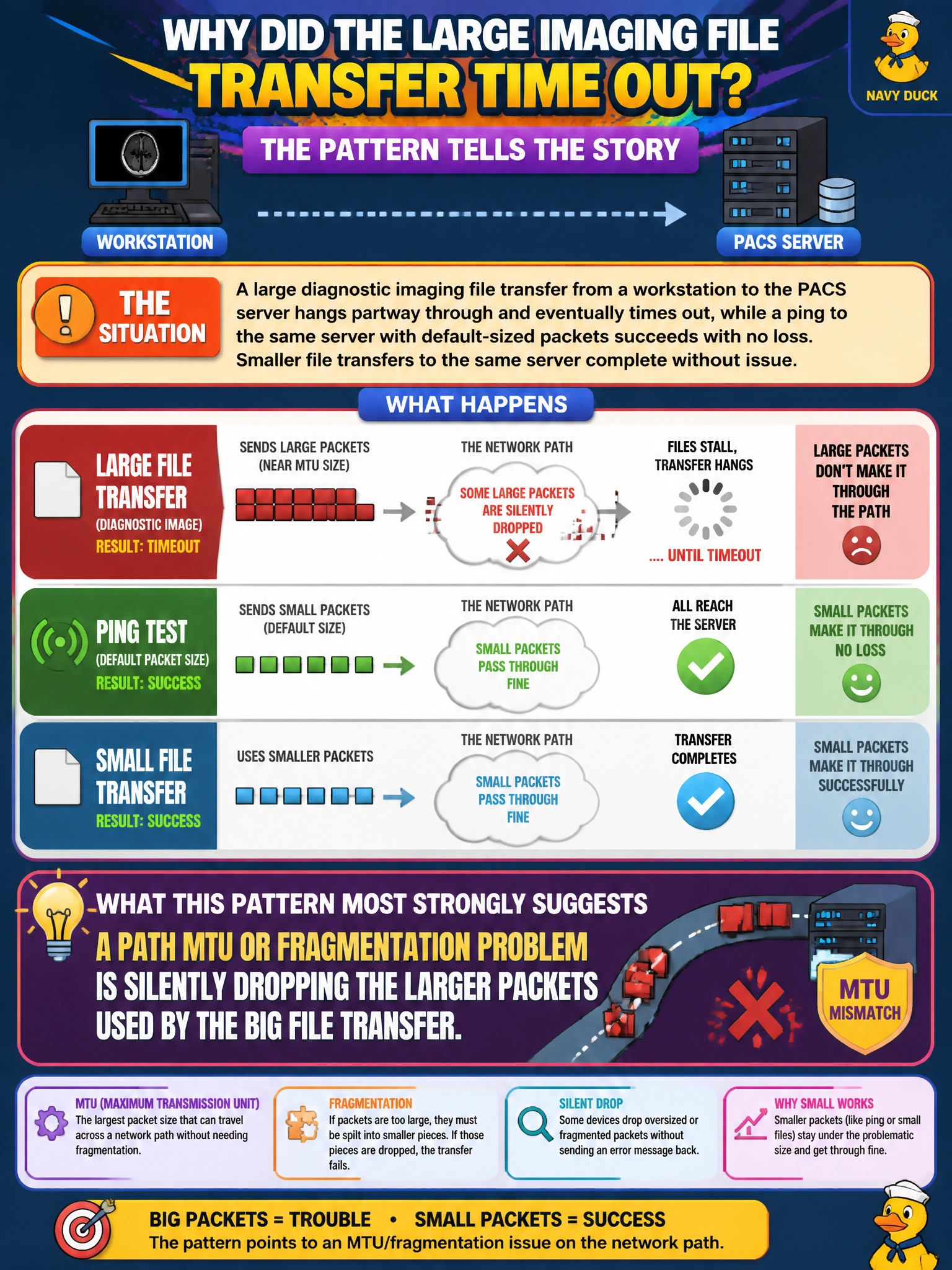
A large diagnostic imaging file transfer from a workstation to the PACS server hangs partway through and eventually times out, while a ping to the same server with default-sized packets succeeds with no loss. Smaller file transfers to the same server complete without issue. What does this pattern most strongly suggest?
Select an answer to reveal the explanation.
Short Explanation
A tiny ping packet can slip through gaps that a big, fully-loaded packet just can't fit through. When only large transfers choke while small pings and small files sail through fine, something along the path is quietly dropping oversized packets instead of properly fragmenting or signaling back that they need to shrink.
Full Explanation
A successful default-sized ping and successful small file transfers both confirm basic reachability, routing, and general path health, which rules out a DNS problem (the workstation is clearly already reaching the correct server) and a VLAN role misassignment (the workstation clearly has adequate access for smaller traffic). The pattern of only large transfers failing points specifically at packet size: somewhere along the path, a device may have a smaller maximum transmission unit than the rest of the path, and if that device drops oversized packets rather than fragmenting them, and the associated ICMP message needed to signal the sender to reduce packet size is itself being filtered (a common effect of overly aggressive firewall rules blocking ICMP), the sender never learns to shrink its packets and the transfer simply stalls and times out. A duplex mismatch would typically manifest as noticeable errors, collisions, or generally poor and inconsistent performance across all traffic sizes, not a clean split between small transfers succeeding and only large ones failing. The operational check is to test the same large file transfer using packets of decreasing size to find the point where transfers start succeeding, and to verify whether ICMP 'fragmentation needed' messages are permitted through any firewalls along the path. A caveat is that many networks intentionally standardize a slightly reduced MTU on certain links (such as tunnels), so the long-term fix is aligning MTU settings end-to-end or ensuring ICMP path-MTU-discovery messages are explicitly permitted rather than blocked.