
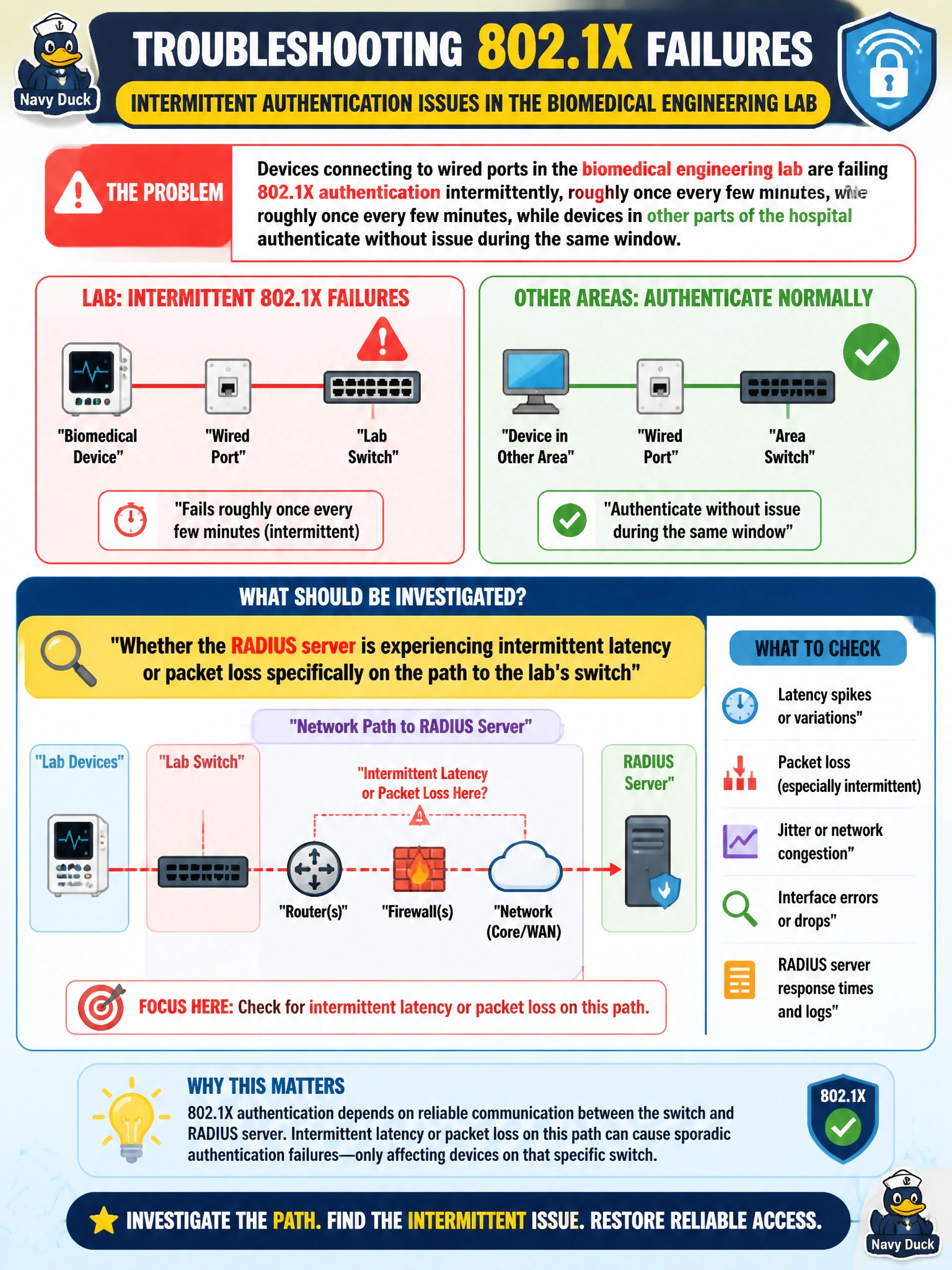
Devices connecting to wired ports in the biomedical engineering lab are failing 802.1X authentication intermittently, roughly once every few minutes, while devices in other parts of the hospital authenticate without issue during the same window. What should be investigated?
Select an answer to reveal the explanation.
Short Explanation
If it's happening everywhere, blame the RADIUS server. If it's happening in just one spot and only sometimes, blame the road between that one spot and the RADIUS server. An intermittent, localized authentication failure points at a shaky path, not a broken server.
Full Explanation
Because the failure is intermittent and localized to one specific area rather than affecting the whole campus, a full RADIUS outage is unlikely (that would produce widespread, consistent failures as described in a campus-wide scenario), but a path-specific problem — packet loss, high latency, or a flaky link somewhere between the lab's switch and the RADIUS server — fits both the intermittent timing and the localized scope precisely, since occasional dropped or delayed authentication requests would cause the switch to time out and fail the exchange only some of the time, and only for devices relying on that particular path. A trunk-versus-access port misconfiguration would typically produce a consistent, not intermittent, connectivity problem, and wouldn't be specific to 802.1X authentication exchanges. A pending firmware update sitting unapplied doesn't actively cause intermittent authentication failures on its own; it's a maintenance item, not an active fault. A DHCP scope nearing exhaustion is unrelated to authentication entirely, since DHCP only comes into play after 802.1X has already succeeded and granted network access. The operational check is to review authentication timeout and retry counters on the lab's switch, and to test reachability and latency from that switch to the RADIUS server over an extended period, watching specifically for intermittent loss rather than a hard outage. A caveat is that a shared uplink or spanning-tree topology change affecting just that segment of the network is a common underlying cause of this kind of localized intermittent latency.