
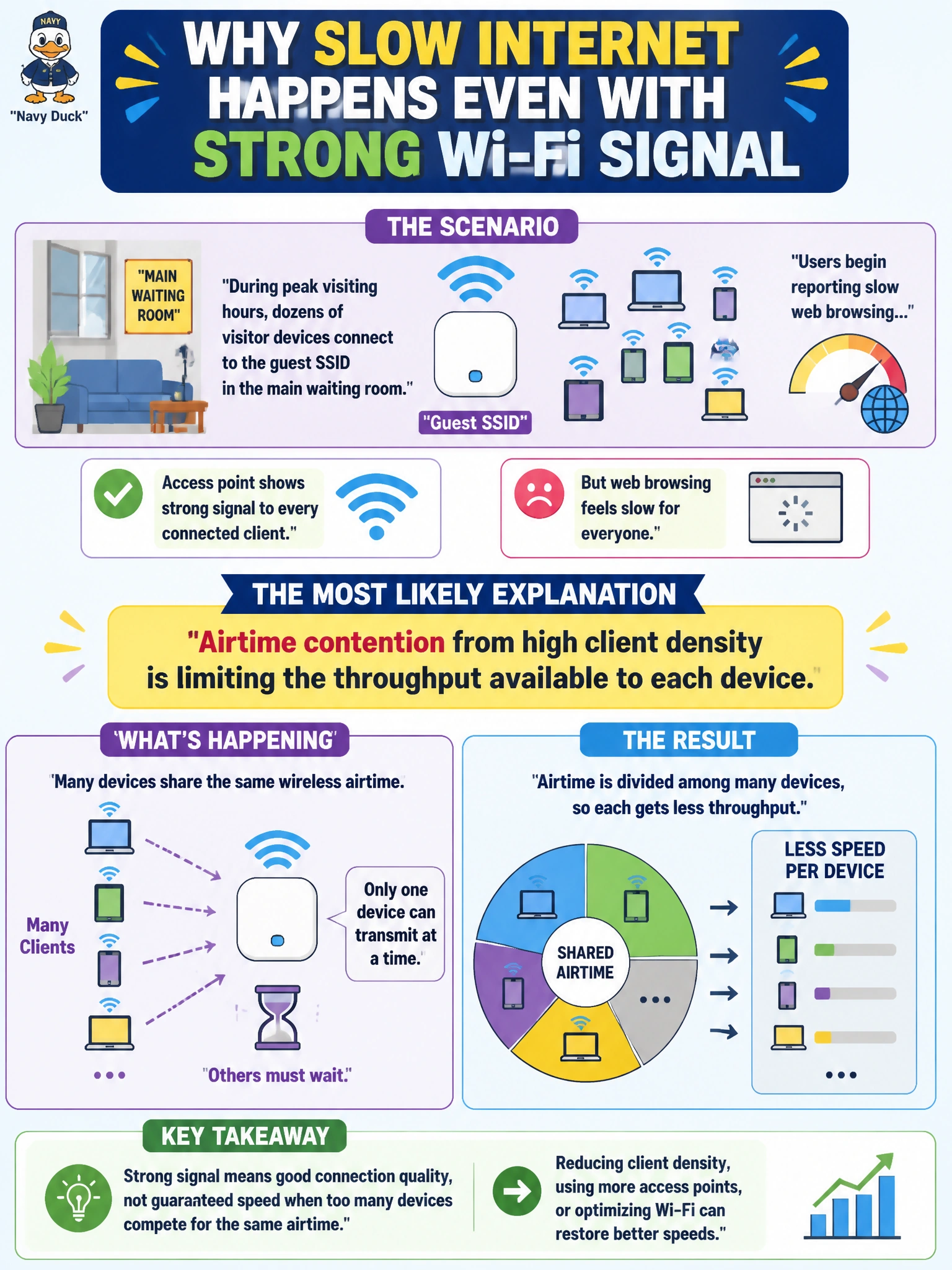
During peak visiting hours, dozens of visitor devices connect to the guest SSID in the main waiting room, and users begin reporting slow web browsing even though the access point shows strong signal to every connected client. What is the most likely explanation?
Select an answer to reveal the explanation.
Short Explanation
Wi-Fi is a shared medium, like one microphone passed around a crowded room. The more people who need a turn to talk, the shorter each person's turn gets, no matter how loud and clear that microphone sounds. Strong signal doesn't mean spare capacity; this is a capacity problem, not a coverage problem.
Full Explanation
Strong signal strength to every connected client rules out a coverage or RF-propagation problem, since the issue clearly isn't about devices struggling to hear the access point. Wi-Fi airtime is a shared resource: every device associated to an AP, and every AP on the same channel within range, must take turns transmitting, and as client count climbs, the average airtime — and therefore throughput — available to any single device drops, even though each device's individual signal quality remains excellent. This is a classic coverage-versus-capacity distinction: an AP can provide excellent coverage (strong signal everywhere) while still being overwhelmed on capacity once enough clients compete for the same airtime, particularly in a high-density space like a waiting room during a peak period. This differs from a DHCP scope nearing exhaustion, which would cause new clients to fail to connect entirely rather than connected clients experiencing slow browsing, and from RADIUS overload, which is irrelevant on an open guest SSID with no per-client 802.1X exchange happening continuously; a duplicate SSID nearby would affect roaming decisions, not sustained throughput to an AP a client is already firmly associated with. The operational check is to review the AP's client count and channel utilization statistics during the peak window and compare against its rated capacity. Remediation options include adding a second AP to split client load, tuning minimum data rates to push slower clients off, or enabling band steering to shift capable clients to the less congested 5 GHz band.