
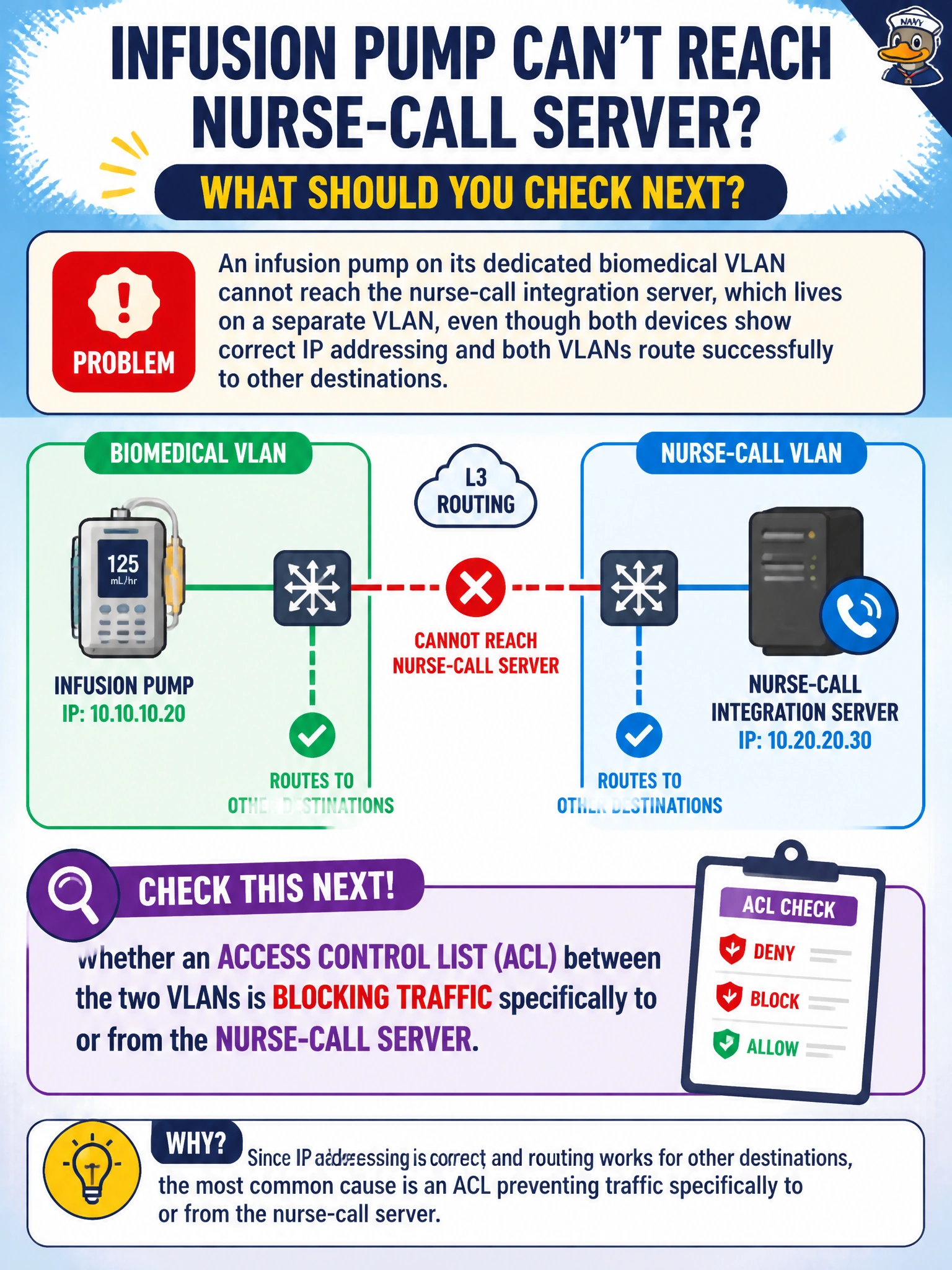
An infusion pump on its dedicated biomedical VLAN cannot reach the nurse-call integration server, which lives on a separate VLAN, even though both devices show correct IP addressing and both VLANs route successfully to other destinations. What should be checked next?
Select an answer to reveal the explanation.
Short Explanation
Correct IP addressing on both ends and other traffic routing fine tells you Layer 3 basically works. What's left is something deliberately standing between these two specific devices, and on a segmented biomedical network, that's usually a security ACL doing exactly its job, just a little too strictly.
Full Explanation
Confirmed correct IP addressing on both devices, along with successful routing to other destinations from each VLAN, rules out addressing and general routing problems, narrowing the issue to something specific to communication between these two particular endpoints rather than a broad network fault. Biomedical device VLANs are commonly segmented deliberately, with access control lists permitting only the specific, necessary traffic (such as to the nurse-call integration server) and denying everything else as a security best practice; if that ACL is missing an entry for this specific pump-to-server path, or was written too restrictively, the result is exactly this symptom — general connectivity works, but this one required path does not. This differs from a DHCP lease-time issue, which has no bearing on inter-VLAN traffic filtering once an address is already assigned, from AP oversubscription, which would cause general wireless performance problems rather than a specific blocked path between two known devices, and from an access-versus-trunk port misconfiguration, which would typically break the pump's connectivity broadly rather than allowing it to route everywhere except this one destination. The operational check is to review the ACL applied at the Layer 3 boundary between the biomedical and nurse-call VLANs for entries covering the specific IP addresses and ports these two systems use, and to test connectivity to the exact required port rather than just a ping. A caveat is that in segmented biomedical environments, this kind of default-deny behavior is often intentional, so the fix is adding a narrowly scoped permit rule rather than loosening the ACL broadly.