
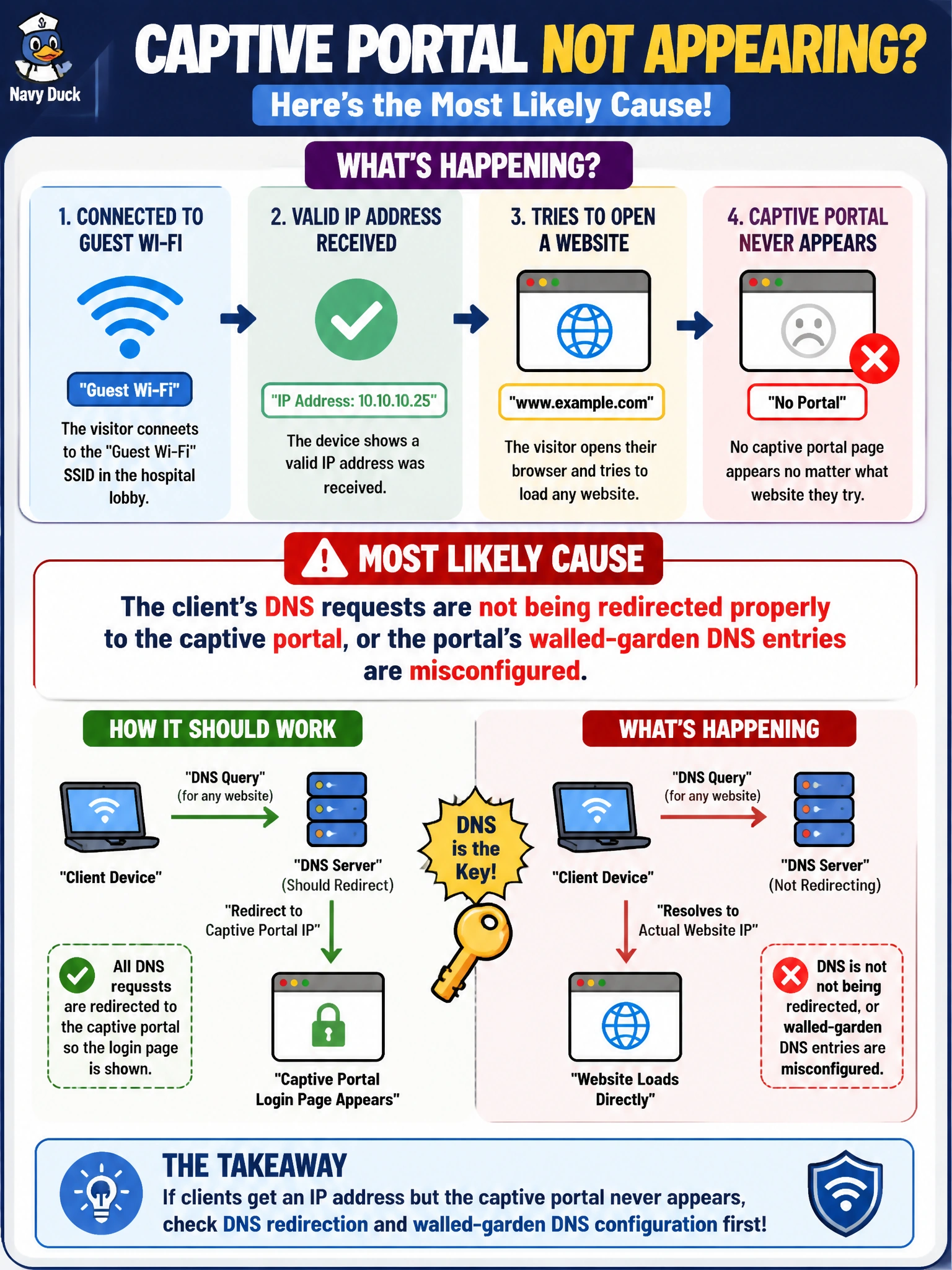
Visitors in the hospital lobby can associate to the guest Wi-Fi SSID and their devices show they received a valid IP address, but the captive portal page never appears in their browser no matter what website they try to load. What is the most likely cause?
Select an answer to reveal the explanation.
Short Explanation
A captive portal works by hijacking the very first DNS lookup a browser makes and pointing it at the portal page instead. If that redirect isn't happening, the browser just quietly fails to find whatever site it originally asked for, and the portal never gets a chance to show up. The client already has an IP; this is strictly a redirect problem.
Full Explanation
A valid IP address confirms DHCP, basic Layer 2 association, and Layer 3 addressing on the guest VLAN are all working correctly, which rules out channel overlap (that would show up as poor signal or failed association, not a fully connected client) and DHCP lease timing (irrelevant once an address has already been successfully issued) as the cause. Captive portals typically work by intercepting a client's first unencrypted DNS or HTTP request and redirecting it to the portal's login page; if the DNS redirection isn't functioning correctly — whether due to a misconfigured redirect rule, a walled-garden exception list that's blocking the portal's own domain, or a client using a DNS-over-HTTPS setting that bypasses the network's DNS entirely — the browser's request simply fails or times out instead of being redirected, and the portal never renders. A wrong native VLAN on a trunk would generally produce a more fundamental connectivity break (wrong subnet or complete failure to communicate) rather than this specific pattern of full IP connectivity paired with a missing redirect. The operational check is to have an affected client attempt to resolve a domain name and observe whether the response comes back as expected for a redirect, and to review the captive portal's configuration for its walled-garden and redirect rules. A caveat is that increasingly, mobile browsers and OS-level DNS-over-HTTPS settings can defeat traditional portal redirection entirely, which is worth ruling out on the affected device specifically.