
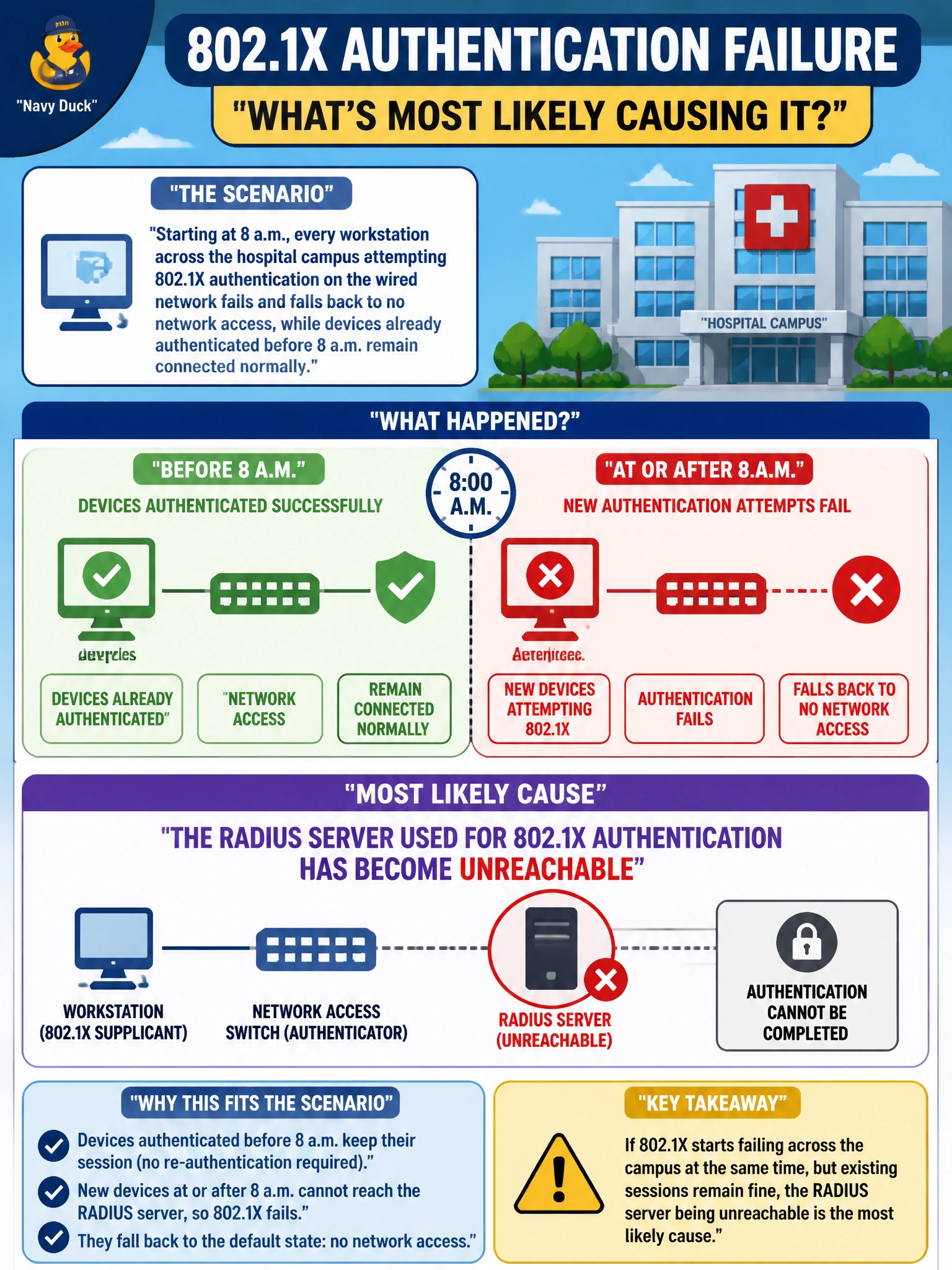
Starting at 8 a.m., every workstation across the hospital campus attempting 802.1X authentication on the wired network fails and falls back to no network access, while devices already authenticated before 8 a.m. remain connected normally. What is the most likely cause?
Select an answer to reveal the explanation.
Short Explanation
Already-connected devices don't need to knock on the RADIUS server's door again; they're already inside. New devices trying to authenticate do need that door to open, and if nobody's answering, they just sit outside. That split between old sessions working and new ones failing points straight at RADIUS.
Full Explanation
The defining clue here is the split between devices that authenticated before the failure window (still connected) and devices attempting to authenticate afresh (all failing) — a switch-level problem like a firmware issue, a spanning-tree recalculation, or a deleted VLAN would typically disrupt existing sessions too, since it affects the data path itself, not just the authentication handshake. 802.1X authentication requires the switch (acting as authenticator) to reach a RADIUS server (the authentication server) to validate credentials for every new session; a device that already completed that handshake and is sitting in an authorized state doesn't need to re-contact RADIUS to keep passing traffic, which is exactly why already-connected devices are unaffected while every new authentication attempt across the whole campus fails at once. This scope — campus-wide, uniform, and starting at a specific point in time — is consistent with a single shared dependency going down, and RADIUS reachability is the shared dependency every 802.1X-enabled switch relies on. The operational check is to verify connectivity from an access switch to the configured RADIUS server IP and confirm the RADIUS service itself is running and responding to test authentication requests. A caveat is that a switch typically has a configurable timeout and retry count before declaring the RADIUS server unreachable, so intermittent RADIUS latency (rather than a full outage) can produce the same symptom more sporadically instead of a hard, campus-wide cutover.