
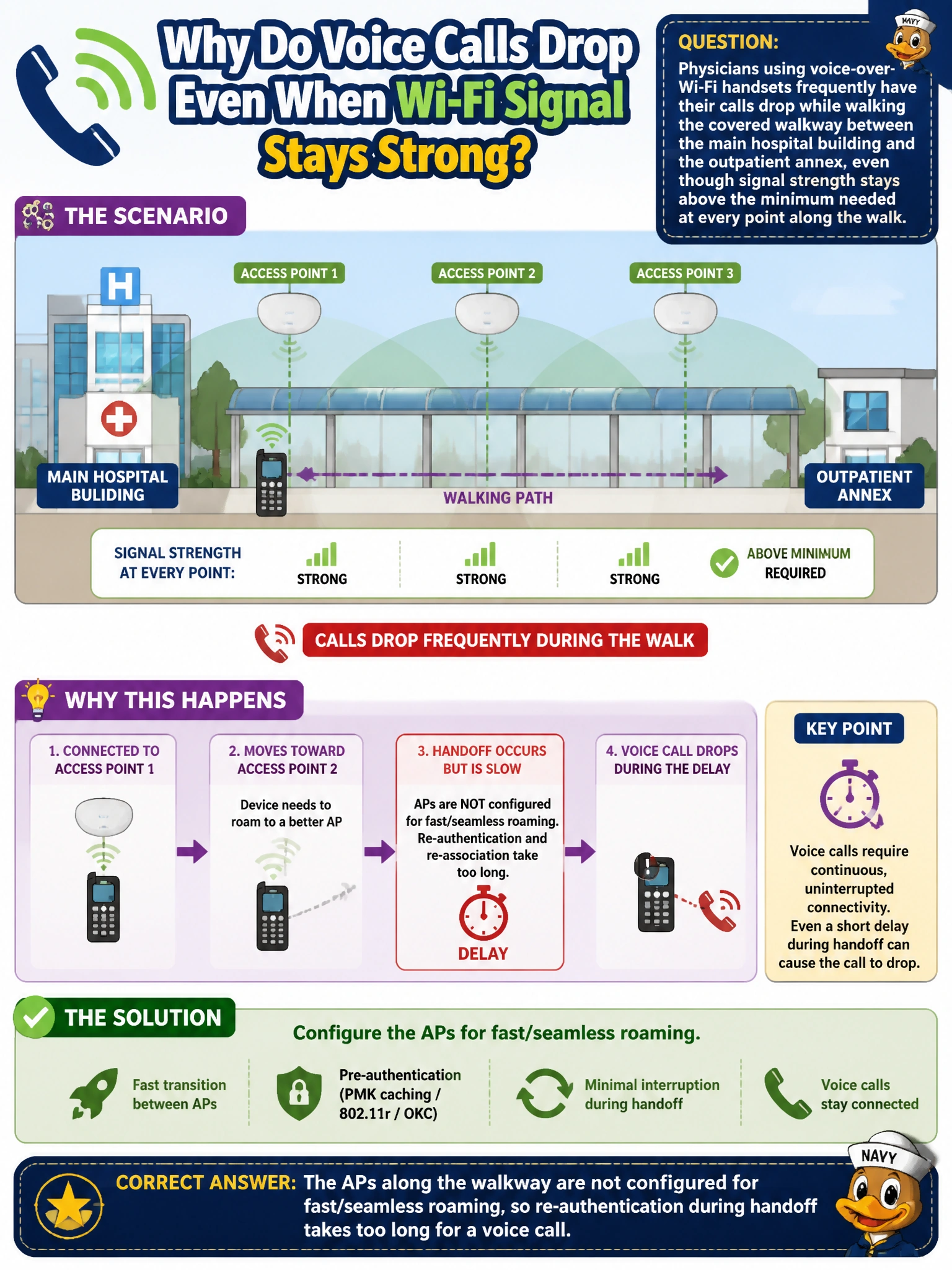
Physicians using voice-over-Wi-Fi handsets frequently have their calls drop while walking the covered walkway between the main hospital building and the outpatient annex, even though signal strength stays above the minimum needed at every point along the walk. What is the most likely cause?
Select an answer to reveal the explanation.
Short Explanation
A voice call can't survive a pause; even a second of silence during a handoff sounds like a dropped call to the person on the phone. If every AP handoff means starting authentication from scratch, that delay is exactly the kind of gap a call session can't tolerate. Fast roaming exists specifically to close that gap.
Full Explanation
Signal strength staying above minimum throughout the walk rules out a coverage problem, since the handset always has enough signal to associate somewhere along the path; the issue is what happens during the handoff between APs, not whether signal exists. Standard 802.1X re-authentication when roaming to a new AP involves a full exchange with the authentication server, which can take long enough that a real-time voice session times out or the audio gap becomes audible and the call drops, even though the underlying network connectivity is restored moments later. Fast or seamless roaming mechanisms are designed specifically to shortcut that full re-authentication (through cached keys or pre-authentication with neighboring APs) so the handoff completes quickly enough for time-sensitive traffic like voice to survive it; without that feature enabled along a corridor where handoffs are frequent, dropped calls during roaming are a predictable outcome. This is distinct from a DHCP lease-time issue (which wouldn't cause mid-call drops tied to physical movement) and from a RADIUS certificate expiration (which would generally cause authentication to fail outright and consistently, not intermittently during roaming while signal is otherwise fine); a duplicate SSID elsewhere wouldn't specifically explain drops localized to this one walkway. The check is to review the roaming/fast-transition settings on the SSID profile serving the walkway APs and confirm it matches what the voice handsets support, then test a call while walking the same path with a wireless analyzer capturing the handoff timing.