
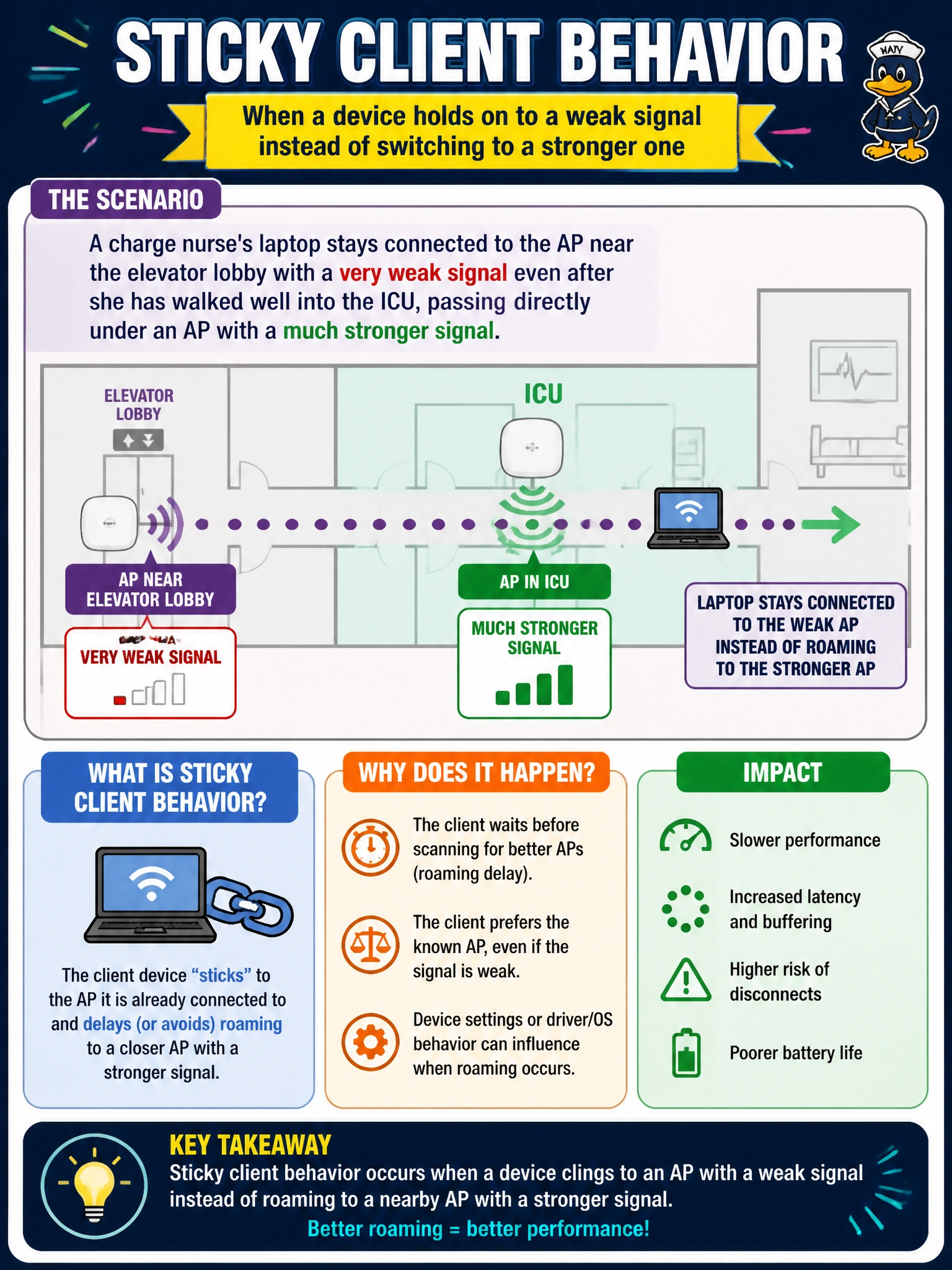
A charge nurse's laptop stays connected to the AP near the elevator lobby with a very weak signal even after she has walked well into the ICU, passing directly under an AP with a much stronger signal. What wireless behavior does this describe?
Select an answer to reveal the explanation.
Short Explanation
Some clients are just loyal to a fault, hanging onto the first AP they joined long after a much better option is sitting right overhead. That's sticky client behavior, and it's a client-side roaming decision, not a network fault. The network offered a better AP the whole time; the laptop just didn't take it.
Full Explanation
This symptom is specifically about a client's roaming decision, not about coverage or infrastructure health, since a strong signal is clearly available from the nearby ICU AP the whole time the laptop was connected to a weak, distant one. Sticky client behavior happens because many client radios use conservative or vendor-specific thresholds for deciding when to roam, and some will hold onto an existing association well past the point where a human (or a signal-strength graph) would expect it to switch, especially without a roaming-assist feature enabled on the infrastructure side. This differs from co-channel interference, which produces contention and slowness rather than a client remaining bound to a weak, distant AP, and it's unrelated to DHCP scope or RADIUS failover, since the laptop never disassociated or needed to re-authenticate on a new segment. The operational check is to look at the client's connection details (signal strength, associated AP/BSSID) over time as the user moves, confirming the client's reported signal degrades steadily without a roam event occurring even when a much stronger AP is nearby. Mitigations include enabling band steering or client-match/roaming-assist features on the WLAN infrastructure, which can proactively disassociate a client stuck on a poor AP so it's forced to reconnect to a better one, and tuning minimum-RSSI thresholds so weak clients are encouraged off an AP before this behavior becomes disruptive to time-sensitive traffic like voice calls.