
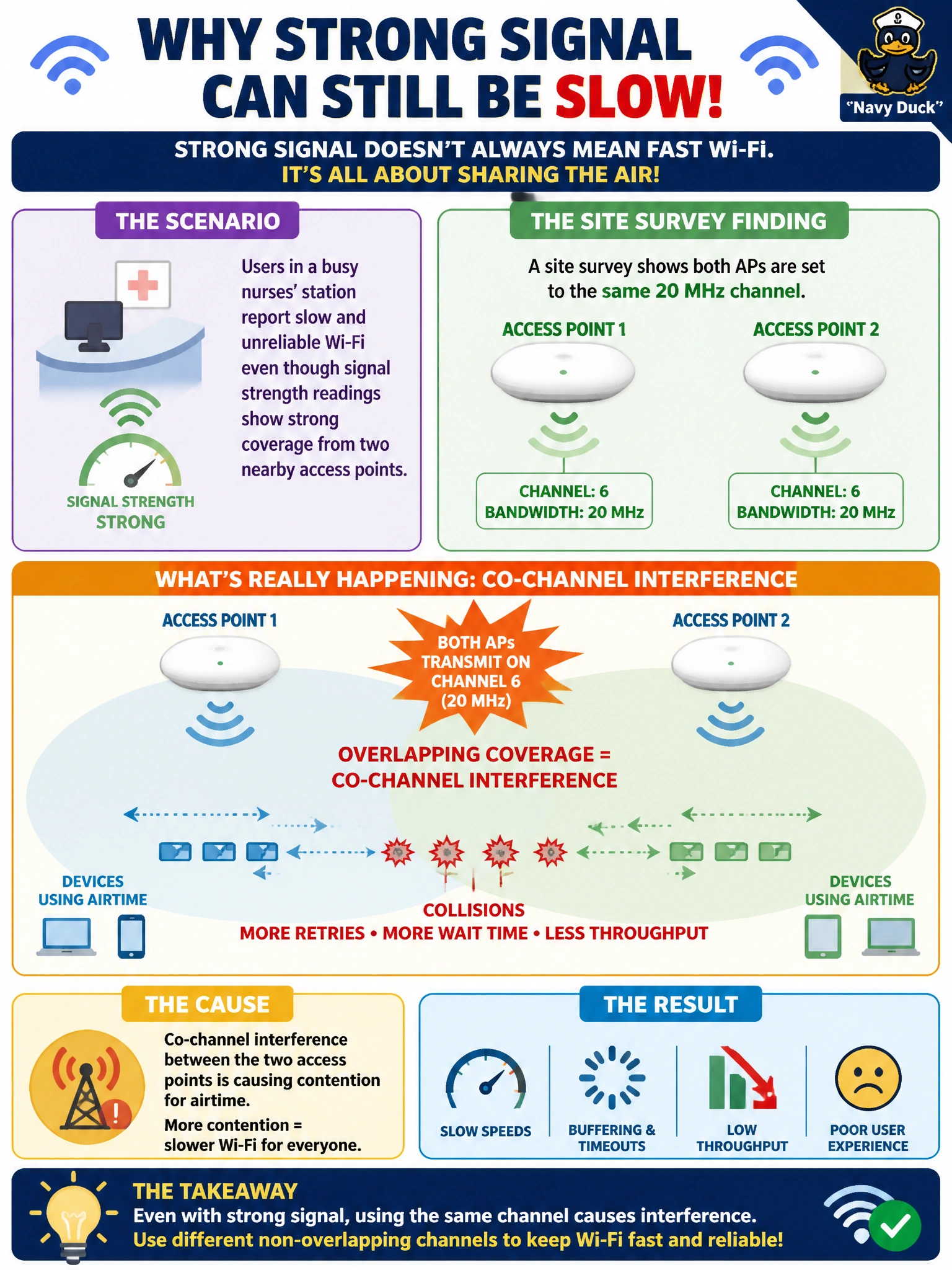
Users in a busy nurses' station report slow and unreliable Wi-Fi even though signal strength readings show strong coverage from two nearby access points. A site survey shows both APs are set to the same 20 MHz channel. What is the most likely cause of the slowness?
Select an answer to reveal the explanation.
Short Explanation
Two radios shouting on the exact same channel in the same space have to take turns, and Wi-Fi handles that by making everybody wait and retry. Strong signal doesn't mean a clear channel; it just means you can hear the noise really well. That constant waiting is what feels like slowness.
Full Explanation
Strong signal strength readings confirm that RF coverage in the area is not the problem, which narrows the issue away from a dead zone and toward something affecting how well clients can actually use the channel once they can hear it. When two access points serving overlapping coverage areas sit on the same channel, every radio within earshot — both APs and every associated client — must share that one channel using CSMA/CA, meaning only one device can transmit at a time and everyone else must wait, detect collisions, and retry; this contention shows up to users as sluggish, inconsistent throughput even though the signal meter looks great. This differs fundamentally from a DHCP lease-time issue, which affects address renewal timing, not real-time throughput, and from a firewall bandwidth rule, which would produce a hard, consistent cap rather than variable slowness tied to channel usage; mismatched SSIDs would simply prevent clients from choosing which AP to join, not cause contention once associated. The operational check is exactly what the site survey already showed — confirming channel assignments on nearby APs — and the fix is to reassign one of the two APs to a non-overlapping channel (or let automatic channel management pick one) so they no longer compete for the same airtime. A caveat: on the 2.4 GHz band only channels 1, 6, and 11 are truly non-overlapping, so a 'different channel' fix must still land on one of those to be effective.