
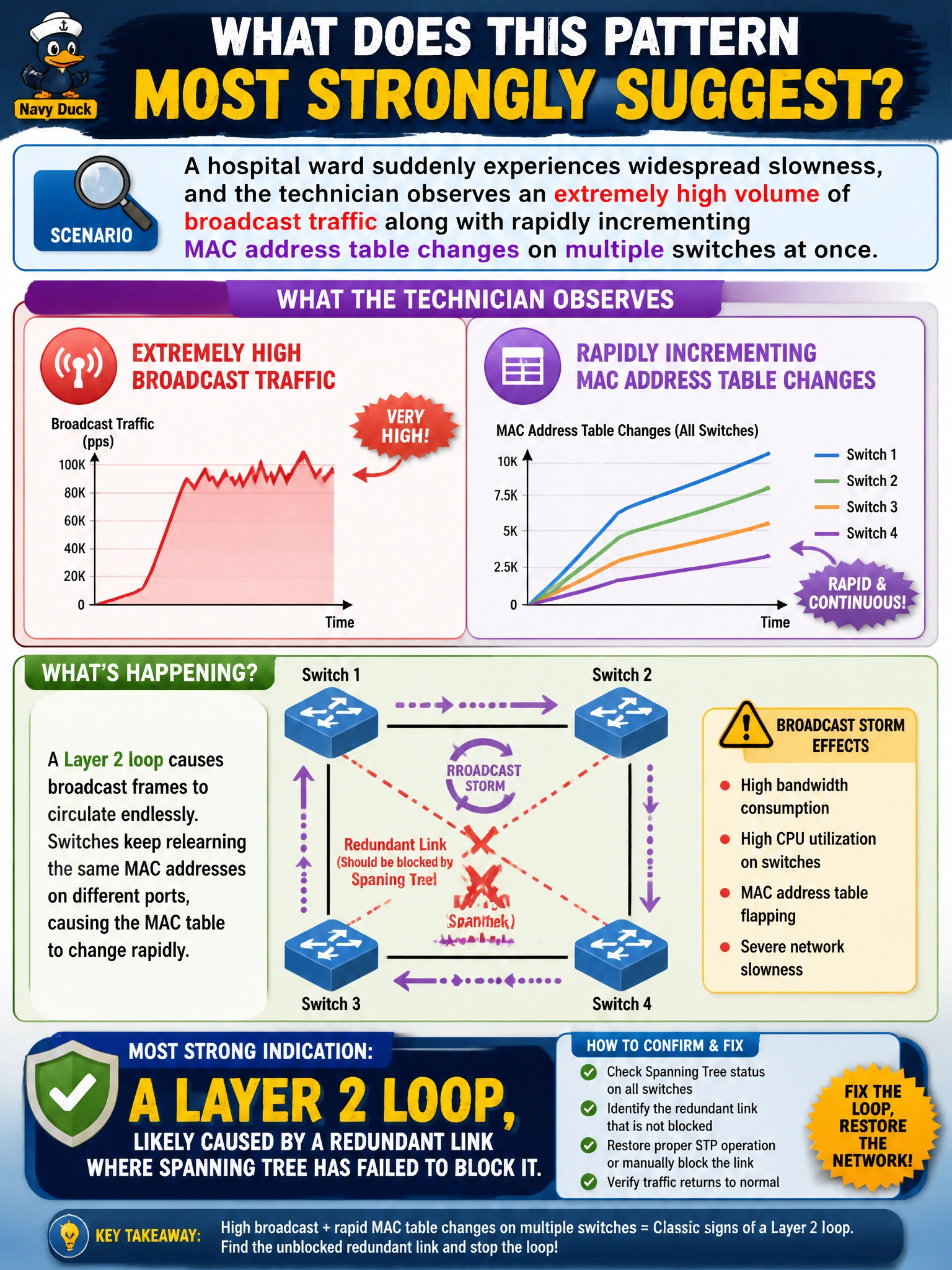
A hospital ward suddenly experiences widespread slowness, and the technician observes an extremely high volume of broadcast traffic along with rapidly incrementing MAC address table changes on multiple switches at once. What condition does this pattern most strongly suggest?
Select an answer to reveal the explanation.
Short Explanation
Broadcast traffic spiking everywhere and MAC tables churning nonstop across multiple switches at once is the classic fingerprint of a loop. Frames are circling the network endlessly, getting relearned and re-broadcast over and over, and everything nearby slows to a crawl. That's spanning tree not doing its job somewhere, letting a redundant path stay active instead of blocking it.
Full Explanation
A Layer 2 loop creates a path where frames, especially broadcasts, can circulate endlessly between switches instead of being delivered and discarded, which floods the network with duplicate broadcast traffic and causes MAC address tables to update rapidly and inconsistently as the same source address appears to arrive from multiple directions in quick succession. This combination, widespread slowness, broadcast storm-level traffic, and rapid MAC table churn across several switches simultaneously, is a strong, recognizable signature of a loop, typically because a redundant link that should have been blocked by spanning tree is instead actively forwarding. An overlapping RF channel affects wireless client performance and airtime contention, but it does not explain simultaneous MAC table instability across multiple wired switches, since RF interference has no direct mechanism to loop wired frames. An exhausted DHCP scope prevents new clients from obtaining addresses but does not generate a broadcast storm or MAC table churn on its own. An ACL blocking legitimate traffic would cause specific traffic to be dropped, producing connectivity failures rather than a flood of broadcast traffic and rapid MAC learning changes. A concrete check is reviewing spanning-tree status across the affected switches to identify a port that should be blocking but is instead forwarding, and removing that redundant path from active forwarding until the loop is corrected.