
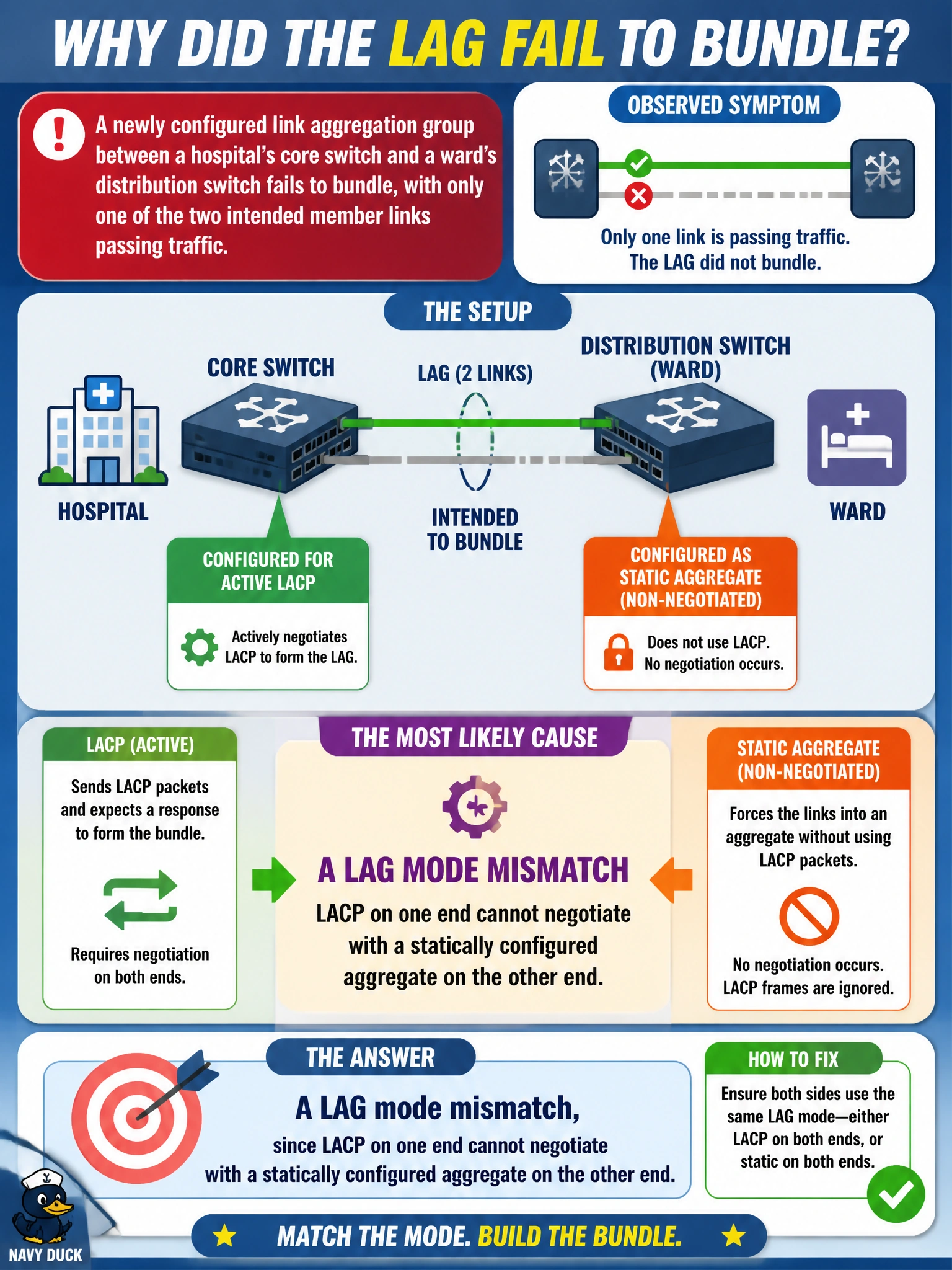
A newly configured link aggregation group between a hospital's core switch and a ward's distribution switch fails to bundle, with only one of the two intended member links passing traffic. The technician finds one switch configured for active LACP while the other switch has the matching ports configured as a static, non-negotiated aggregate. What is the most likely cause?
Select an answer to reveal the explanation.
Short Explanation
LACP is a conversation, both ends need to be speaking it to actually agree on a bundle. A static aggregate on one side just assumes the links are bundled without ever negotiating anything, so it can't hold up its end of that conversation with an LACP side. The mismatch is exactly why only one link is coming up instead of both.
Full Explanation
Link aggregation using LACP requires both ends to actively negotiate which physical links belong in the bundle through control frames exchanged between the two devices; a statically configured aggregate, by contrast, assumes the specified links are bundled without any such negotiation and does not send or expect LACP control frames at all. When one end runs active LACP and the other end is statically configured, the LACP side has no negotiating partner, so member links may fail to form a working bundle, individual links can behave inconsistently, or, as here, only a subset of links ends up actually passing traffic. The fix is aligning both ends to the same aggregation method, either both static or both LACP with compatible modes. A VLAN mismatch on a member interface would typically affect which traffic is permitted across that member, not whether the bundle itself negotiates and forms correctly. A PoE budget shortfall concerns power delivery to end devices and has no relationship to link aggregation negotiation between two switches. A duplicate IP address on the aggregate interface is a Layer 3 addressing conflict that would produce different symptoms, such as intermittent reachability or ARP issues, not a failure of the Layer 2 bundle to form. A concrete check is confirming the aggregation mode configured on each switch matches, and correcting whichever side is set incorrectly.