
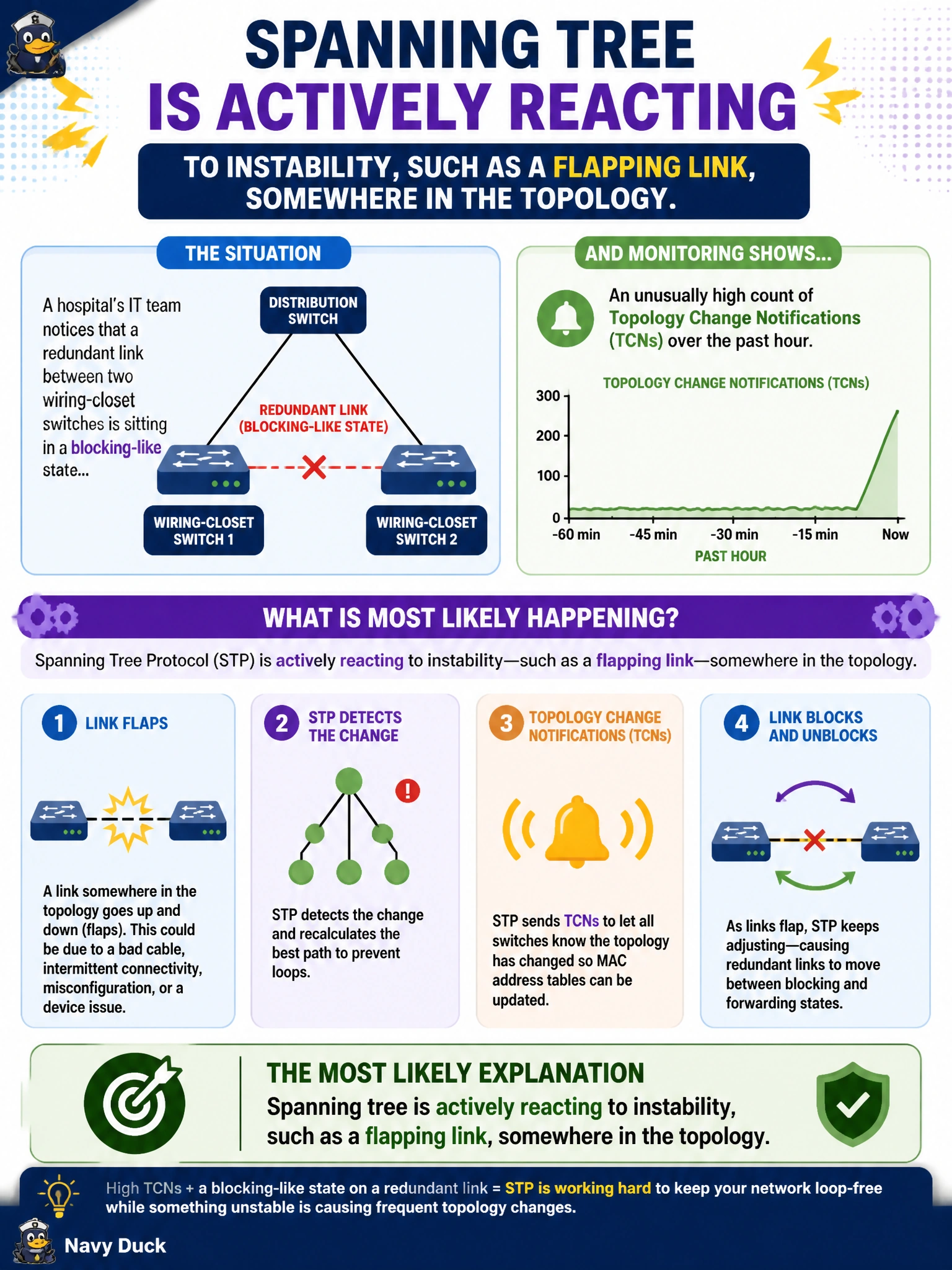
A hospital's IT team notices that a redundant link between two wiring-closet switches is sitting in a blocking-like state, and network monitoring shows an unusually high count of topology change notifications over the past hour. What is the most likely explanation?
Select an answer to reveal the explanation.
Short Explanation
One port sitting quietly in blocking is completely normal for a redundant link, that's spanning tree doing its job. But a flood of topology change notifications means something nearby keeps flapping and STP keeps reacting to it. The blocking state itself isn't the problem, the flapping upstream is.
Full Explanation
Spanning tree intentionally places a redundant link into a blocking-like state to prevent a Layer 2 loop, and that alone is expected, healthy behavior in a topology with intentional redundancy. A high rate of topology change notifications, however, indicates the spanning-tree topology is being recalculated repeatedly, which typically happens when a port somewhere in the network is flapping up and down, or when a device is repeatedly joining and leaving the topology, forcing spanning tree to keep reconverging. This distinguishes the healthy, static blocking state from the real symptom worth chasing: the flapping instability driving repeated recalculation, not the blocking state itself. A native VLAN mismatch does not cause a spanning-tree port to enter blocking state; blocking is a loop-prevention decision based on the spanning-tree algorithm's view of the topology, not VLAN tagging behavior. Exceeding a PoE budget affects power delivery to end devices, not a switch-to-switch redundant link's spanning-tree state, and it is unrelated to topology change notifications. A misconfigured DHCP relay agent affects address assignment, not Layer 2 loop prevention or topology recalculation. A concrete check is reviewing interface logs across the topology for a specific port repeatedly transitioning up and down and addressing that flapping link directly.