
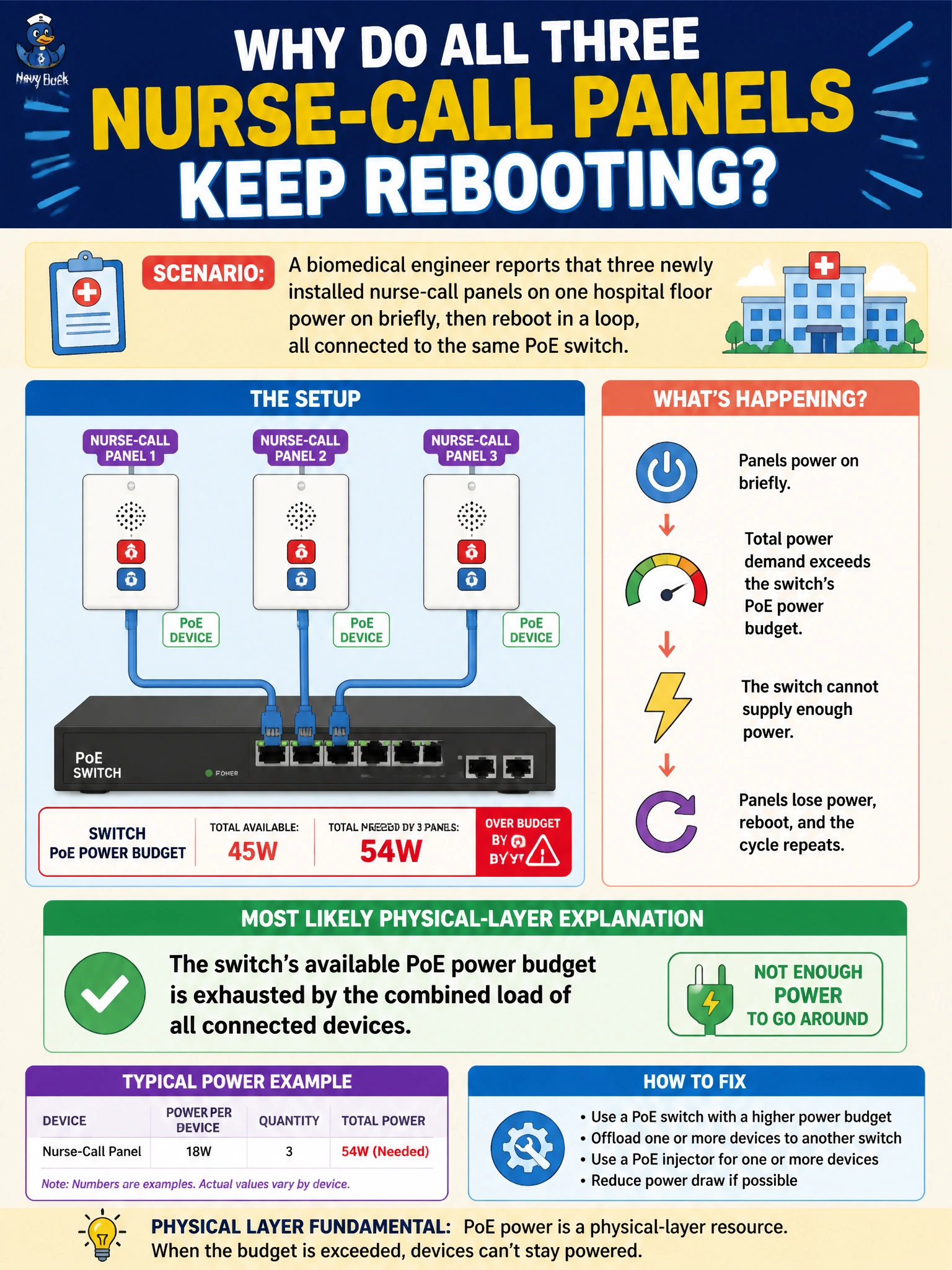
A biomedical engineer reports that three newly installed nurse-call panels on one hospital floor power on briefly, then reboot in a loop, all connected to the same PoE switch. What is the most likely physical-layer explanation?
Select an answer to reveal the explanation.
Short Explanation
Devices that power up and then die in a loop are a classic power story, not a logical one. When you add up everyone's demand on a shared PoE budget and it comes up short, the switch can't keep every device fed and something has to give. That's a physical-layer, power-delivery problem, not a VLAN or routing issue.
Full Explanation
PoE-powered endpoints depend on the switch having enough aggregate power budget to sustain every connected device simultaneously; when total demand approaches or exceeds that budget, a switch may cycle power to some ports to protect itself, which shows up exactly as devices briefly powering on and then rebooting. This is a physical-layer power-delivery symptom tied to how much wattage the switch can actually deliver across all its active ports, not a symptom of Layer 2 or Layer 3 configuration. A wrong VLAN would not cause a power-cycling behavior at all; a misassigned VLAN affects where traffic goes once a device is powered and linked, not whether it stays powered. Spanning-tree blocking a port changes forwarding state for traffic, but it does not remove electrical power from a PoE port, so it cannot explain a reboot loop. An incorrect default gateway would prevent the device from reaching networks beyond its own subnet, but it has no bearing on whether the device retains power at all. A concrete check is reviewing the switch's total PoE power budget against the sum of the power class or negotiated wattage for every connected device on that switch.