
After successfully upgrading firmware on a campus access switch, why does the technician leave the previous firmware image intact on the other boot partition instead of deleting it right away?
Select an answer to reveal the explanation.
Short Explanation
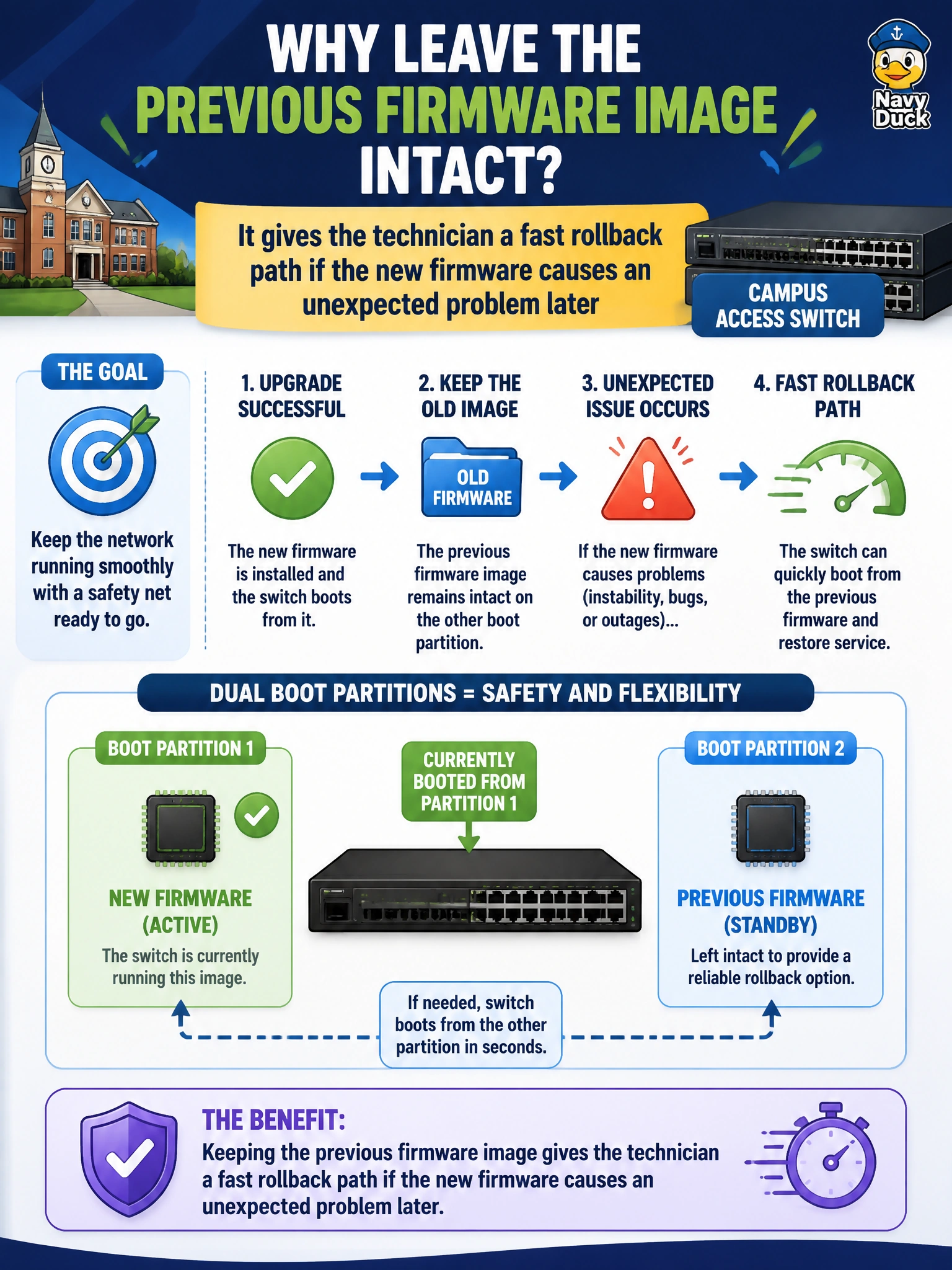
Keeping the old firmware around is like keeping the receipt after you buy something new — you hope you won't need it, but returning is painless if you do. If the new image causes a problem that only shows up after hours of real traffic, the technician can reboot back into the known-good version quickly. Deleting that safety net right away removes the fastest way back to a working state.
Full Explanation
AOS-CX switches store firmware on two partitions, and after an upgrade the previously-active image typically remains on the other partition until it is explicitly overwritten. Retaining it gives operations a rollback path: if the newly-activated firmware exhibits a problem that wasn't caught during initial validation — an interoperability issue that only surfaces under a specific traffic pattern, for instance — the technician can reboot into the untouched prior image rather than troubleshoot live or attempt an emergency re-download under pressure. Guest SSID broadcast is a wireless controller and AP function tied to WLAN configuration, not to which firmware partition a wired access switch happens to be booted from, so the two are unrelated. Firmware itself does not retroactively correct VLAN configuration errors; VLAN assignments are configuration data, separate from the firmware image, and a bad VLAN setup persists across firmware versions until someone fixes it directly. Port count is a hardware property of the switch model and is fixed regardless of which firmware image is active. A caveat: rollback is a short-term safety net, not a long-term state — once the new firmware is validated as stable, the older image should eventually be refreshed on a normal upgrade cadence rather than kept indefinitely. As an operational check, confirm the standby partition still shows the previous known-good version before starting a new upgrade cycle.