
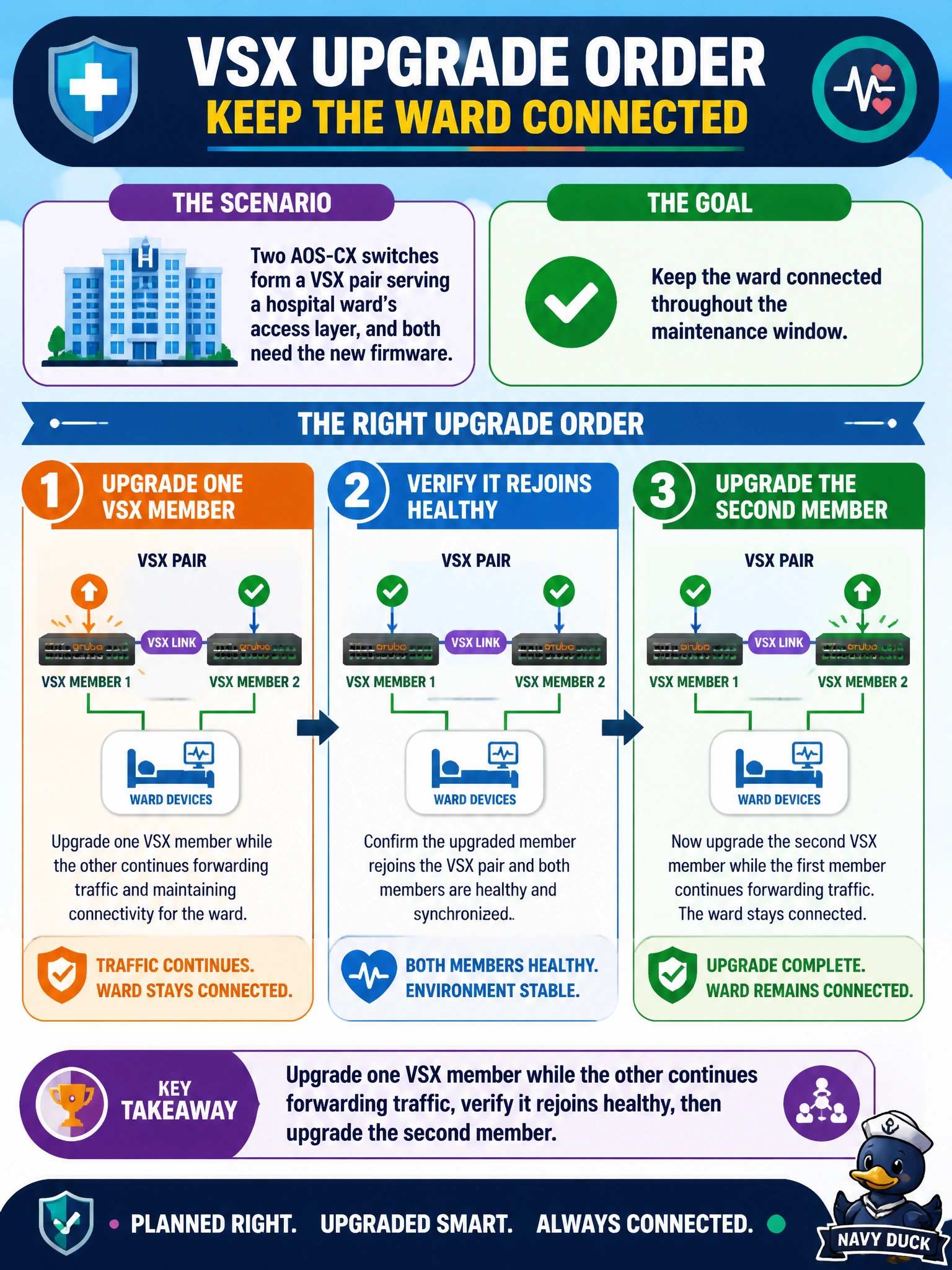
Two AOS-CX switches form a VSX pair serving a hospital ward's access layer, and both need the new firmware. What upgrade order keeps the ward connected throughout the maintenance window?
Select an answer to reveal the explanation.
Short Explanation
A VSX pair is built so one twin can always cover for the other, like two nurses on the same shift. Upgrading them one at a time means the partner that's still on the old image keeps carrying the ward's traffic while its sibling reboots. Once the upgraded switch rejoins and looks healthy, you flip to the other side and repeat, so the ward is never fully dark.
Full Explanation
VSX synchronizes state between two chassis so that either member can forward traffic for the pair's shared links; upgrading members sequentially exploits exactly that design, since the still-active member absorbs the traffic while its partner reloads into the new image. After the first member comes back up, the technician confirms it has rejoined the VSX pair in a healthy state — links up, synchronization restored — before touching the second member, so a problem with the new image is caught while the other switch is still available as a safety net. Powering off both switches together throws away the redundancy the pair exists to provide and takes the entire ward offline for the whole upgrade, which is the outcome a VSX design is meant to avoid. Choosing an upgrade order based on which switch is physically nearer has nothing to do with maintaining service and is not a real selection criterion. Waiting for a campus-wide outage window sacrifices the redundant pair's whole purpose and unnecessarily disrupts unrelated parts of the hospital for a change that a one-at-a-time approach doesn't require. A caveat worth remembering: some interoperability between mismatched firmware versions on the two members is only supported for a limited window, so the second member should be upgraded promptly rather than left mismatched. As an operational check, verify VSX synchronization status shows both members healthy before declaring the change complete.