
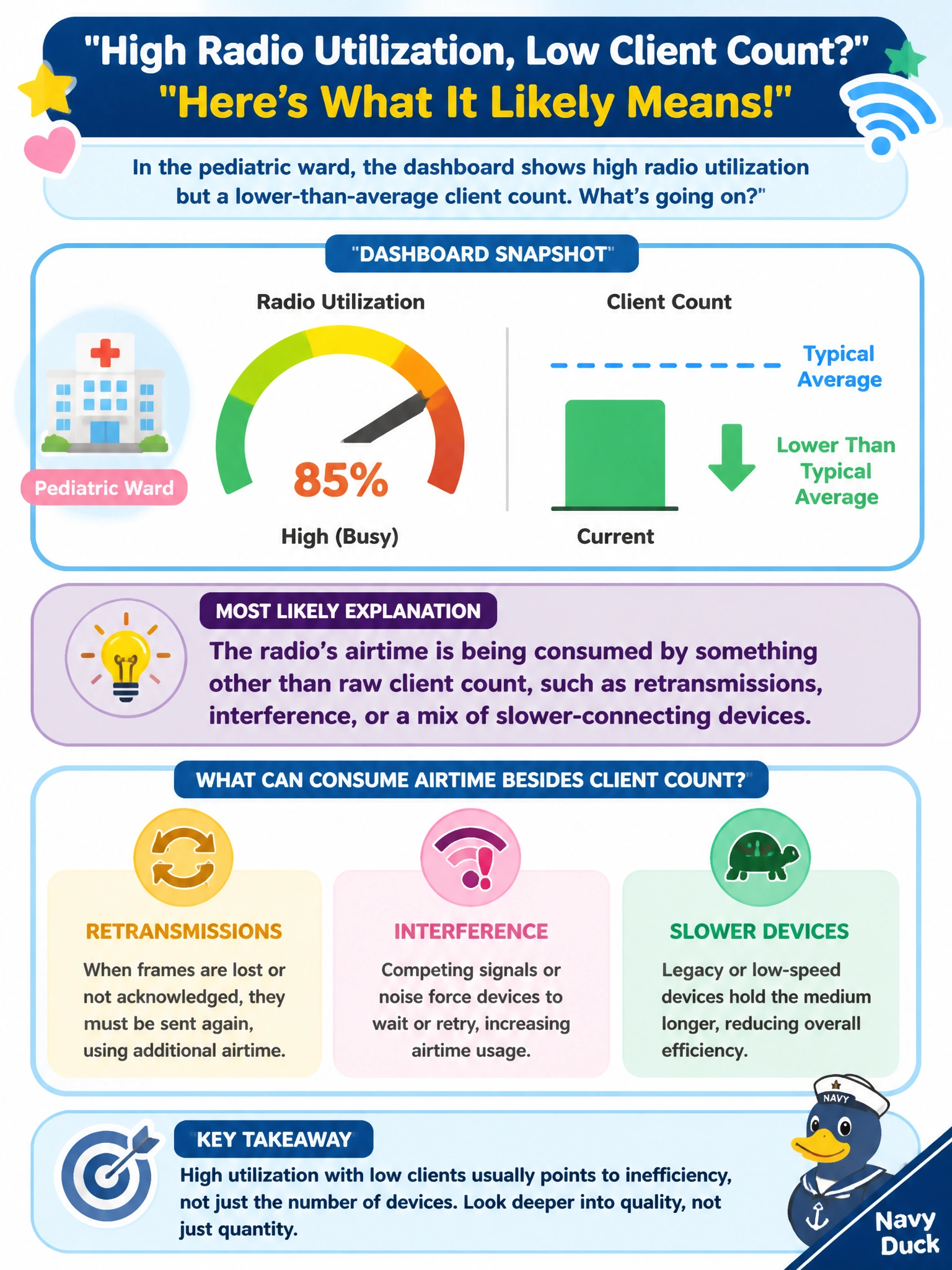
A dashboard widget for the pediatric ward shows an access point's radio utilization at 85 percent alongside a client count that is actually lower than the ward's typical average. What does this combination most likely indicate about what is being reported?
Select an answer to reveal the explanation.
Short Explanation
Airtime and headcount aren't the same measurement. Radio utilization tracks how busy the actual airwaves are, and a handful of slow, noisy, or retransmitting devices can hog that airtime just as much as a crowd of fast ones — like one loud talker filling a whole meeting even when the room isn't full.
Full Explanation
Radio utilization measures how much of the available airtime is actually being consumed, which is influenced by factors beyond raw client count, including retransmissions caused by interference, a mix of clients connecting at slower data rates that each take longer to send the same amount of data, or nearby RF noise forcing retries, so a high utilization figure alongside a below-average client count points toward one of those airtime-consuming factors rather than a simple headcount story. Declaring the dashboard miscalibrated assumes utilization and client count must move in lockstep, which is not how RF works; the same number of clients can consume very different amounts of airtime depending on their connection quality and speed. The access point clearly has not stopped serving clients, since the scenario explicitly states clients are still connected, just fewer than the ward's typical average, so a zero-service explanation does not fit the given facts. The claim that the report is only measuring wired switch ports mischaracterizes the metric entirely; radio utilization is by definition a wireless measurement of the radio interface itself, not a wired port statistic. The operational takeaway for reporting purposes is that utilization and client count are two distinct, complementary metrics, and a mismatch between them is itself informative rather than an error. A sensible next check is to look at the per-client data rates and retry counts on that radio, since slow or retrying clients are the most common cause of this exact pattern.