
A technician wants the monitoring platform to notify the on-call team immediately if a nurse-station switch stops responding, rather than waiting for someone to notice it missing from tomorrow's report. What monitoring concept is the technician relying on?
Select an answer to reveal the explanation.
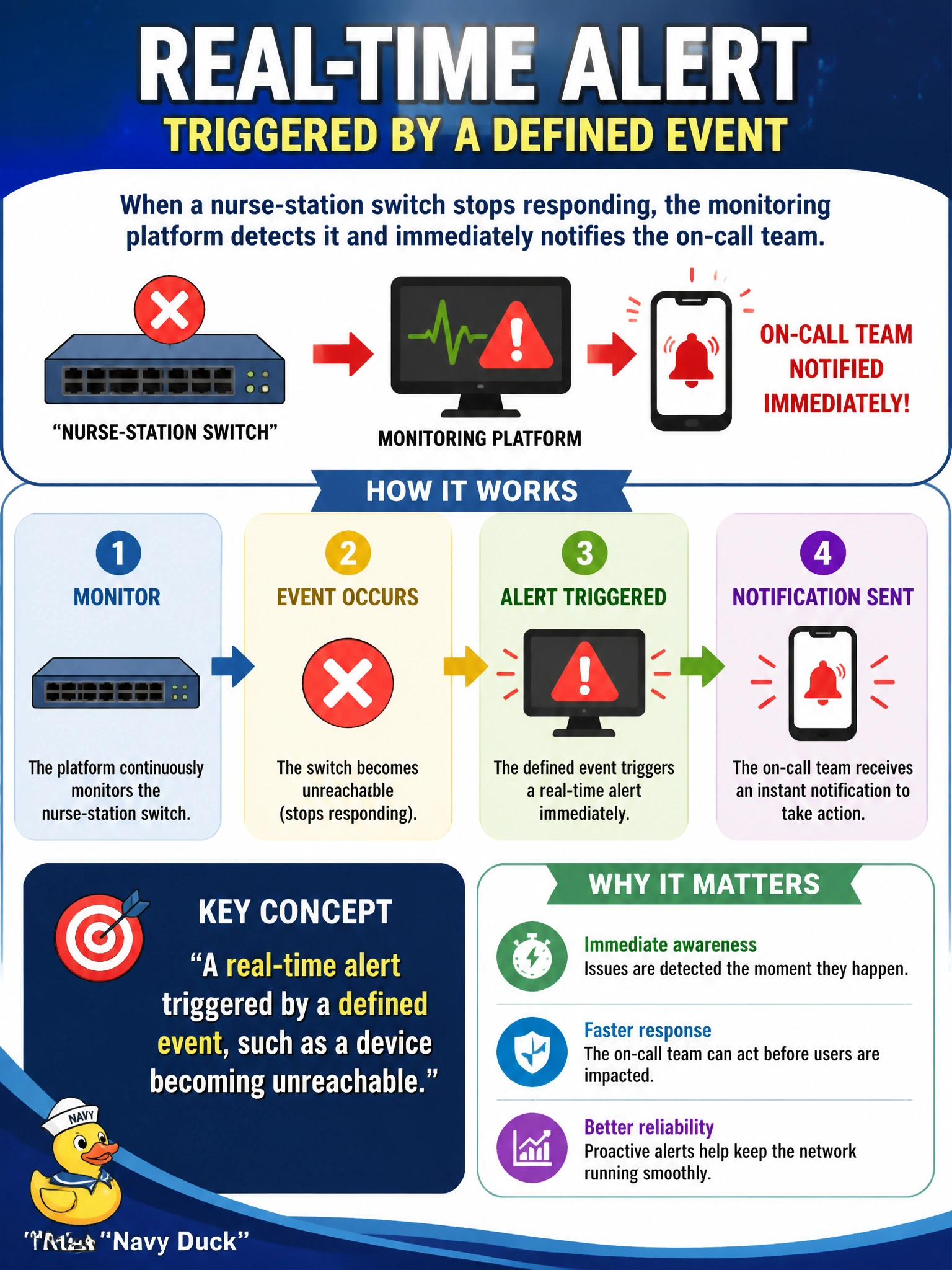
Short Explanation
Immediate notification is exactly what a real-time alert is for — it watches for a defined event, like a device going silent, and pushes word out the moment it happens, rather than waiting for someone to go looking. Think of it as the difference between a smoke detector and reading yesterday's fire report.
Full Explanation
Getting notified the moment a device stops responding, rather than discovering it later, is the defining purpose of a real-time alert: the monitoring platform watches for a specific triggering condition, such as a device failing to respond to polling, and pushes a notification out immediately when that condition is met, rather than waiting for a person to review anything. A scheduled weekly report is generated on a fixed cadence and only reflects conditions at generation time, so an outage that happened and even resolved between reports could be missed entirely, which is the opposite of the immediacy being asked for here. A historical log is valuable for looking backward at what already happened, but it is passive; nothing pushes information out of a log on its own; someone has to go search it, which reintroduces the delay the technician is trying to eliminate. A manual nightly SNMP query run by a person is still a periodic, delayed check, only as fast as the human running it, and it does not notify anyone the instant the switch actually goes down. The concept worth keeping distinct here is that alerts are push notifications tied to defined trigger conditions, while reports and logs are pull mechanisms someone has to go retrieve. A reasonable operational check when setting this up is confirming the alert has a defined escalation path, such as which on-call contact receives it, since a correctly triggered alert that nobody sees is functionally the same as no alert at all.