
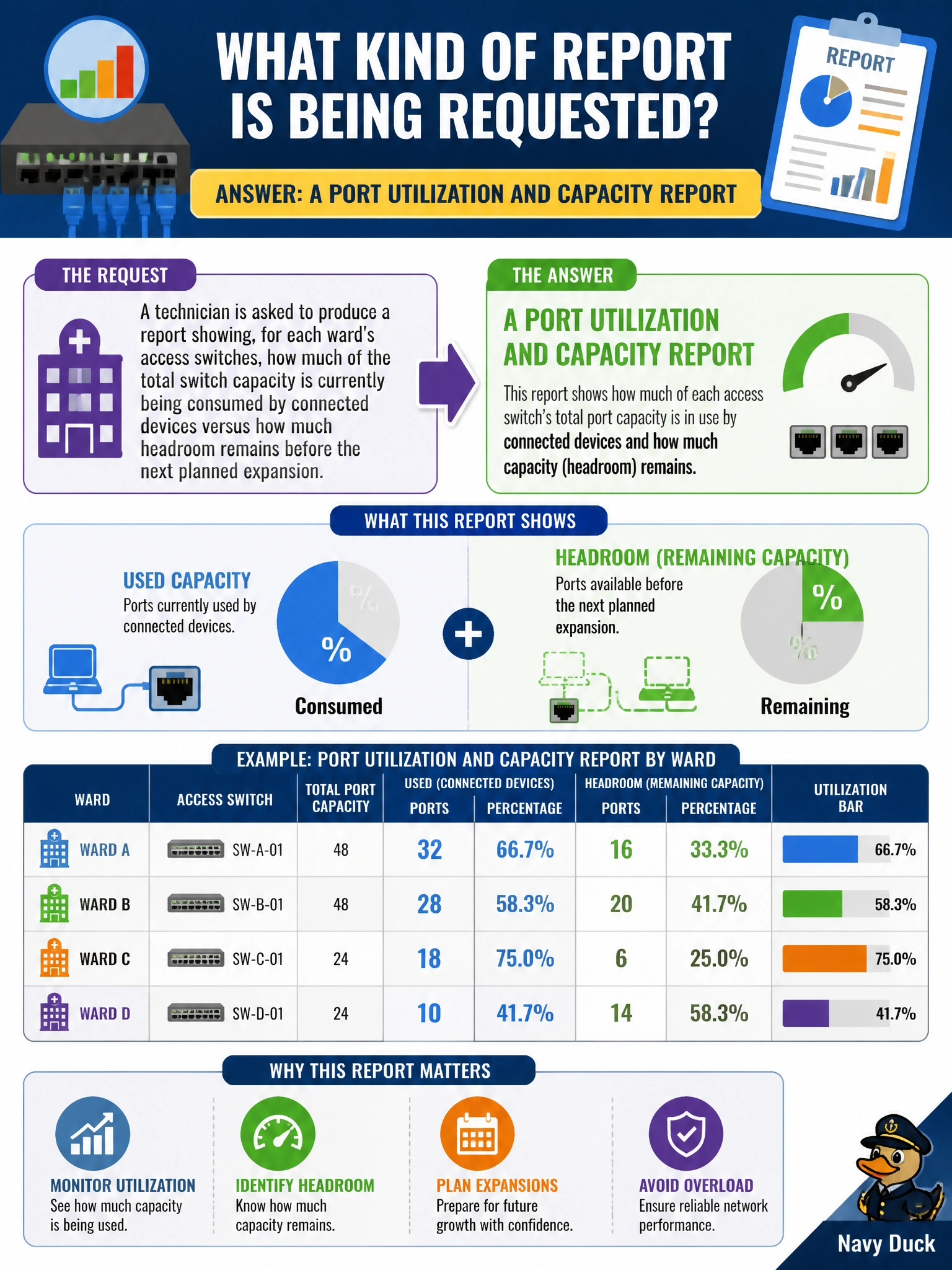
A technician is asked to produce a report showing, for each ward's access switches, how much of the total switch capacity is currently being consumed by connected devices versus how much headroom remains before the next planned expansion. What kind of report is being requested?
Select an answer to reveal the explanation.
Short Explanation
This request is about how full each switch is and how much room's left — that's a capacity question, not a security or software question. Think of it like checking how many parking spaces are taken versus open before deciding whether to build a new lot.
Full Explanation
A request framed around current consumption against remaining headroom on switch hardware, per ward, is describing a port utilization and capacity report, which tracks how many switch ports or how much bandwidth is already in use compared to total available capacity, precisely the input needed to plan an upcoming expansion. A vulnerability assessment evaluates security weaknesses in devices or configurations and has nothing to do with how much physical or logical capacity is consumed. A firmware release-notes summary describes what changed in a software version, an entirely unrelated axis of information from port or capacity counts. A wireless roaming behavior report tracks how clients move between access points, which concerns mobility patterns rather than switch port capacity, and this scenario is explicitly about wired switch infrastructure per ward. Recognizing the report category correctly matters because capacity planning decisions, like whether a ward needs additional switch ports before its expansion, depend specifically on utilization-versus-capacity data and would be poorly served by any of the other report types listed. A sound check to include is confirming the report accounts for both currently active ports and any reserved-but-unused ports set aside for the planned growth, since counting only active ports would understate true remaining headroom.