
A technician sets a custom alert threshold on the imaging suite's access points so that an alert fires only when client count exceeds double the normal daily peak. Why would a technician deliberately set the threshold that high rather than at the normal peak itself?
Select an answer to reveal the explanation.
Short Explanation
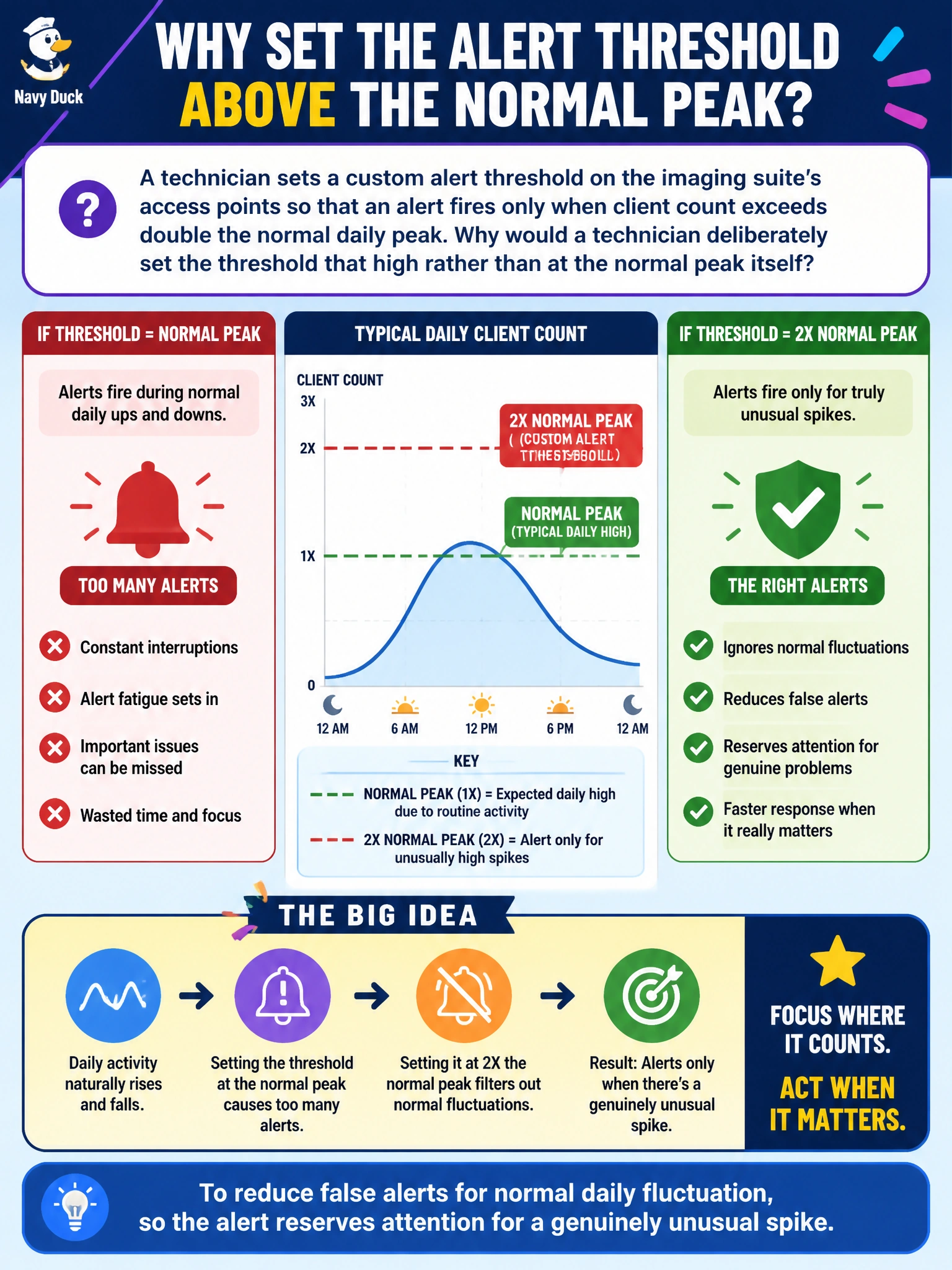
Setting the bar too low just means constant noise — an alert that fires every single day teaches everyone to ignore it. Setting it well above normal peak means when it does go off, it actually means something unusual is happening, worth a second look.
Full Explanation
A well-chosen alert threshold is set above the expected normal range specifically to filter out routine fluctuation and reserve the alert for a condition that genuinely deserves investigation, so setting it at double the normal daily peak means the alert only fires when something clearly out of the ordinary is happening, such as an unplanned crowd or a data source malfunctioning, rather than during an ordinary busy afternoon. There is no platform requirement mandating a specific multiplier like double the historical average; threshold values are a judgment call made by whoever configures monitoring, based on how much routine variation the environment normally shows. An alert threshold does not trigger any automatic hardware response like adding radios; alerting is a notification mechanism, and any capacity change resulting from an alert would be a separate manual or planned action taken afterward. A threshold also has no bearing on whether the access point accepts new client connections; that behavior depends on its actual client capacity and configuration, not on a monitoring alert setting. The broader principle here is that alert tuning is a balance between sensitivity and noise, and thresholds set too close to normal operating levels generate so many alerts that staff start ignoring them, which defeats the entire purpose of alerting. A sound practice when setting such a threshold is to review several weeks of historical peak data first, rather than guessing at a multiplier from a single day's reading.