
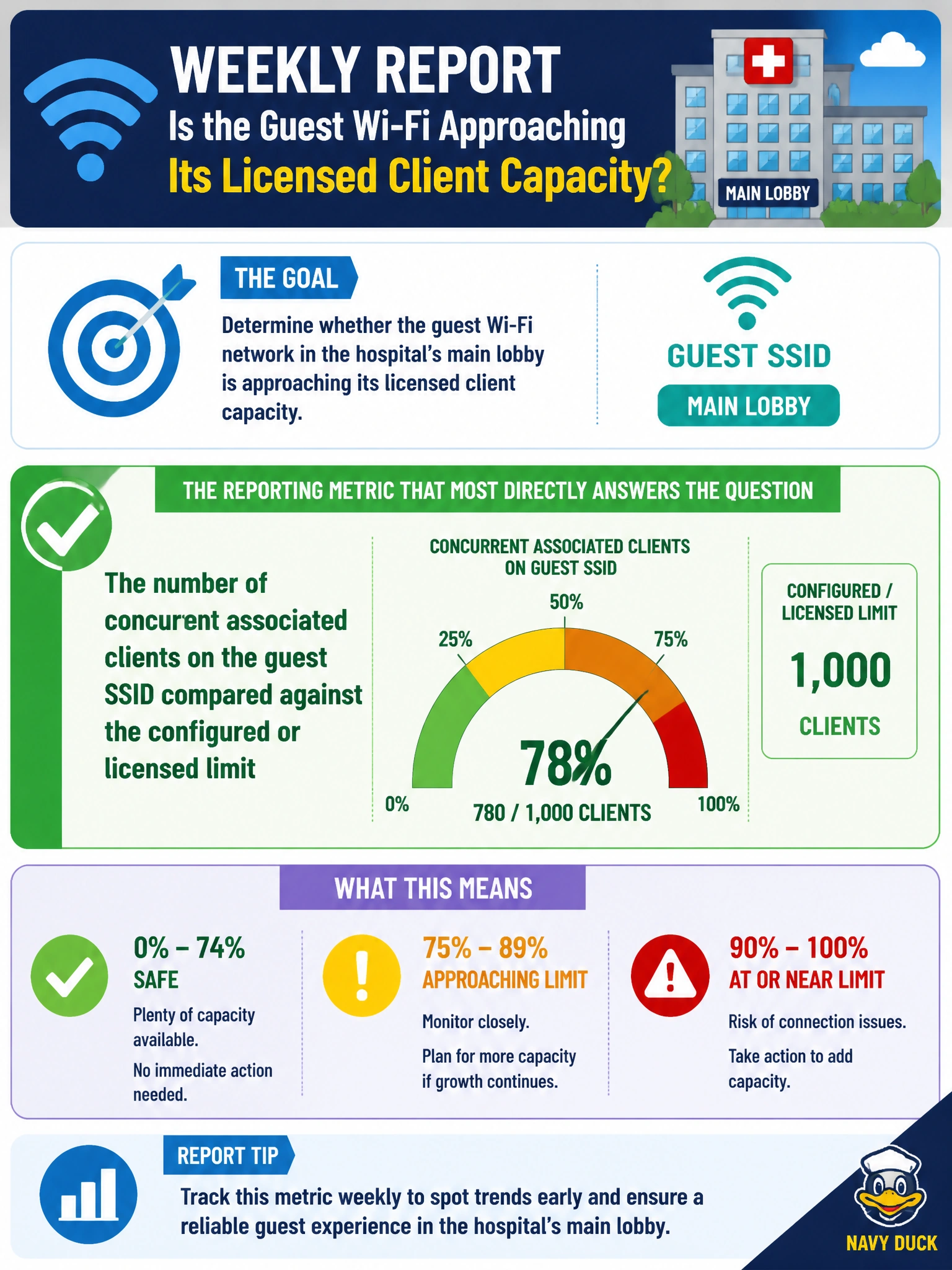
A weekly report needs to show whether the guest Wi-Fi network in the hospital's main lobby is approaching its licensed client capacity. Which reporting metric most directly answers that question?
Select an answer to reveal the explanation.
Short Explanation
Capacity is a headcount question, not a signal-quality question. You want to know how many guests are actually connected right now versus the ceiling you're allowed, the same way a parking garage sign tracks cars against total spaces, not how well-lit each spot is.
Full Explanation
Answering whether a network is approaching a capacity limit requires comparing a current count against a defined ceiling, so the metric that directly answers this is the number of concurrently associated clients on the guest SSID measured against its configured or licensed maximum, which is exactly the kind of trend a weekly report can chart to flag an approaching threshold. Average signal strength describes RF quality experienced by connected devices, which is a coverage or performance concern rather than a capacity concern; a lobby could have excellent signal strength while still being at or near its client limit, so the two metrics are unrelated. The number of SSIDs broadcast in the lobby describes network design, specifically how many separate wireless networks exist in that area, and has no bearing on how many devices are connected to any one of them. The access points' firmware version is an operational maintenance detail entirely separate from client counts and carries no capacity information at all. The distinction worth keeping straight for reporting is that each of these metrics answers a genuinely different operational question, so picking the wrong one produces a report that looks relevant but doesn't actually inform the decision being asked about. A reasonable check alongside this metric is to look at the trend over recent weeks, not just today's snapshot, since a single high count could be an outlier tied to a one-time event in the lobby.