
A technician configuring a switch to send SNMP data to the hospital's monitoring platform is asked, at a conceptual level, what SNMP actually does in this arrangement. Which description is accurate?
Select an answer to reveal the explanation.
Short Explanation
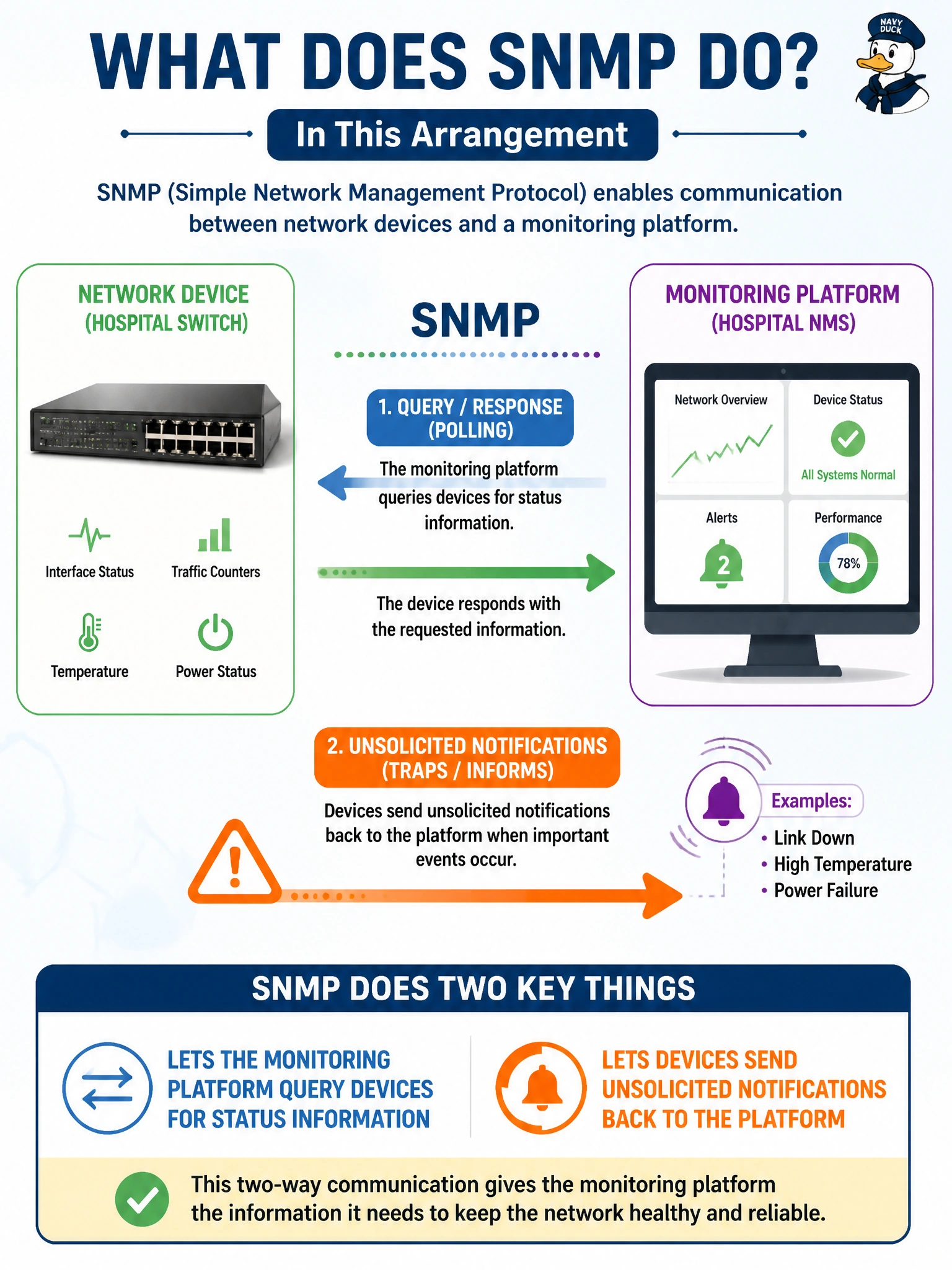
SNMP is basically a question-and-answer channel plus a doorbell. A monitoring platform can ask a device "what's your status?" and get an answer back, and the device can also ring the doorbell on its own when something notable happens. That two-way conceptual relationship is the whole idea.
Full Explanation
At a conceptual level, SNMP provides a management protocol with two directions of communication: a monitoring platform can poll a device for status values such as interface counters or CPU load, and a device can independently send an unsolicited notification, commonly called a trap, back to the platform when a defined condition occurs, which together is what makes SNMP-based monitoring useful for both scheduled reporting and near-real-time alerting. It has nothing to do with encrypting wireless traffic, which is the job of protocols like WPA2 or WPA3 operating between an access point and its clients at a completely different layer of the problem. It does not assign IP addresses either; that function belongs to DHCP, a separate service devices rely on when they first join a network. It also does not store a historical archive of every packet crossing a switch, which would describe full packet capture, an entirely different and far more resource-intensive tool than a lightweight status-polling protocol. Keeping these roles distinct matters for a NOC technician because mixing them up leads to reaching for the wrong tool when a report or an alert is needed. A practical check when setting this up is confirming the monitoring platform and the switch agree on the same SNMP version and community or credentials, since a mismatch produces silent polling failures rather than an obvious error.