
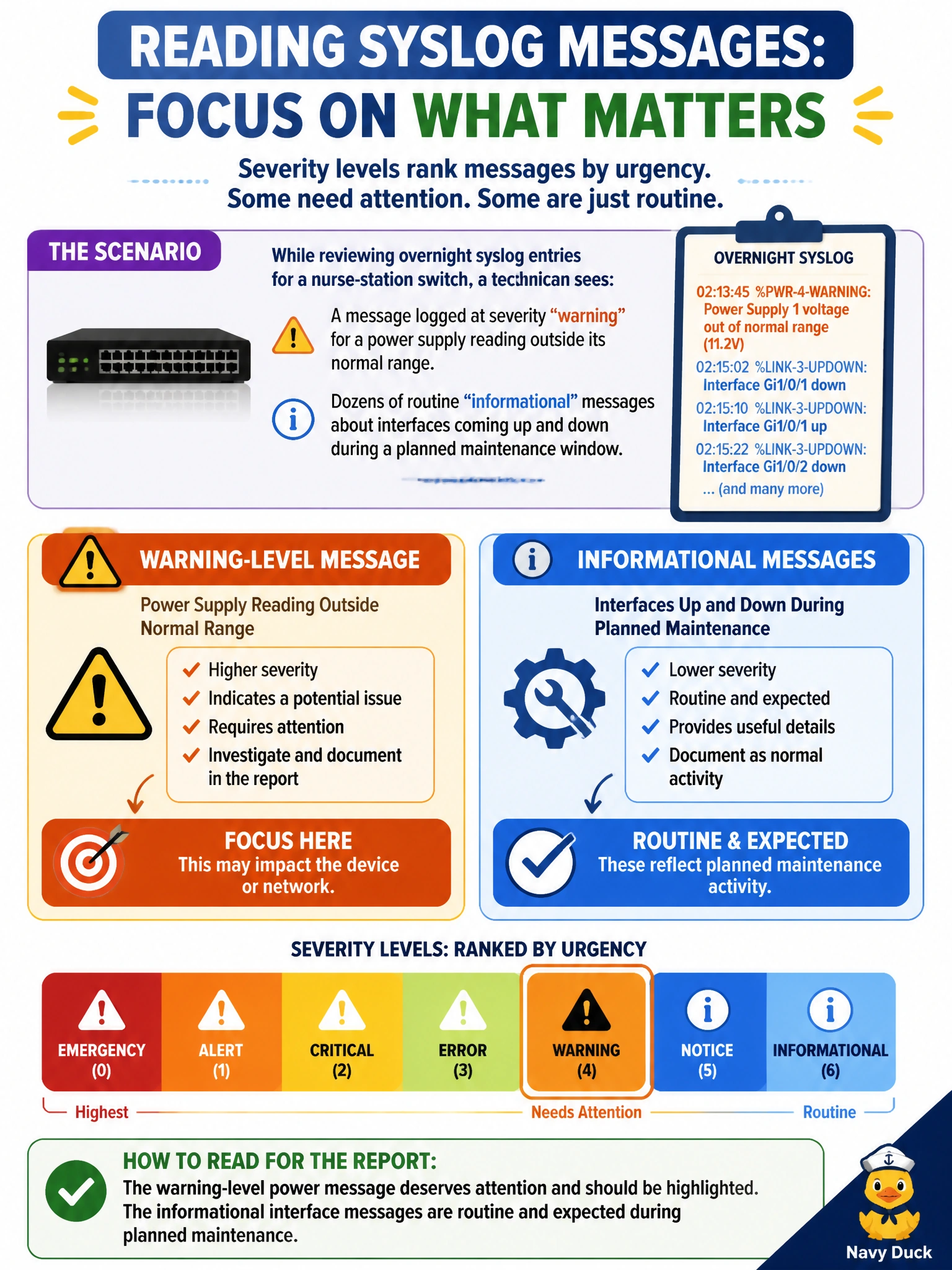
While reviewing overnight syslog entries for a nurse-station switch, a technician sees a message logged at severity "warning" for a power supply reading outside its normal range, alongside dozens of routine "informational" messages about interfaces coming up and down during a planned maintenance window. How should the technician read these two message types for the report?
Select an answer to reveal the explanation.
Short Explanation
Syslog severity is basically a triage tag, sorting messages from routine to urgent so you don't have to read every line the same way. A pile of "informational" messages during planned maintenance is just noise you expected to see. A "warning" about a power supply, though, is the line worth circling.
Full Explanation
Syslog severity levels exist specifically to let a reviewer triage volume, and a warning-level message ranks meaningfully above an informational one, so a power-supply reading outside normal range deserves attention in the report even if it is a single line buried among many others. The dozens of informational interface up/down messages during a known, planned maintenance window are exactly the expected byproduct of that maintenance and do not indicate a problem, so treating message count as a proxy for importance gets it backwards — volume is not urgency. Placing every message, regardless of severity, into an escalation section defeats the purpose of having severity levels at all and buries the one entry that actually needs eyes on it. The idea that syslog only records events already fixed is incorrect; syslog records events as they happen, regardless of whether anything has been remediated, which is precisely why the power-supply warning is worth flagging now rather than assuming it resolved itself. The concrete check for the report is to note the power-supply warning's exact timestamp and any repeat occurrences, since a warning that only appeared once versus one that keeps recurring changes how urgently it should be escalated.