
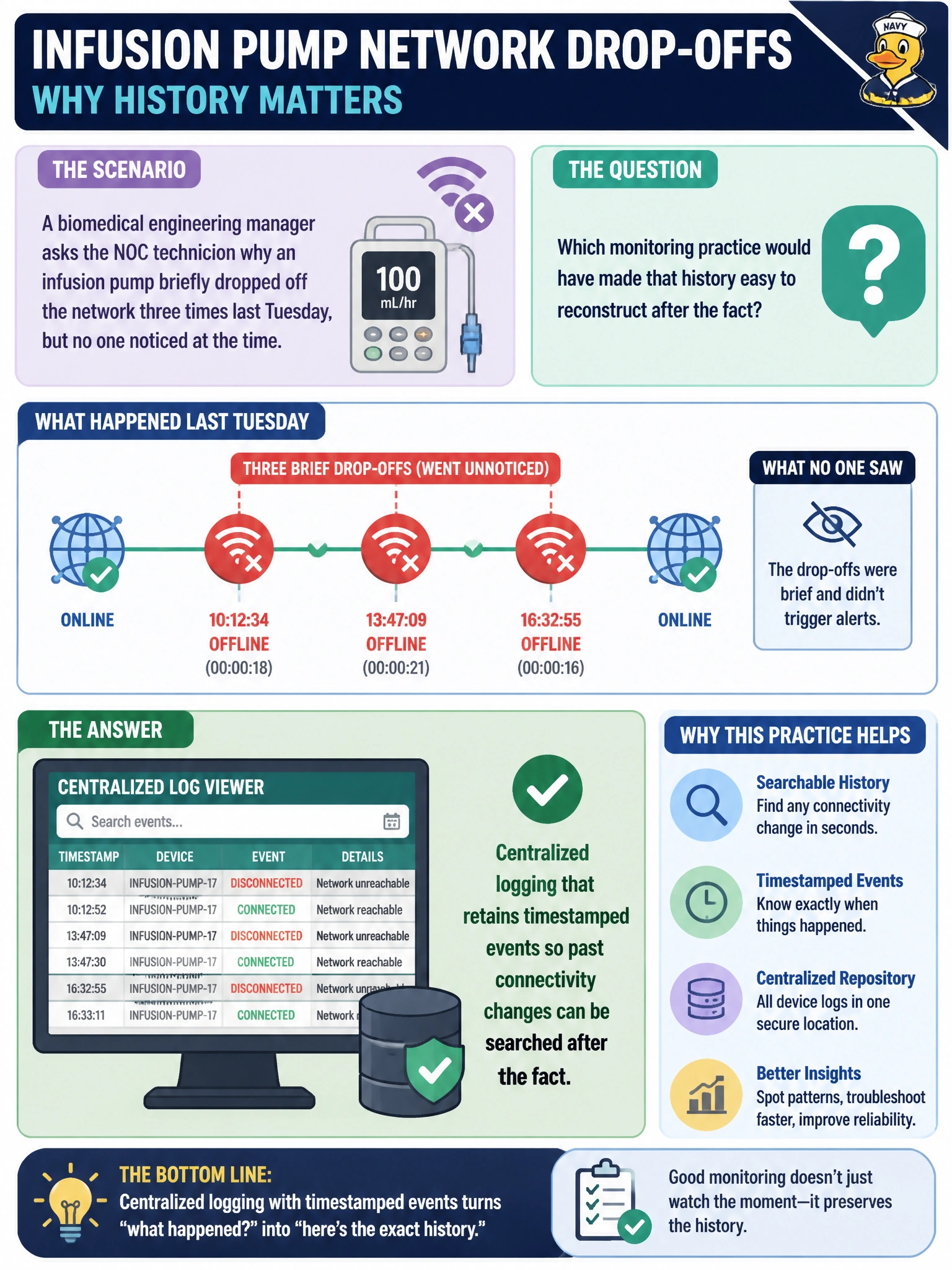
A biomedical engineering manager asks the NOC technician why an infusion pump briefly dropped off the network three times last Tuesday, but no one noticed at the time. Which monitoring practice would have made that history easy to reconstruct after the fact?
Select an answer to reveal the explanation.
Short Explanation
You can't reconstruct last Tuesday from what the network looks like today — that ship has sailed. Centralized, timestamped logging is what lets you rewind, kind of like reviewing camera footage instead of asking whoever happened to be walking by.
Full Explanation
Reconstructing what happened at specific past moments requires a record that was captured continuously and retained with timestamps, which is exactly what centralized logging provides: events like a client disassociating and reassociating get written with a time stamp the moment they happen, so a technician can search back to last Tuesday and find each of the three drops. Real-time dashboard tiles only reflect current state and are overwritten as conditions change, so they cannot answer a question about a past event unless that state happened to persist until now. Checking current signal strength describes the present moment only and says nothing about a transient drop that already resolved days earlier. Relying on staff memory is unreliable and imprecise for pinpointing exact times, especially for a brief drop that produced no visible symptom on a pump's normal operation. The caveat worth noting operationally is that log retention has a finite window, so this only works if the logging system was configured to keep events long enough to cover the requested period — worth checking before promising an answer.