
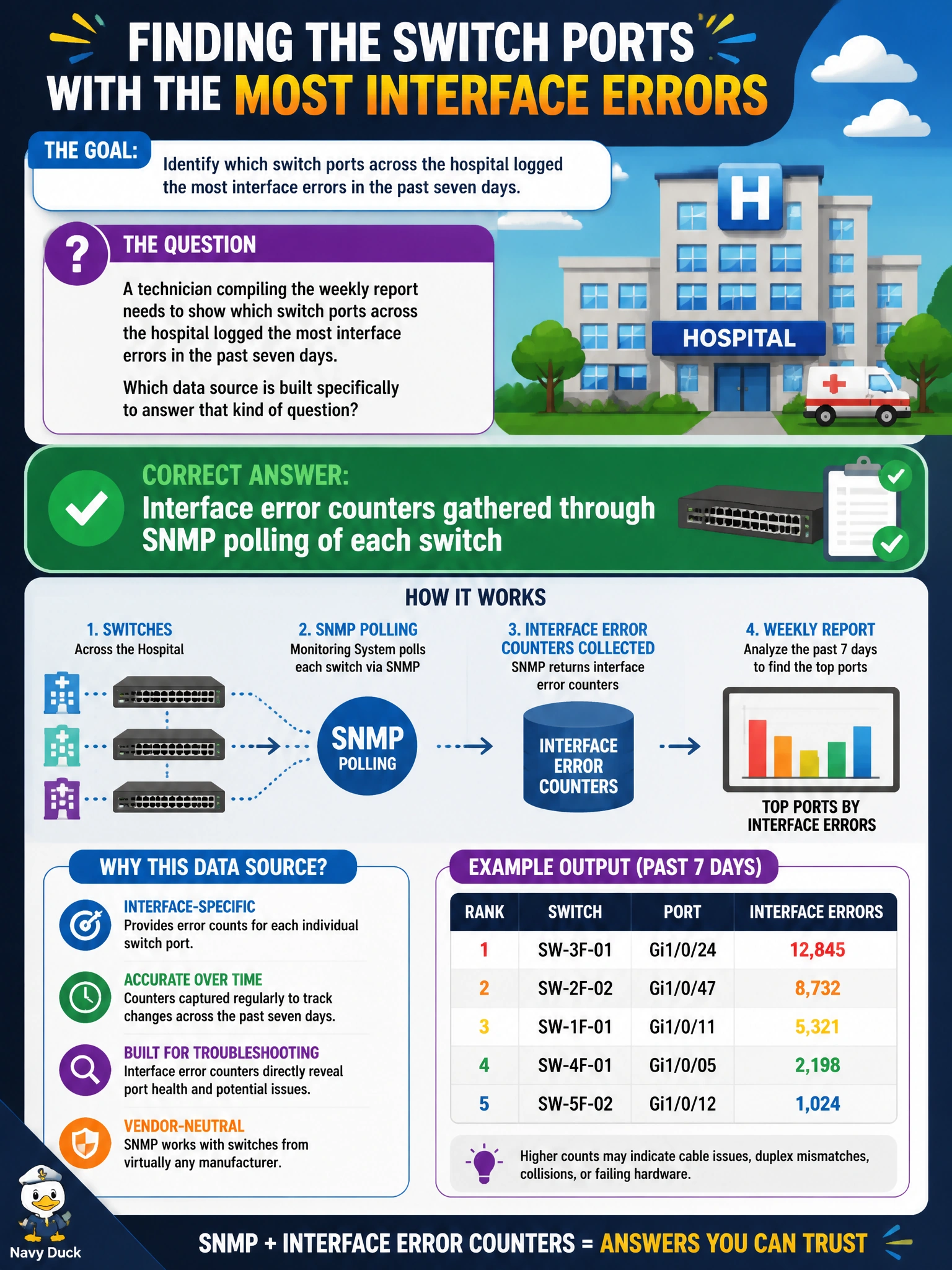
A technician compiling the weekly report needs to show which switch ports across the hospital logged the most interface errors in the past seven days. Which data source is built specifically to answer that kind of question?
Select an answer to reveal the explanation.
Short Explanation
Different tools answer different questions, and this one is asking about wired port errors over time. SNMP is built exactly for that: it quietly polls counters like CRC errors and collisions off every switch, the same way a utility meter quietly tracks usage without anyone flipping a switch to check it.
Full Explanation
Answering "which ports had the most errors this week" requires a time-series count of interface error counters, and SNMP polling is the standard mechanism for periodically pulling those counters — things like CRC errors, collisions, and discards — from every managed switch so they can be aggregated and ranked for a report. A DHCP lease log records which client got which IP address and when, which is useful for tracking address assignment but contains nothing about interface error rates on switch ports. A list of currently associated wireless client MAC addresses is a snapshot of who is connected right now, not a historical error count, and it describes wireless association rather than wired interface health at all. A configured SSID broadcast list is static configuration data describing what network names an access point advertises, which has no relationship to error counting on any interface. The distinction worth remembering for this domain is that SNMP's core value in a monitoring context is exactly this kind of periodic counter polling across a fleet of devices, which is why it underlies so many utilization and error reports. A reasonable operational check is to confirm SNMP polling is actually enabled and reachable on a given switch before trusting a zero-error result for it, since a switch that never answered polls looks identical to one with no errors.