
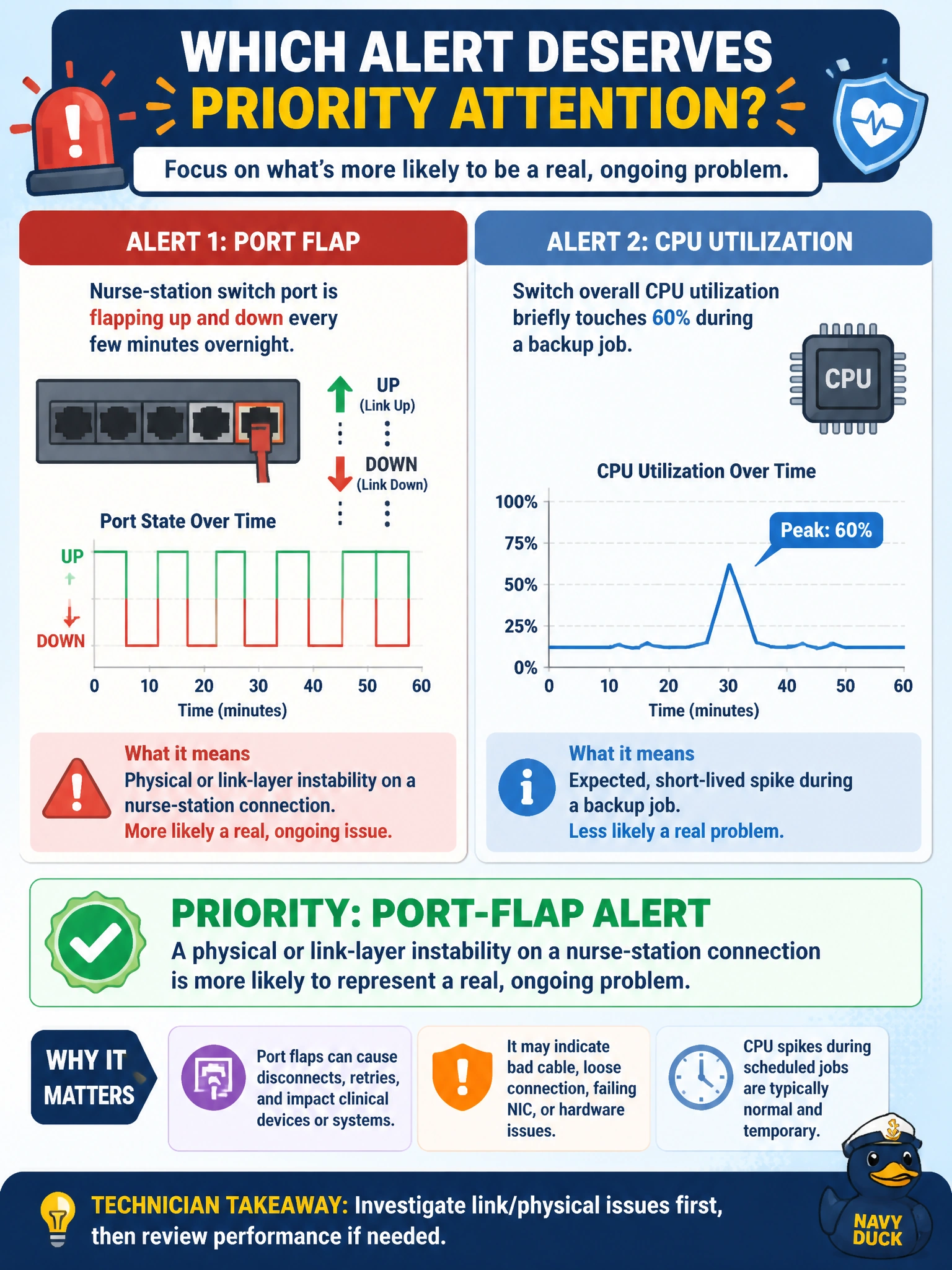
A nurse-station switch in the cardiology ward generates an alert overnight for a single port flapping up and down every few minutes, while a separate alert fires for the switch's overall CPU utilization briefly touching 60 percent during a backup job. Which alert deserves priority attention from the technician on the morning shift?
Select an answer to reveal the explanation.
Short Explanation
Not every alert deserves the same amount of worry. A brief CPU bump during a nightly backup is like your car's fan kicking on when it's hot outside — normal and expected. A port flapping every few minutes on a nurse-station line, though, is a repeating symptom that points to something actually wrong with the connection.
Full Explanation
Prioritizing alerts means judging which one describes a persistent, unresolved condition versus a transient, expected one, and a port that flaps every few minutes overnight is still flapping in the morning unless something changed, which makes it the higher-priority item to investigate on a connection serving clinical staff. A brief CPU spike that coincides with a known nightly backup job is a predictable, short-lived load event rather than a sign of ongoing trouble, so treating it as equally urgent wastes the limited time available on a morning shift. Dismissing both alerts because the CPU condition cleared ignores that the port-flap alert describes a recurring pattern, not a one-time blip, so "it cleared" does not apply to it the same way. Treating any CPU threshold breach as proof of imminent hardware failure overstates what a brief utilization spike means; sustained high CPU over time is a much stronger signal than one momentary crossing tied to a known scheduled task. Rating every overnight alert as equally urgent regardless of content defeats the purpose of having distinct alert types in the first place. The right operational check is to review the port's flap history and last-flap timestamp before the shift starts, since a still-flapping port needs attention now while a settled, explainable spike can be noted and closed.