
After onboarding a new ward's nurse-call system, which uses MAC authentication because it can't run a supplicant, the technician wants to confirm the deployment actually worked. What should be verified specifically for this device?
Select an answer to reveal the explanation.
Short Explanation
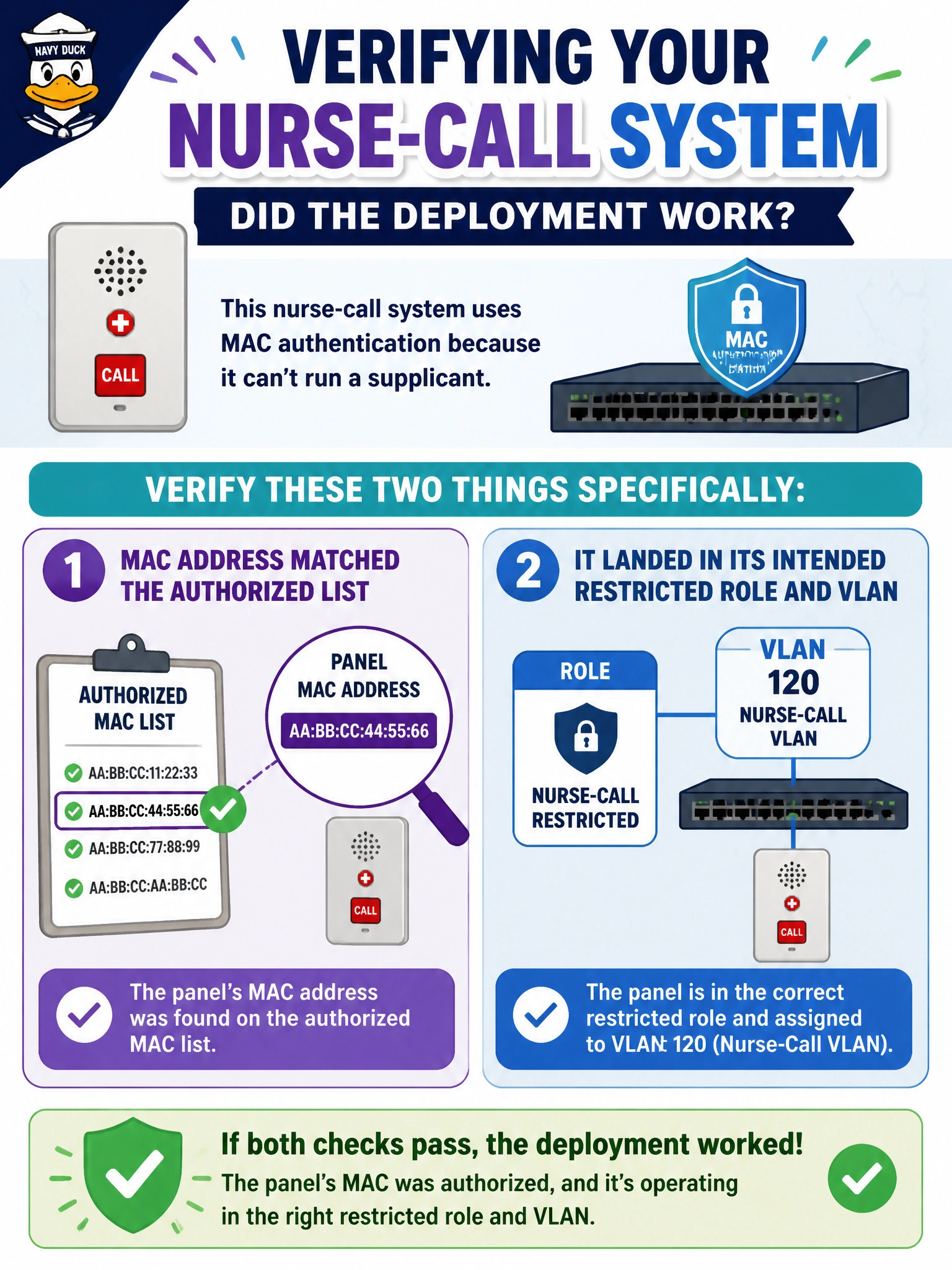
For a device that can't prove itself with credentials, the whole validation rests on one thing: did its hardware address get recognized, and did it land in the tightly scoped role it's supposed to have? That's the check that actually matters here.
Full Explanation
Because the nurse-call panel relies on MAC authentication rather than an identity-based exchange, validating its deployment means confirming the authentication path that's actually in use: that its MAC address matches the authorized entry, that it was accepted, and critically, that it landed in the specific restricted role and VLAN the design intended for this device type, not a broader or default role. Since MAC authentication offers no cryptographic identity proof, confirming the resulting role is tightly scoped is the practical way to keep the security tradeoff of MAC authentication in check. A firmware update completing successfully is a legitimate operate-phase task, but it's unrelated to whether the network authentication and role assignment for this device were configured and validated correctly. The panel's touchscreen brightness is a cosmetic device setting with no bearing on network authentication or segmentation at all. The panel displaying the correct time might reflect an NTP or clock-sync issue worth investigating separately, but it does not confirm anything about whether the device authenticated correctly or landed in its intended role and VLAN. The concrete validation step is checking the switch or controller's client table for this device's MAC address and confirming both its authentication method and assigned role match what the ward's design called for.