
Family members visiting a patient on the surgical ward connect to the hospital's guest Wi-Fi and are presented with a login page before they can browse the internet, but they should never be able to reach the clinical systems staff use on a different SSID. What ensures this separation for the guest connection?
Select an answer to reveal the explanation.
Short Explanation
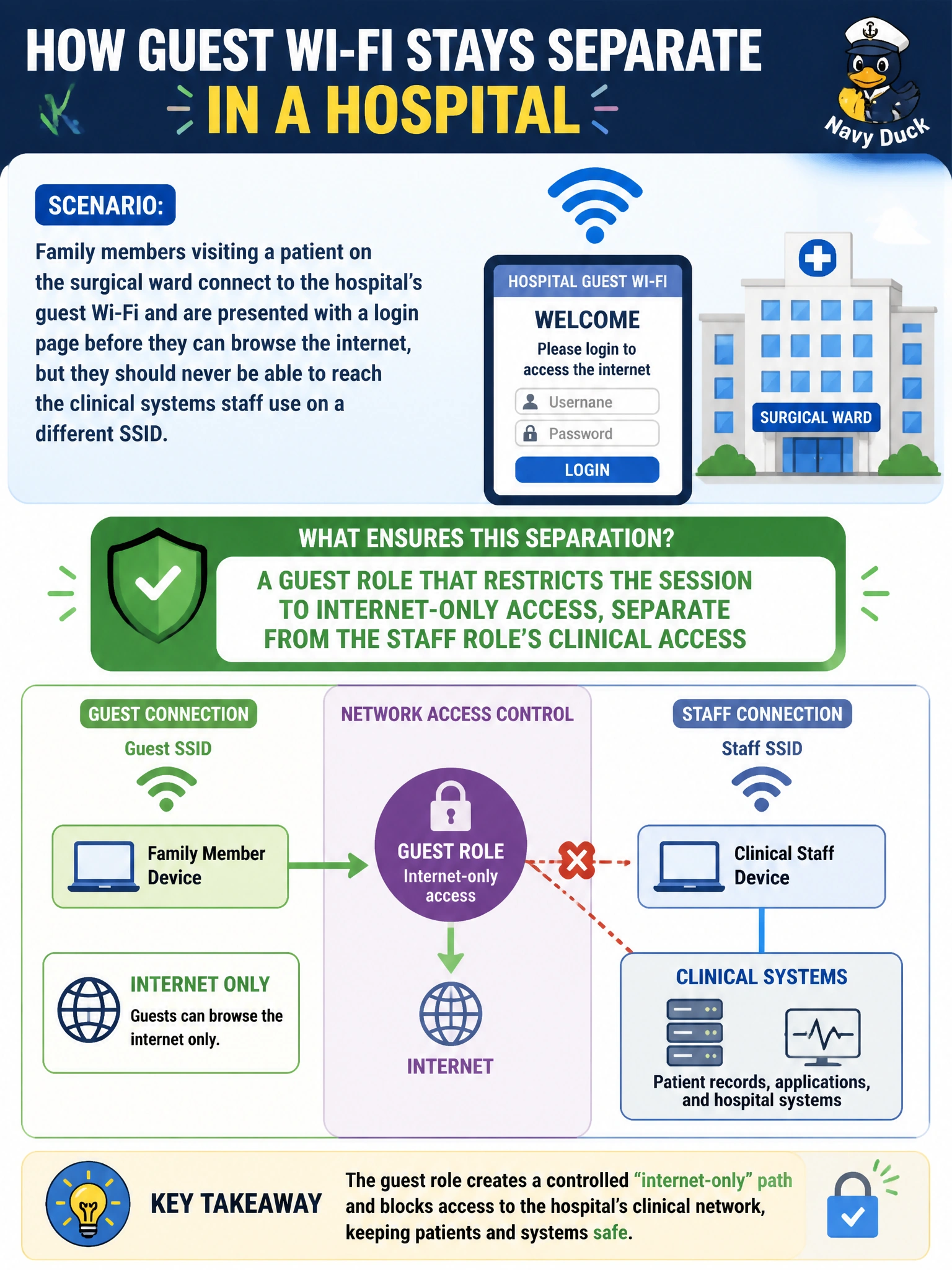
Being on a different Wi-Fi name doesn't automatically mean being fenced off from anything. What actually keeps a visitor's phone out of clinical systems is the role the guest login lands them in — one built to allow internet and nothing else.
Full Explanation
Separation between guest and staff access comes from role-based policy applied after authentication, not from any incidental property of the SSID itself: a guest role is deliberately scoped to permit only internet-bound traffic and to deny reachability to internal clinical systems, VLANs, and servers that the staff role can reach. This is what makes it safe to offer visitor Wi-Fi at all in a healthcare setting, since the restriction is enforced by policy rather than relying on visitors simply not knowing where clinical systems live. Broadcasting the guest SSID on a different radio band, such as 2.4 GHz versus 5 GHz, is a coverage and capacity decision with no bearing on which destinations a session is permitted to reach; a device on either band could still reach clinical systems if the role allowed it. Physical distance from the access point affects signal strength and possibly which AP a device associates to, but it has no relationship to what that device is authorized to reach once connected. A longer passphrase on the guest SSID might make the guest network technically harder to join, but a passphrase alone does not control what an admitted client can reach afterward. Validating this separation means connecting as a guest and confirming that a clinical resource is unreachable while general internet access still works.