
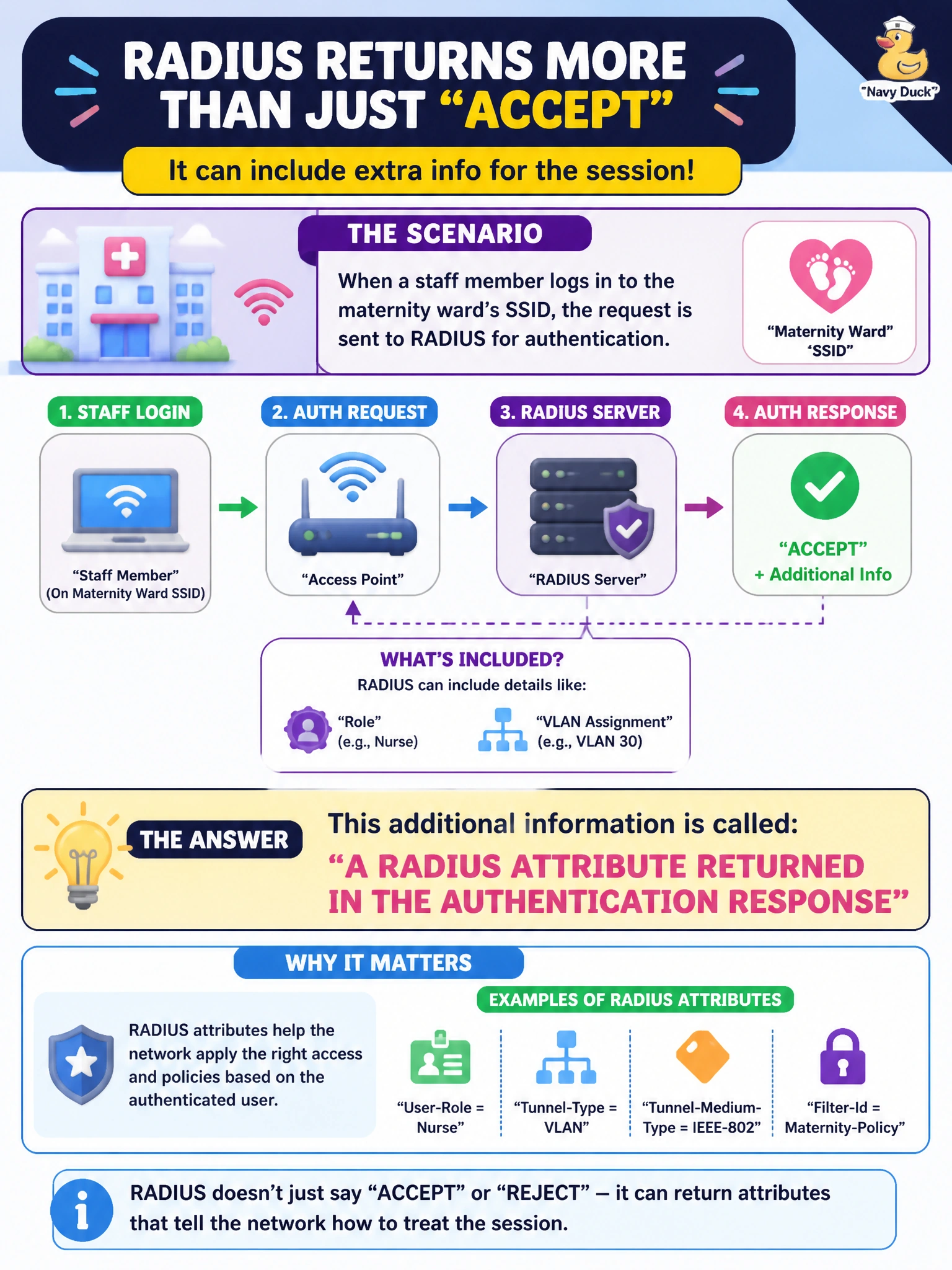
When RADIUS accepts a staff member's login on the maternity ward's SSID, it can include additional information alongside the plain accept, such as which role or VLAN that session should receive. What is this additional information called?
Select an answer to reveal the explanation.
Short Explanation
RADIUS doesn't just say "yes" — it can hand back extra instructions with that yes. Those extra instructions are called attributes, and they're what tell the switch or AP which role or VLAN to apply.
Full Explanation
RADIUS communicates using attribute-value pairs, and beyond the basic accept or reject decision, a RADIUS server can return attributes in its response that instruct the authenticator how to treat the session, commonly including which VLAN to assign or which role name to apply. This is the mechanism that makes automatic, per-user or per-device role assignment possible without manual per-port configuration, since the authenticator simply reads and applies whatever the attribute specifies. A trunk negotiation frame is part of how switches agree to carry tagged VLAN traffic across a link between them, an entirely different Layer 2 process unrelated to a single client's authentication outcome. A spanning-tree BPDU is a bridge protocol data unit used for loop prevention between switches, with no role in identity or policy assignment for an individual client. A DHCP option is metadata exchanged during IP address leasing, such as the default gateway or DNS server, and while it may indirectly reflect which VLAN the device is on, it isn't what carries the role or VLAN decision back from RADIUS in the first place. A useful check when troubleshooting a role mismatch is inspecting the authentication server's log for the exact attribute value returned for that session and comparing it to what the switch or controller actually applied.