
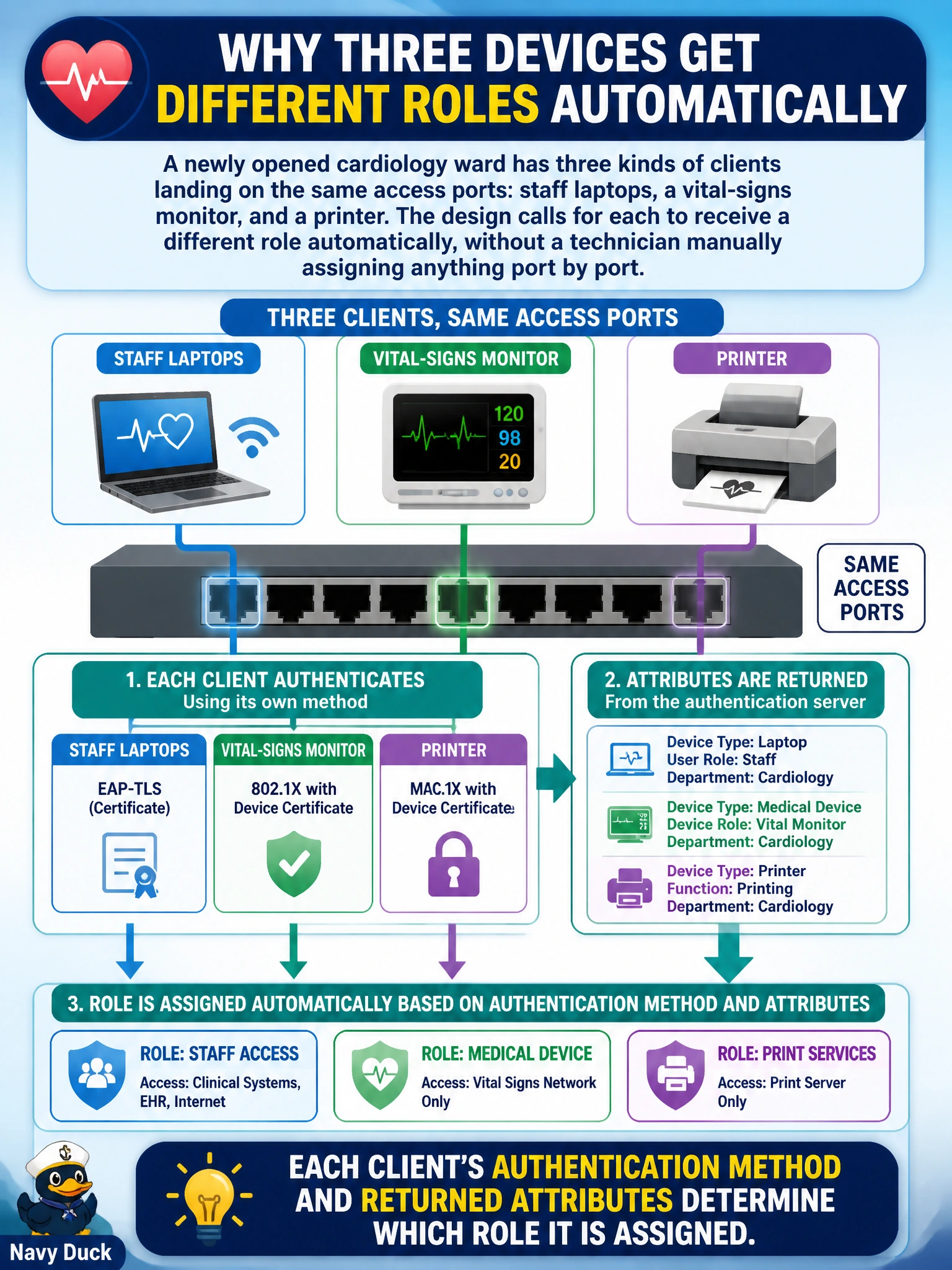
A newly opened cardiology ward has three kinds of clients landing on the same access ports: staff laptops, a vital-signs monitor, and a printer. The design calls for each to receive a different role automatically, without a technician manually assigning anything port by port. What makes this automatic differentiation possible?
Select an answer to reveal the explanation.
Short Explanation
The port doesn't play favorites — what decides the outcome is how each device proves itself. A laptop doing 802.1X and a monitor doing MAC authentication can land on the exact same port and still walk away with completely different roles.
Full Explanation
Role-based access works because the role is tied to the authentication outcome for that specific client, not to the physical port it happens to be connected to, which is what allows staff laptops, a vital-signs monitor, and a printer to share the same port design yet receive different treatment. A staff laptop authenticating via 802.1X with domain credentials can return a staff role attribute, while a monitor using MAC authentication can be mapped to a restricted biomedical-device role, and a printer might land in yet another role based on its own MAC entry. This is central to scaling an access-layer design across a mixed-device ward without hand-configuring every port differently. A switch cannot determine identity or intended role from traffic volume; that is a monitoring metric, not an authentication signal, and using it that way would be unreliable and insecure. Fixing a role permanently to a port would defeat the purpose of dynamic role assignment and would break the moment a different device type is plugged into that same port later. Forcing every device on a port to share one role ignores that different device types on the same physical port legitimately need different levels of access, which is exactly the problem role-based assignment solves. To validate this, plug a test device of each type into the same port in turn and confirm each receives its expected, distinct role.