
A new technician is learning 802.1X and hears the terms supplicant, authenticator, and authentication server for the first time while shadowing a rollout on the surgical wing. Which pairing correctly matches each role to what it does?
Select an answer to reveal the explanation.
Short Explanation
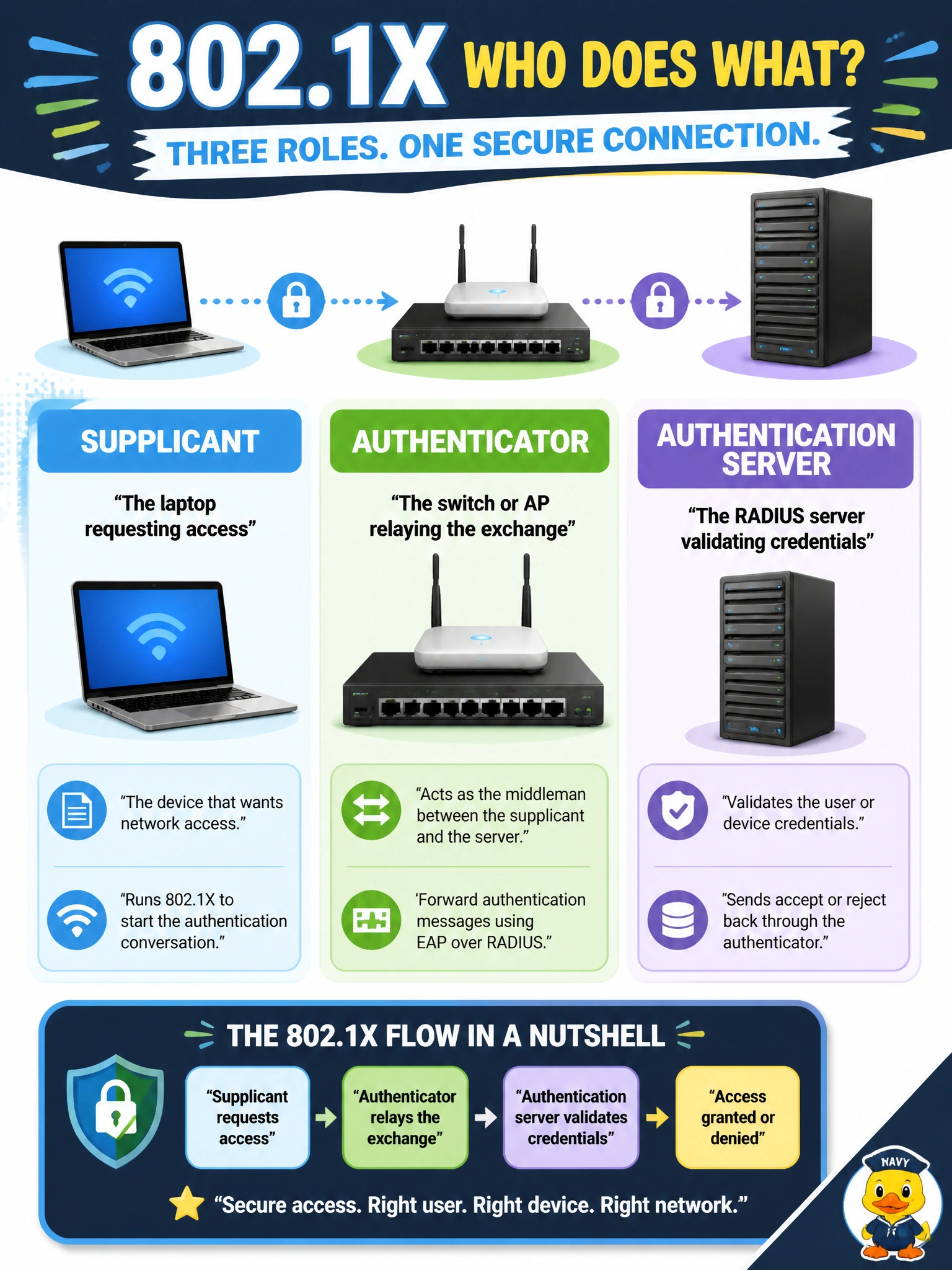
Think of it as three actors in one handshake: the laptop is the one asking to get in, the switch or AP is the middleman passing the request along, and RADIUS is the one actually saying yes or no. Keep those three roles straight and 802.1X stops feeling like alphabet soup.
Full Explanation
The 802.1X model defines three distinct roles that each do one job: the supplicant is the client device seeking network access and running the software that initiates the EAP exchange, the authenticator is the switch port or access point that controls whether traffic is allowed through and relays the exchange between supplicant and server without itself making the accept or reject decision, and the authentication server is the RADIUS server that actually validates the presented credentials against an identity store and returns the decision. Confusing these roles leads to misconfiguration, such as expecting a switch to store user credentials when its actual job is only to forward the exchange. Swapping supplicant and authenticator, or authenticator and authentication server, gets the entire model backwards and would make troubleshooting an authentication failure much harder because the technician would be looking at the wrong device for the wrong kind of problem. Describing all three terms as the same RADIUS server erases the distinction between the device requesting access, the device gatekeeping the port, and the device making the decision, which are three separate systems even in a single-vendor deployment. A good way to reinforce this mentally during a rollout is to trace one authentication attempt end to end and name which physical device is acting as each of the three roles.