
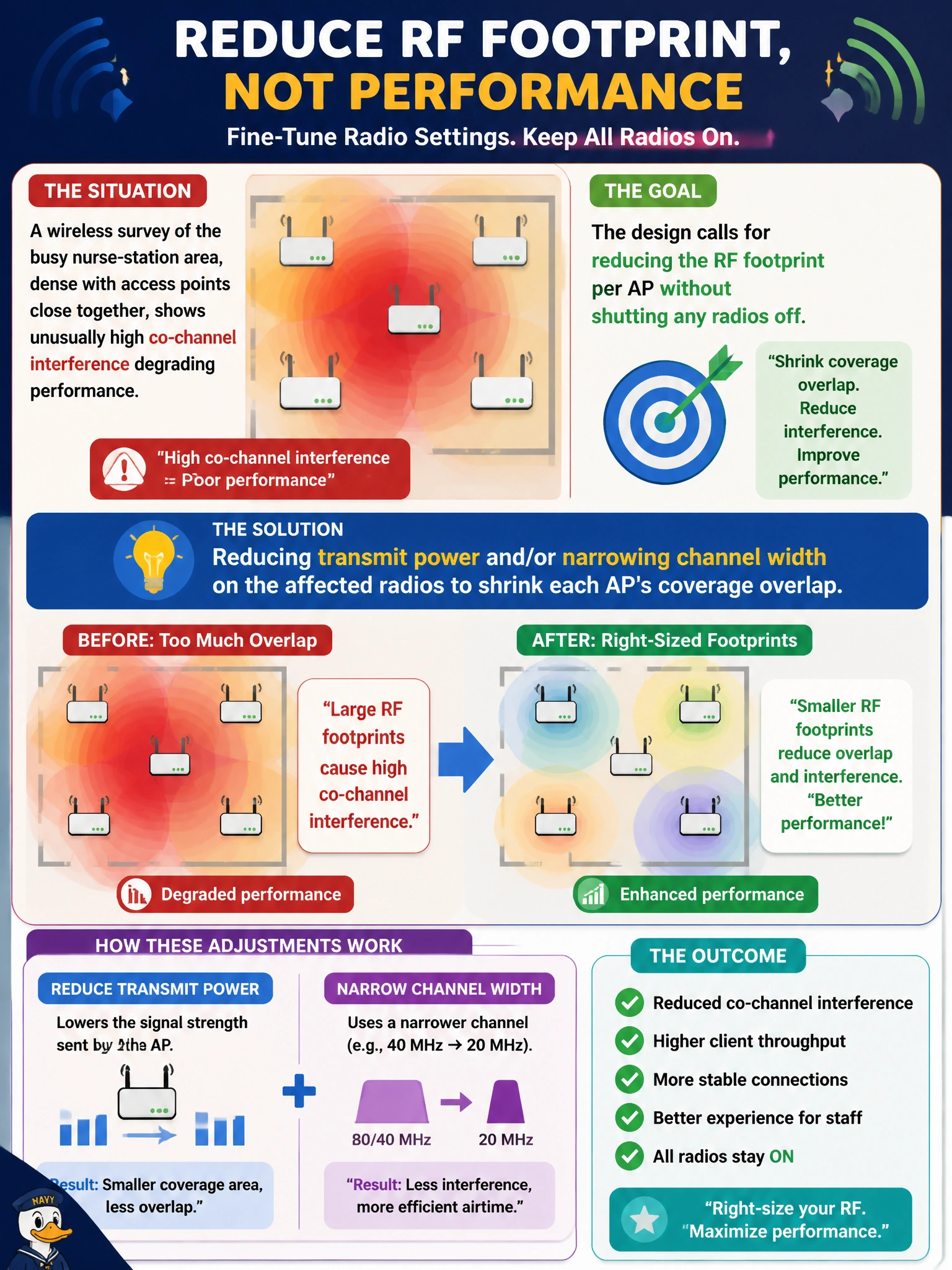
A wireless survey of the busy nurse-station area, dense with access points close together, shows unusually high co-channel interference degrading performance. The design calls for reducing the RF footprint per AP without shutting any radios off. Which radio setting adjustment addresses this?
Select an answer to reveal the explanation.
Short Explanation
When APs are packed close together, each one blasting at full strength just steps all over its neighbors. Turning down the power (and sometimes narrowing the channel) shrinks each AP's footprint just enough that neighboring radios stop fighting for the same air.
Full Explanation
In a high-density deployment, reducing transmit power and/or narrowing channel width on the affected radios shrinks each AP's effective coverage area, which directly reduces the overlap between neighboring APs that causes co-channel interference — this is a standard high-density RF tuning response and matches the design's goal of shrinking footprint without turning anything off. Increasing channel width does the opposite of what is needed: it consumes more spectrum per AP and typically increases the chance of overlapping with neighboring APs' channels, worsening interference rather than reducing it. Forcing every AP onto the same single channel does not make them 'cooperate' — same-channel APs whose coverage overlaps generate the classic co-channel interference problem the survey is already flagging; this makes the symptom worse, not better. Disabling load balancing changes how clients are steered between APs but does nothing about the underlying RF overlap or channel contention between the radios themselves — it doesn't address the actual interference mechanism. A caveat: reducing power too aggressively can create coverage holes, so this kind of tuning should be validated against real client experience, not just interference metrics alone. Operational check: re-run the RF survey after the change and confirm both the interference reading improves and no new coverage gaps appear in the nurse-station area.