
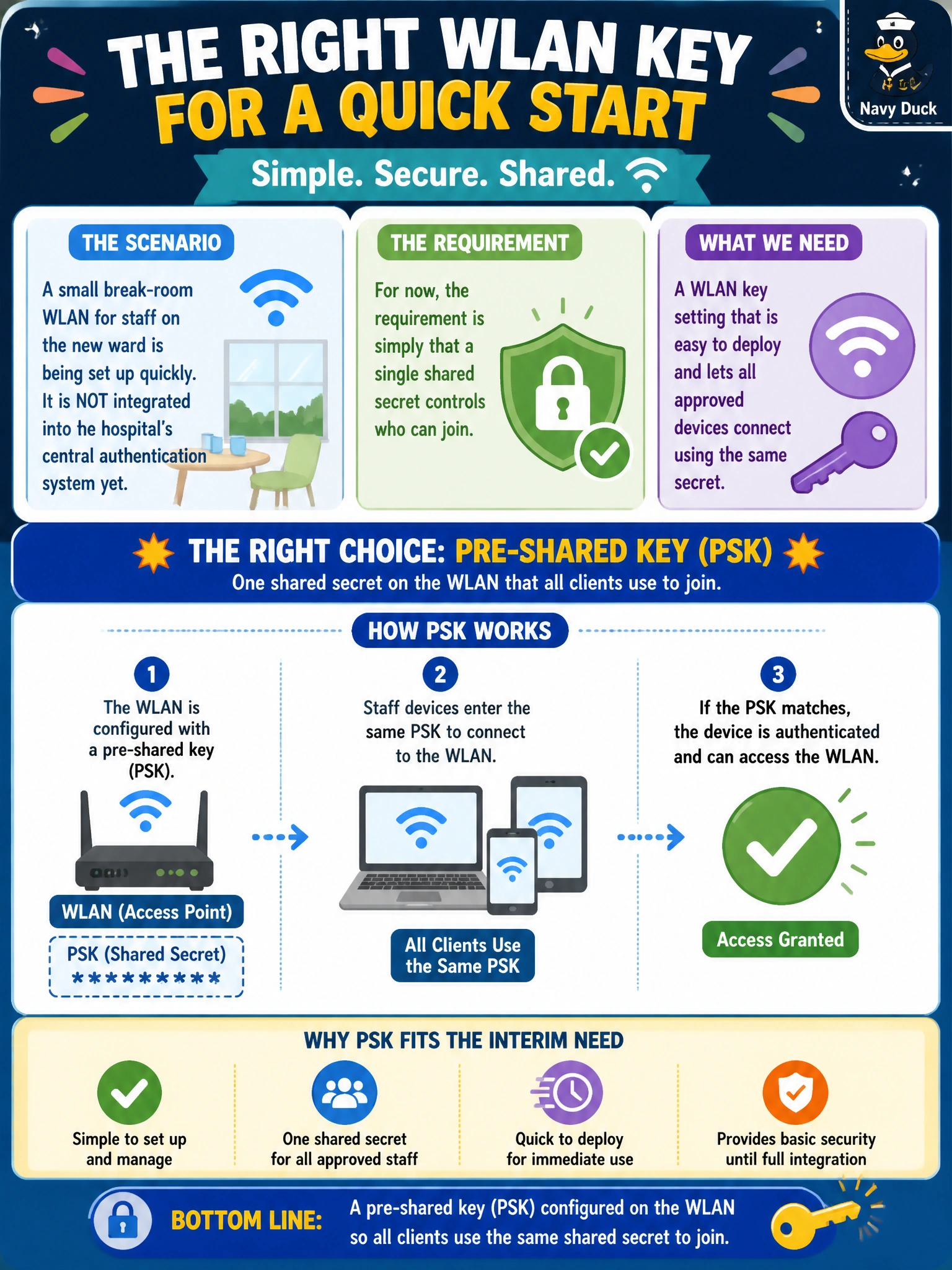
A small break-room WLAN for staff on the new ward is being set up quickly, without integrating it into the hospital's central authentication system yet. The requirement for now is simply that a single shared secret controls who can join. Which WLAN key setting fits this interim need?
Select an answer to reveal the explanation.
Short Explanation
Sometimes you just need one password that everyone types in to get on — no server lookups, no per-user accounts. That's exactly what a pre-shared key WLAN setting is for: one shared secret, configured once on the network side.
Full Explanation
A pre-shared key (PSK) is a WLAN-level setting where a single shared passphrase is configured on the network and every joining client must supply that same passphrase, which matches the interim requirement of 'one shared secret controls who can join' without any backend authentication infrastructure involved. Open authentication requires no key at all, meaning literally anyone in range could join, which fails the stated requirement that a secret gate access. 802.1X against RADIUS is a per-user authentication model requiring a backend server and typically individual credentials — the scenario explicitly says the WLAN isn't being integrated with central authentication yet, so this is the more complex system being deliberately deferred, not the interim fit. Certificate-based authentication goes even further, requiring a certificate issued and installed per device, which is a heavier, infrastructure-dependent approach entirely mismatched to a quick, simple interim setup. A caveat: PSK's simplicity is also its weakness — the shared secret must be communicated to every staff member and rotated if someone leaves, which is exactly why it's framed here as interim rather than the long-term answer. Operational check: confirm a client without the correct passphrase is rejected during association, while one with the correct passphrase joins successfully.